Construction projects bleed millions from equipment downtime, reactive repairs, and poor asset decisions. Smart construction asset management flips this equation—cutting costs 20-40%, boosting uptime 50%, and turning equipment from cost centers into profit drivers. This guide reveals the full lifecycle strategy, proven technologies, and implementation roadmap for AEC firms ready to dominate through asset intelligence.
What is Construction Asset Management?
Construction asset management is the end-to-end process of planning, acquiring, operating, maintaining, and retiring physical assets—such as heavy equipment, tools, vehicles, scaffolding, and site infrastructure—to extend lifespan, cut downtime, and manage total ownership cost. In construction, it also covers temporary job-site assets, building components during handover, and digital assets like BIM. It aligns availability with project goals and combines financial tracking, maintenance schedules, and performance analytics to drive ROI.
The Asset Management Lifecycle
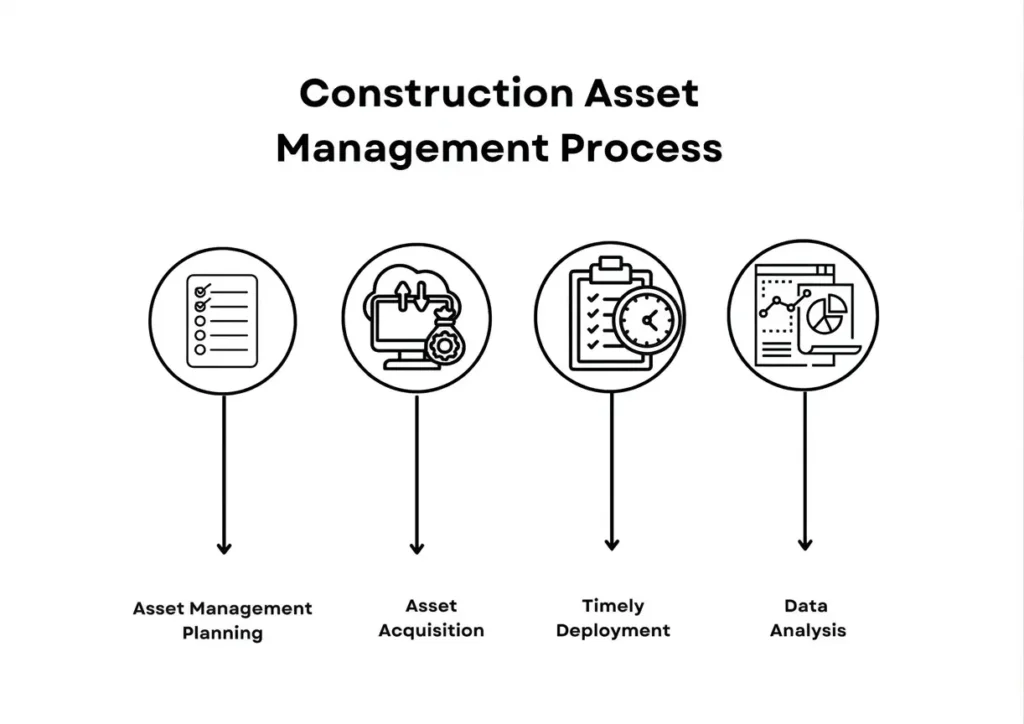
The construction asset management lifecycle follows a continuous loop across five core stages, each building on the previous to sustain long-term value:
- Planning and Acquisition: Assess project needs, budget for total lifecycle costs (purchase + operation + maintenance), select assets based on specs and ROI, and procure through leasing, buying, or rental agreements
- Deployment and Operation: Deploy assets to site with operator training, track utilization rates, monitor real-time performance via telematics, and optimize scheduling to avoid idle time
- Maintenance and Optimization: Implement preventive maintenance schedules, conduct condition-based inspections, analyze failure data to predict breakdowns, and upgrade assets to extend service life
- Performance Review: Measure KPIs like utilization percentage, total cost per hour, downtime frequency, and fuel efficiency to identify underperforming assets and inform future planning
- Disposal or Renewal: At end-of-life, decommission via auction, trade-in, recycling, or refurbishment; capture residual value and lessons learned to refine the next acquisition cycle
Construction Asset Management Lifecycle Stages
Breaking down the stages in detail:
- Planning: Forecast asset requirements against project schedule and scope; evaluate lease vs. buy economics including resale value
- Acquisition: Source equipment meeting safety standards, emissions compliance, and telematics compatibility; negotiate contracts with maintenance clauses
- Commissioning: Test assets on-site, tag with GPS/RFID for tracking, integrate into fleet management systems, and train operators
- Operations: Deploy based on daily work plans; use IoT sensors for real-time location, fuel tracking, and overload alerts
- Maintenance: Shift from reactive fixes to predictive maintenance using vibration analysis, oil sampling, and AI failure prediction
- Decommissioning: Audit final usage data, prepare for resale or scrap, and document lifecycle performance for tax and warranty claims
The Benefits of Construction Asset Management
Strategic asset management transforms construction operations:
- Cost Reduction: Lowers total ownership costs by 20-30% through optimized utilization, preventive maintenance, and better procurement decisions
- Increased Productivity: Reduces downtime by up to 50% with predictive maintenance, keeping crews working instead of waiting on repairs
- Risk Mitigation: Tracks compliance with safety regulations, OSHA standards, and emissions rules to avoid fines and insurance hikes
- Improved Decision-Making: Real-time utilization data reveals underused assets for reallocation or resale, maximizing fleet ROI
- Sustainability Gains: Extends asset life to reduce new purchases; optimizes fuel use and supports electric/hybrid transitions
- Scalable Capacity: Enables just-in-time asset scaling for project peaks without over-investing in permanent fleet expansion
How to Implement Construction Asset Management Strategies
Successful implementation follows a phased rollout:
- Asset Inventory: Catalog all equipment with serial numbers, purchase dates, maintenance history, and current condition assessments
- Technology Stack: Deploy fleet management software with GPS tracking, telematics, and mobile maintenance apps
- Policy Development: Create standardized maintenance schedules, utilization thresholds (e.g., minimum 70% annual usage), and disposal triggers
- Team Training: Upskill operators, mechanics, and managers on asset tracking systems and preventive maintenance protocols
- KPI Dashboard: Track metrics like cost per operating hour, availability rate (>95% target), and maintenance cost as % of asset value (<15%)
- Continuous Improvement: Monthly reviews of asset performance data to refine acquisition criteria and maintenance intervals
How Technology Can Help With the Process
Modern technology accelerates asset management maturity:
- IoT Telematics: Real-time GPS, fuel monitoring, idle time alerts, and geofencing to prevent unauthorized use
- CMMS/EAM Software: Computerized maintenance management systems like UpKeep, Fiix, or IBM Maximo for work orders, parts inventory, and predictive analytics
- Asset Tagging: QR codes, RFID, and NFC for instant access to service history via mobile scans
- AI Predictive Maintenance: Machine learning analyzes vibration, temperature, and usage patterns to predict failures 2-4 weeks in advance
- Digital Twins: BIM-integrated asset models track installed equipment performance post-handover
- Cloud Dashboards: Centralized views of fleet status across multiple job sites for executives and project managers
Pro Tip: At AMC we provide Professional BIM management that ensures seamless asset data integration across the project lifecycle
Discover our BIM Management Services to connect your construction assets with digital workflows from day one.
Challenges in Construction Asset Management
Common hurdles include:
- Asset Fragmentation: Equipment scattered across multiple sites with inconsistent tracking
- Reactive Maintenance Culture: Fixing breakdowns instead of preventing them, leading to cascading delays
- Data Silos: Maintenance records trapped in spreadsheets rather than integrated platforms
- High Utilization Pressure: Pushing assets beyond design limits to meet deadlines, accelerating wear
- Skilled Labor Shortages: Lack of trained technicians for advanced diagnostics and repairs
- Regulatory Complexity: Varying emissions, safety, and disposal rules across jurisdictions
How to Choose the Right Construction Asset Management Software
Key selection criteria:
| Feature | Must-Have | Nice-to-Have |
| Mobile Access | Offline work orders, GPS check-ins | AR maintenance guides |
| Integration | QuickBooks, Procore, Autodesk | ERP systems, telematics APIs |
| Scalability | Multi-site, multi-user support | Global fleet management |
| Analytics | Utilization reports, cost tracking | Predictive failure AI |
| Cost | $10-50/user/month | Custom enterprise pricing |
| Support | 24/7 phone/chat | On-site implementation |
Popular options: Trimble Accubid, AssetWorks, EZFleet, and FMX for construction-specific workflows.
Conclusion
Construction asset management shifts projects from reactive fixes to strategic optimization across the full lifecycle—acquisition, predictive maintenance, and disposal. With telematics, CMMS, and AI, firms can cut costs 20–40%, boost productivity, and enable scalable, data-driven growth.