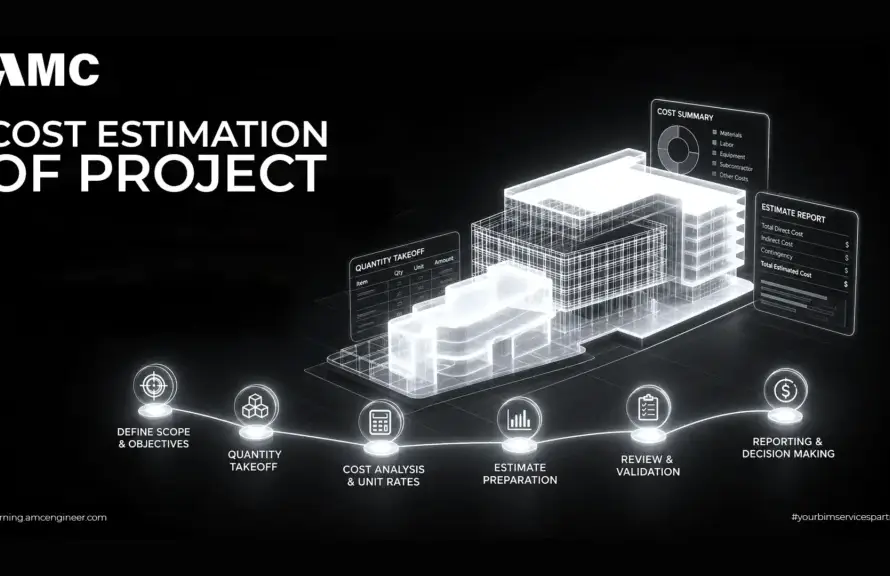
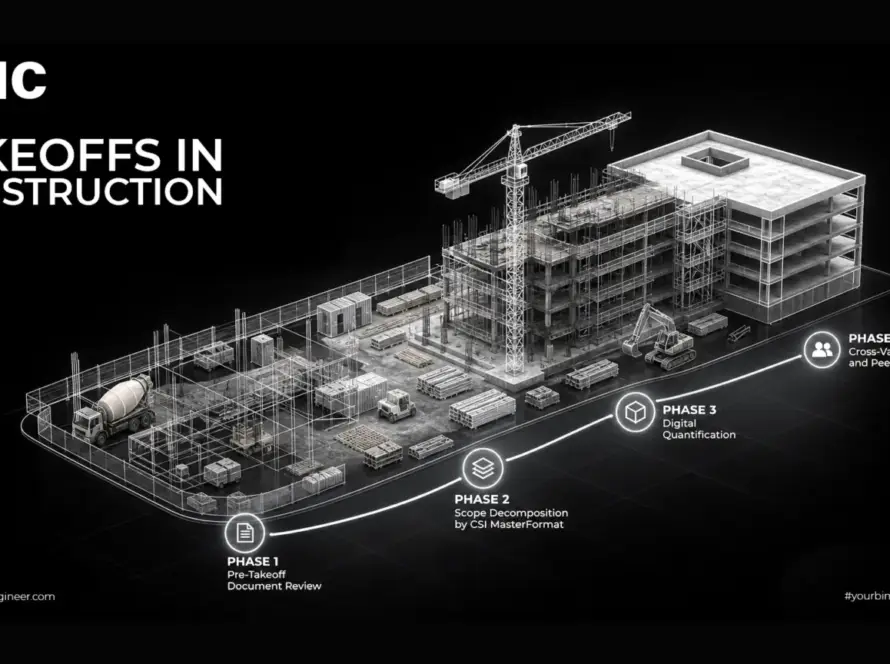
A Bill of Quantities is the priced schedule of measured work that turns a design into a tender, a tender into a contract sum, and a contract sum into monthly payments. It is a commercial document before it is a technical one. Most guides to it are written around British measurement practice — NRM2, CESMM — which is useful background and not what governs a project in Riyadh or Dubai. This guide covers what a BOQ contains, which measurement standard actually applies in the Gulf, how the document behaves under a FIDIC-based contract, and where the disputes come from.
- What a Bill of Quantities is
- BOQ vs BOM vs quantity takeoff
- The six sections of a BOQ
- The types of BOQ
- Measurement standards: NRM2, CESMM and POMI
- Who prepares the BOQ
- How a BOQ is prepared
- Units and item descriptions
- Re-measurable vs lump sum contracts
- The BOQ under FIDIC-based contracts
- Provisional sums and day works
- 5D BIM: from model to BOQ
- Gulf pricing realities
- Seven BOQ failures
- Frequently asked questions
What Is a Bill of Quantities?
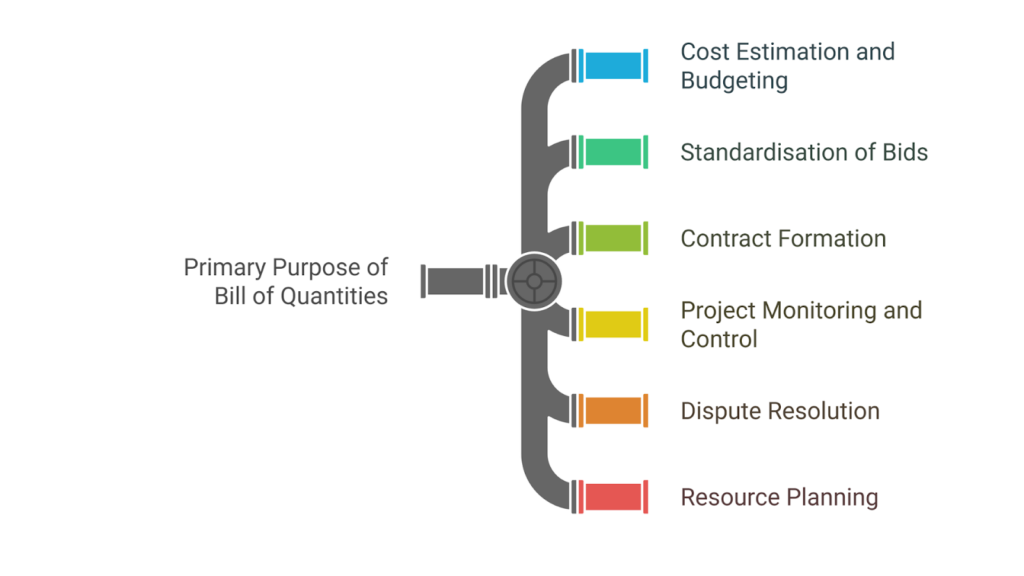
A Bill of Quantities is a document that itemises the measured work required to complete a construction project, with a description, a unit of measurement, a quantity and a rate against each item. Contractors price it during tender, and the priced document becomes part of the contract.
Its purpose is comparability. When every tenderer prices the same schedule of the same items measured the same way, the client can compare bids on a like-for-like basis rather than on a set of lump sums whose contents nobody can inspect. That single function — making competing prices comparable — is why the document exists, and it explains most of its conventions.
It is prepared by a quantity surveyor or cost consultant from the design drawings and specification, and it is worth being clear at the outset: a BOQ is used mainly on substantial projects. Smaller works and renovations frequently do not need one.
Bill of Quantities vs Bill of Materials vs Quantity Takeoff
Three documents, three purposes, and confusing them is one of the most common causes of budget error on Gulf projects.
| Quantity Takeoff | Bill of Quantities | Bill of Materials | |
|---|---|---|---|
| What it is | The measurement process | A priced schedule of measured work items | A list of physical materials to buy |
| Purpose | Establishing quantities | Tendering, contract sum, monthly valuation | Procurement and delivery |
| Includes labour and plant? | No | Yes — rates are inclusive | No — materials only |
| Includes waste? | No | Within the contractor’s rate, not shown | Yes — explicit allowance |
| Owned by | Estimator / BIM coordinator | Quantity surveyor | Procurement |
| Governed by | The model or drawings | A method of measurement | The specification and approved vendor list |
The commercial trap is treating the BOQ as a shopping list. A BOQ item reading “supply and fix 200 mm blockwork — 1,850 m²” is a work item whose rate covers blocks, mortar, ties, lintels, labour, plant, waste and profit. Ordering blocks against that 1,850 m² figure under-buys everything else. Our guide to the construction bill of materials covers the procurement side and how one BOQ line expands into several BOM lines.
Need measured quantities you can tender or order from?
AMC Engineer produces BIM-based quantity takeoff, bills of quantities and procurement-ready material schedules for projects across Saudi Arabia and the UAE — measured from coordinated models, not estimated from drawings.
The Six Sections of a BOQ
A conventional BOQ is not just a table of items. It has a defined structure, and each part does something specific in the tender.
| Section | What it contains | Why it matters |
|---|---|---|
| Form of Tender | The formal offer the contractor signs | The legal instrument of the bid |
| Information | Project details, site data, drawings referenced, conditions assumed | Establishes what the tenderer was told |
| Requirements | Preliminaries: site establishment, supervision, temporary works, insurances, programme obligations | Frequently the largest single sum after the main trades, and the least scrutinised |
| Pricing Schedule | The measured work items with descriptions, units, quantities and rates | The body of the document |
| Provisional Sums | Allowances for work not yet defined | A frequent source of dispute — see below |
| Day Works | Rates for work executed on a time-and-materials basis | Applies where work cannot be measured under the contract items |
The Types of BOQ
| Type | When it is used | Characteristic |
|---|---|---|
| Firm | Design complete | Quantities finalised from complete drawings; deviations are the contractor’s risk within the contract terms |
| Approximate | Design incomplete | Items described but quantities estimated; expected to be re-measured |
| Provisional | Scope partly undefined | Contains provisional quantities or sums adjusted as the project develops |
| Elemental | Cost planning and comparison | Organised by building element rather than by trade, for benchmarking |
| Trade bill | Package procurement | Covers one trade only — flooring, plastering, roofing — rather than the whole project |
| Revised | Substantial change | Reissued to reflect a significant scope or design change |
The distinction that carries the most commercial weight is firm versus approximate, because it determines who carries quantity risk. A firm BOQ transfers more of it to the contractor; an approximate BOQ keeps it with the employer and requires re-measurement. Issuing an approximate BOQ and describing it as firm is one of the fastest routes to a claim.
Measurement Standards: NRM2, CESMM and POMI
A BOQ only produces comparable bids if every tenderer measures the same way. That is what a method of measurement is for — it defines what is included in an item, what is measured separately, and how each item is described.
| Standard | Issued by | Typical application |
|---|---|---|
| NRM2 New Rules of Measurement 2 |
RICS | Building works, primarily UK practice |
| CESMM Civil Engineering Standard Method of Measurement |
ICE | Civil engineering and infrastructure — earthworks, drainage, roads |
| POMI Principles of Measurement (International) |
RICS | Widely used on international projects, including across the Middle East |
| Employer’s own method | Client or developer | Common on giga-project programmes and large developers, and usually binding where it exists |
This is where most guidance on the subject stops being useful regionally. Almost every English-language article on BOQs assumes NRM2, because most of them are written for the UK market. On projects in Saudi Arabia and the UAE, POMI is the method commonly encountered — it was written for international use rather than for UK domestic practice, which is precisely why it travelled.
What the choice actually changes:
- What is deemed included in a rate. Different methods draw the line differently on items such as formwork, working space, disposal and finishing. A contractor pricing to one method against a bill measured to another will either overprice or carry unpriced work.
- How items are described. Description rules determine how much detail an item carries, and therefore how much interpretation the contractor has to make.
- What is measured separately. Whether an operation gets its own item or is absorbed into another materially changes the bill’s structure.
Who Prepares the Bill of Quantities
- The quantity surveyor or cost consultant prepares, reviews and finalises the document: analysing drawings and specifications, measuring quantities, structuring the bill into logical sections, applying the method of measurement, and ensuring consistency in descriptions and units.
- The design team provides the drawings, specification and scope, and — critically — resolves vague or incomplete details when the QS raises them. Ambiguity left unresolved at this stage becomes a priced assumption.
- The employer or client approves the bill and provides project-specific requirements.
- The contractor prices it, and in doing so interrogates it. A well-prepared bill produces few tender queries; a poor one produces dozens.
How a Bill of Quantities Is Prepared
- Confirm the design is sufficiently complete. Firm quantities require complete drawings and a finalised specification. Measuring an incomplete design produces an approximate bill whatever it is labelled.
- Establish the method of measurement and its edition, and the bill structure — by trade, by element, or by the employer’s required format.
- Take off quantities from the drawings or the model, discipline by discipline, recording the basis of each measurement.
- Assign units of measurement consistently — m, m², m³, tonnes, numbers, items — in accordance with the method.
- Write item descriptions to the description rules, carrying enough specification detail that the item is priceable without guesswork.
- Structure and sequence the bill into sections that follow the method and the way the work will actually be procured.
- Add provisional sums and day works where scope is undefined or unmeasurable.
- Check and issue. Verify totals, cross-check against drawings, confirm no scope is unbilled, and issue with the tender documents.
Note what is not in that list: rates. The consultant’s BOQ is issued unpriced. Rates are inserted by tenderers, which is what makes the document a competitive instrument.
Units and Item Descriptions
Item descriptions are where BOQ disputes originate more often than quantities are.
A quantity is a number that can be checked against a drawing. A description is language, and language admits interpretation. When a description says “excavate” without stating disposal, or “supply and fix” without stating what fixing is included, two contractors price two different scopes and neither is wrong.
Three practices reduce this materially:
- Follow the method’s description rules rather than writing free-form descriptions. That is what the rules exist for.
- Cross-reference the specification clause in the item description, so the technical requirement is unambiguous.
- State what is deemed included where the method leaves discretion, particularly on interfaces between trades.
Re-measurable vs Lump Sum Contracts
The same BOQ behaves completely differently depending on the contract form it sits inside, and this is the distinction most guides omit entirely.
| Re-measurable contract | Lump sum contract | |
|---|---|---|
| What the BOQ does | Quantities are re-measured as work proceeds; payment follows actual measured work | The priced BOQ builds a fixed contract sum |
| Quantity risk | Largely with the employer | Largely with the contractor |
| Suits | Work where quantities cannot be fixed in advance — earthworks, refurbishment, infrastructure | Work where the design is complete and quantities are reliable |
| Administration | Heavier — continuous measurement and agreement on site | Lighter — valuation against progress |
| Rates used for | Valuing actual work and variations | Valuing variations and interim payment |
Both forms are used across the Gulf, frequently within the same programme — a lump sum building contract alongside re-measurable enabling works or infrastructure. The error to avoid is assuming which one applies. Read the contract, not the bill.
The Bill of Quantities Under FIDIC-Based Contracts
Most substantial contracts in Saudi Arabia and the UAE are based on a FIDIC form with amended particular conditions. Under those forms the BOQ is not merely a tender document — it stays live through the whole project, and almost no published guidance addresses this.
It is the basis of interim payment
Monthly valuations are built from measured progress against bill items at bill rates. The structure of the bill therefore determines how easy or contentious monthly valuation is. A bill with items that do not map onto how work is actually executed produces monthly arguments about percentage completion.
It is the basis of valuing variations
Where a variation involves work of a similar character executed under similar conditions, bill rates are normally the starting point for valuing it. Where it does not, a new rate is derived — often from bill rates by analogy. Either way, the rates a contractor inserted at tender govern the value of changes years later, which is why rate loading at tender is a recognised commercial behaviour and why abnormally high or low rates attract scrutiny.
It interacts with claims
Preliminaries in particular, being time-related, sit at the centre of prolongation claims. The way they were priced and broken down at tender affects what can be recovered.
The particular conditions govern
Standard FIDIC forms are heavily amended in this region. Measurement provisions, valuation rules, the treatment of quantity variation and the status of the BOQ itself are all commonly modified. Reading the general conditions alone will give you the wrong answer.
Working from an incomplete design or an unpriceable bill?
We produce measured quantities from Revit models, IFC files or 2D drawings — with a documented basis of measurement, so what you tender and what you order reconcile.
Provisional Sums and Day Works
Two sections of the bill that account for a disproportionate share of disputes.
Provisional sums
An allowance included for work that cannot yet be defined or measured — a specialist package not yet designed, a statutory connection whose cost is unknown, or an element still subject to client decision.
The problems arise from three habits:
- Using them to cover incomplete design. A provisional sum is a legitimate device for genuinely undefined work, not a substitute for finishing the drawings. Bills full of provisional sums transfer the cost uncertainty back to the employer while giving the appearance of a priced tender.
- Not defining how they are expended. The contract should state how the work is instructed, how it is valued when it is, and what the contractor is entitled to for overheads and attendance.
- Failing to account for programme. Undefined work has undefined duration, and provisional sums that materialise late can carry time consequences that nobody priced.
Day works
Rates for work carried out on a time-and-materials basis, used where work cannot reasonably be valued by measurement — typically small, unforeseen or highly disrupted operations.
The recurring issue is record-keeping. Day works are only recoverable where labour hours, plant hours and materials were recorded contemporaneously and signed as agreed at the time. Records assembled afterwards are routinely challenged, and usually successfully. Agree the daily record format and the signing authority in the first week of the project, not at the first day works claim.
5D BIM: From Model to Bill of Quantities
Quantities extracted from a coordinated BIM model are faster to produce, update when the design changes, and are traceable back to the element they came from. That is the case for model-based measurement, and it is a strong one.
It also has limits that get glossed over in vendor material:
- The model only counts what is modelled. Temporary works, formwork, working space, disposal, scaffolding and site establishment are almost never in the model, and they are real bill items.
- Model quantities are not measured quantities. A method of measurement has rules about what is deemed included, what is measured net or gross, and what is measured separately. A raw model schedule does not follow those rules; converting it into a compliant bill is skilled work.
- Level of development governs reliability. Quantities from an LOD 200 model are indicative. Tender-grade quantities generally need LOD 300 or better, and procurement-grade needs more. Our guide to BIM levels of development covers what each level supports.
- Classification has to align. For model elements to map onto bill items, the model’s classification must correspond to the bill’s structure — a decision taken at model setup, not at measurement.
Used well, 5D shifts the QS’s effort from measuring to verifying and applying the method — which is the higher-value part of the job. Used naively, it produces a fast bill that does not comply with the method of measurement and cannot be priced consistently.
Where quantities feed the programme rather than the tender, see our guide to construction planning, and for the wider model context, our guide to BIM in construction.
Gulf Pricing Realities
A BOQ is only as sound as the assumptions behind its rates, and several regional factors affect those materially.
- Material price volatility. Steel, cement, copper and aluminium move enough within a project cycle to break a fixed rate. Whether the contract carries a price adjustment or escalation provision changes how a contractor prices, and its absence gets priced as risk.
- Import lead times. Long-lead imported items carry programme risk that shows up in preliminaries and in the rates themselves. Our guide to the bill of materials covers the order-to-site path.
- The working calendar. Summer outdoor work restrictions and reduced Ramadan hours affect productivity for external trades, and productivity assumptions sit inside every rate. A bill priced on a temperate-climate output rate is priced wrong for a third of the year.
- Local content requirements. Where IKTVA or ICV provisions apply, supplier selection is constrained, which can affect achievable rates.
- Authority approval durations, which affect programme and therefore time-related preliminaries.
Seven Bill of Quantities Failures
| Failure | What it causes | The fix |
|---|---|---|
| Method of measurement not named | Tenderers price different scopes; bids are not comparable | Name the method and edition in the tender documents |
| Measuring an incomplete design as a firm bill | Re-measurement, variations and claims from the first month | Issue as approximate and say so, or complete the design first |
| Vague item descriptions | Two estimators price two scopes; the difference becomes a variation | Follow the description rules and cross-reference the specification |
| Provisional sums covering incomplete design | Cost uncertainty returned to the employer under the appearance of a priced tender | Use provisional sums only for genuinely undefined work |
| No agreed day works record format | Claims rejected for want of contemporaneous signed records | Agree the record format and signing authority in week one |
| Model quantities issued as a bill | A schedule that does not comply with the method and cannot be priced consistently | Convert model output into a compliant bill; add unmodelled items |
| Rates carried from a previous project | A tender priced against expired market conditions | Re-price from current quotations; record rate dates and validity |
Frequently Asked Questions
What is a Bill of Quantities?
A document that itemises the measured work required to complete a construction project, with a description, unit of measurement, quantity and rate against each item. Contractors price it at tender and the priced document becomes part of the contract. Its purpose is comparability — when every tenderer prices the same items measured the same way, bids can be compared like for like.
What is the difference between a Bill of Quantities and a BOM?
A BOQ lists measured work items and its rates include labour, plant, waste and profit; it is used for tendering, the contract sum and monthly valuation. A BOM lists physical materials with the quantities that will actually be purchased including waste allowances; it is used to raise purchase orders. One BOQ line typically expands into several BOM lines.
What are the sections of a Bill of Quantities?
Conventionally: the Form of Tender, an Information section covering project and site data, a Requirements section covering preliminaries, the Pricing Schedule containing the measured items, Provisional Sums for undefined work, and Day Works rates for work executed on a time-and-materials basis.
What are the main types of BOQ?
Firm, prepared from complete drawings with finalised quantities. Approximate, prepared where design is incomplete and quantities are estimated. Provisional, containing quantities or sums adjusted as the project develops. Elemental, organised by building element for cost planning. Trade bills covering a single trade. And revised, reissued after substantial change.
Which method of measurement applies in Saudi Arabia and the UAE?
Most English-language guidance assumes NRM2, which is primarily UK building practice, or CESMM for civil engineering. On international projects including across the Middle East, POMI — Principles of Measurement (International), issued by RICS — is commonly encountered, having been written for international rather than UK domestic use. Large employers frequently impose their own method, which normally takes precedence. Always confirm the method and edition from the tender documents.
Why does the method of measurement matter?
Because it defines what is deemed included in a rate, how items are described, and what is measured separately. A contractor pricing to one method against a bill measured to another will either overprice or carry unpriced work, and comparability between bids — the whole point of a BOQ — is lost.
Who prepares the Bill of Quantities?
A quantity surveyor or cost consultant, working from the design team’s drawings and specification. The design team resolves vague or incomplete details when raised, and the employer approves the bill. The consultant issues it unpriced; rates are inserted by tenderers, which is what makes it a competitive instrument.
What is the difference between a re-measurable and a lump sum contract?
Under a re-measurable contract, quantities are re-measured as work proceeds and payment follows actual measured work, so quantity risk sits largely with the employer. Under a lump sum contract, the priced BOQ builds a fixed contract sum and quantity risk sits largely with the contractor. Both are used across the Gulf, sometimes on the same programme, so read the contract rather than assuming.
How is the BOQ used under a FIDIC-based contract?
It stays live throughout. Monthly valuations are built from measured progress against bill items at bill rates, and variations are commonly valued using bill rates where the work is of similar character. Time-related preliminaries sit at the centre of prolongation claims. Standard FIDIC forms are heavily amended in this region, so the particular conditions govern rather than the general conditions.
What is a provisional sum?
An allowance for work that cannot yet be defined or measured — a specialist package not yet designed, or an element still subject to client decision. It is legitimate for genuinely undefined work and problematic when used to cover incomplete design, because it returns cost uncertainty to the employer while giving the appearance of a priced tender. How it is instructed, valued and attended should be defined in the contract.
What are day works and why are they disputed?
Rates for work carried out on a time-and-materials basis where the work cannot reasonably be valued by measurement. Disputes almost always concern records: day works are generally recoverable only where labour hours, plant hours and materials were recorded contemporaneously and signed as agreed at the time. Agree the record format and signing authority in the first week of the project.
Can a BOQ be produced from a BIM model?
Quantities can be extracted from a coordinated model and doing so is faster, updates with design changes and is traceable to source elements. But the model only counts what is modelled — temporary works, formwork, working space and disposal are real bill items that are rarely modelled — and a raw model schedule does not follow the rules of a method of measurement. Converting model output into a compliant bill is skilled work, and reliability depends on the model’s level of development.
Conclusion
A Bill of Quantities exists to make competing prices comparable, and everything that goes wrong with one traces back to that purpose being undermined: an unnamed method of measurement, a vague item description, an incomplete design measured as though it were finished, or provisional sums standing in for decisions nobody made.
On projects in Saudi Arabia and the UAE there are two further points that international guidance misses. The measurement standard is frequently not the British one most articles assume, and the difference changes what a rate is deemed to include. And under the FIDIC-based forms common here, the bill does not stop working at award — the rates a contractor inserted at tender go on to value variations and interim payments for the life of the project. Name the method, complete the design before you call the bill firm, and write descriptions two estimators would price the same way.
Let’s get the quantities right before they become a contract sum.
AMC Engineer delivers BIM-based quantity takeoff, bills of quantities and engineering calculations for contractors, consultants and developers across Saudi Arabia and the UAE — measured from coordinated models with a documented basis.