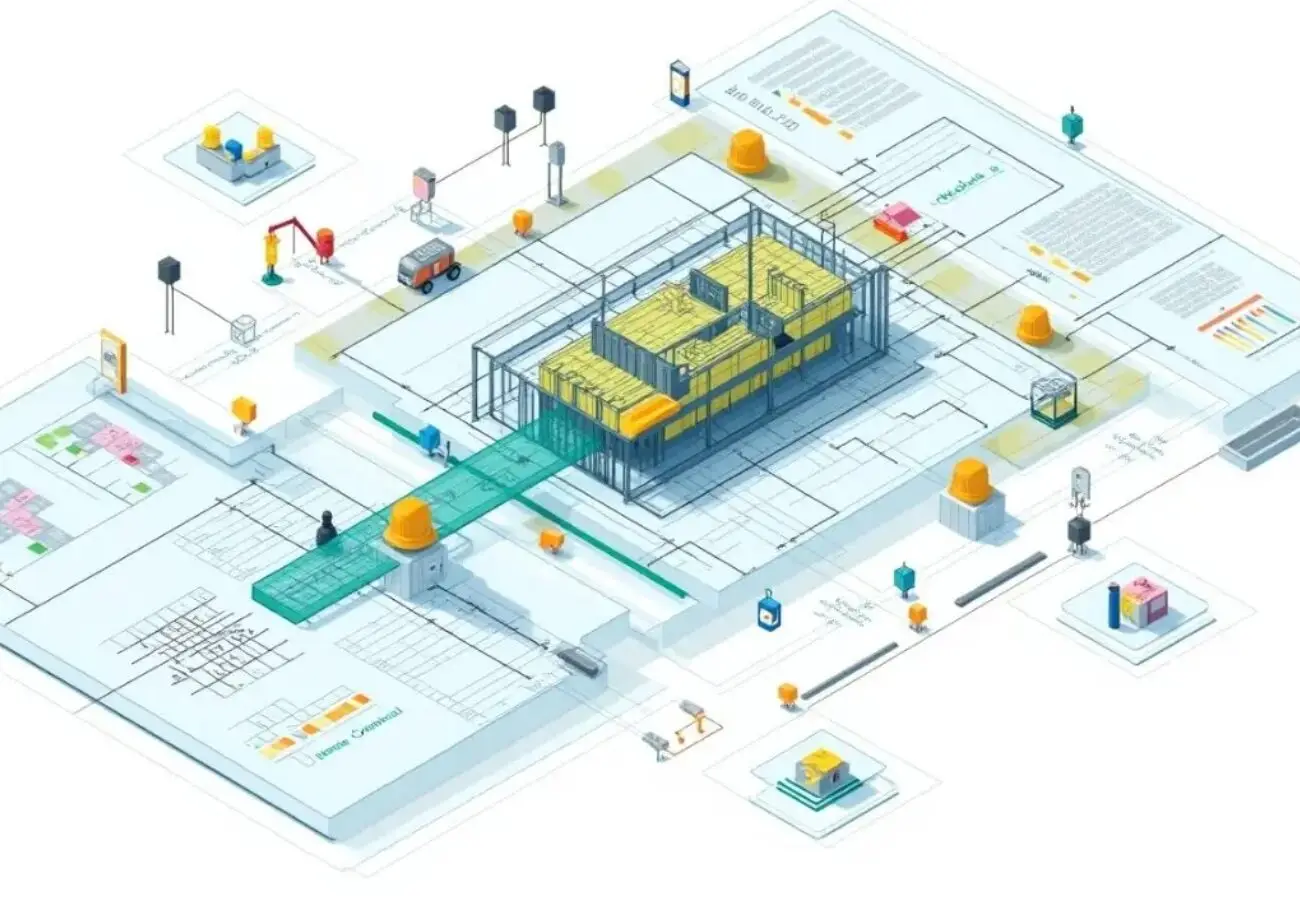
A BIM Execution Plan (BEP) is the master document that governs how Building Information Modeling will be implemented, managed, and delivered on a construction project. Whether you’re an owner, contractor, or BIM manager, understanding the BEP is essential for delivering projects on time, within budget, and to the correct standard.
What Is a BIM Execution Plan?
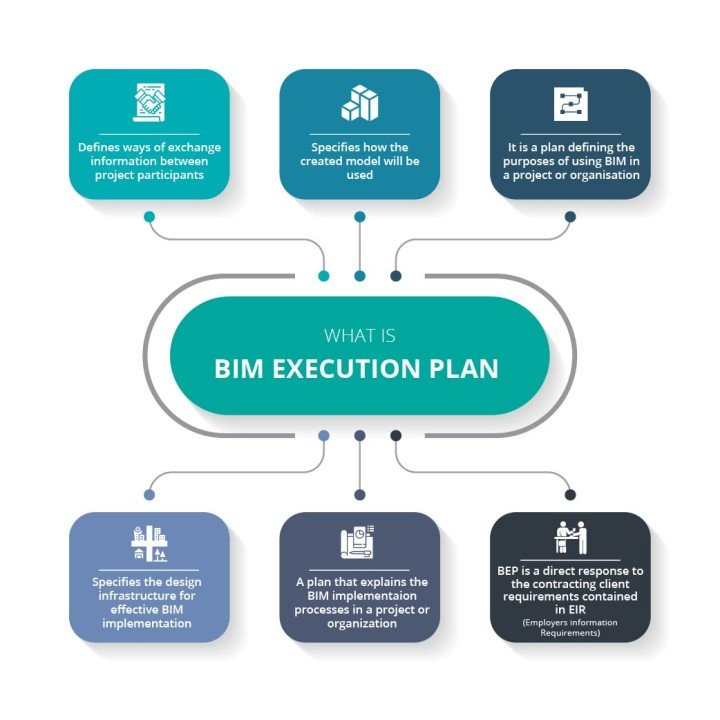
A BIM Execution Plan is a formal document that defines how a project will be executed, monitored, and controlled with regard to BIM. Its primary purpose is to make clear what every member of the project team can expect from each other — who does what, how, and when.The BEP translates high-level BIM requirements (typically from the client’s Employer’s Information Requirements – EIR) into a structured, actionable plan. It covers roles, responsibilities, software platforms, data exchange formats, deliverable schedules, and quality control procedures. Think of it as the “constitution” of your BIM project — everything that happens on the model side must align with it.
Importance of a BIM Execution Plan
Without a BEP, BIM implementation on complex projects quickly becomes uncoordinated, costly, and inconsistent. Here is why a well-crafted BEP is non-negotiable:
- Establishes clear responsibilities — every stakeholder knows their role and deliverable at each project stage
- Reduces rework and clashes — by standardizing modelling protocols and coordination workflows upfront
- Aligns all software and data standards — preventing interoperability failures between architects, engineers, and contractors
- Provides a contractual framework — ensuring BIM commitments are legally enforceable obligations, not suggestions
- Supports lifecycle asset management — the BEP’s handover guidelines ensure that the digital model remains useful post-construction for facility management
- Enables client confidence — a well-written BEP demonstrates to the appointing party that the delivery team has the capability to manage information correctly
Types of BIM Execution Plan
There are two distinct types of BEP, each serving a different phase of the project lifecycle:
The Pre-Contract BEP is essentially a proposal — it shows the appointing party that your team understands their EIR, has the right software, and has a sound information strategy. The Post-Contract BEP then refines and expands that draft into a binding, working document that drives every BIM activity on site. Both are prepared in direct response to the Employer’s Information Requirements.
Elements of a BIM Execution Plan
A comprehensive BEP contains the following core components:
- Project information and scope — name, location, client, value, timeline, and delivery method
- BIM objectives — specific uses such as clash detection, 4D scheduling, 5D cost estimation, or facility management
- Roles and responsibilities — who manages information, who models what, and who approves deliverables
- Standards and protocols — naming conventions, file formats, CDE (Common Data Environment) rules, and data exchange formats
- Level of Development (LOD) — the required detail level for each model element at each project phase
- Collaboration and coordination strategy — clash detection frequency, federated model meetings, and inter-discipline workflows
- Information Delivery Plan (IDP) — what information is needed, when, from whom, and in what format
- Software and IT infrastructure — which tools each team will use (e.g., Revit, Navisworks, BIM 360)
- Quality control and validation — model auditing procedures and approval workflows
- Risk management — identified risks and mitigation strategies
- Data security and ownership — who owns the model data and how it is protected
- Training and support — ensuring all team members can execute the BEP requirements
- Handover/post-construction guidelines — how the model transitions to the asset information model (AIM)
How to Create a BIM Execution Plan Step by Step
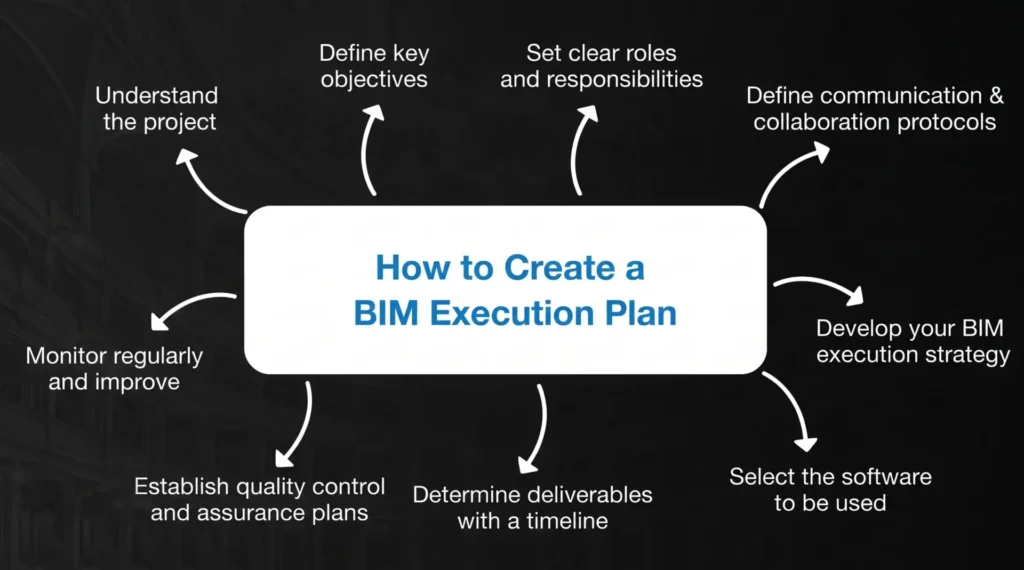
Creating a BEP follows a structured process aligned with the Penn State BIM Execution Planning framework and ISO 19650. Here are the key steps:
Step 1: Define Project Information and BEP Objectives
Start with project name, scope, client, stakeholder details, and the specific BIM goals for the project — such as clash detection, 4D planning, or asset management.
Step 2: Identify BIM Uses
Determine which BIM applications will be employed (e.g., design authoring, structural analysis, energy simulation, quantity take-off) and link each to a project goal.
Step 3: Assign Roles and Responsibilities
Define the BIM Manager, Information Manager, task team leads, and each stakeholder’s specific deliverables using a responsibility matrix.
Step 4: Establish Standards and Protocols
Document the naming conventions, file formats, CDE platform, coordinate system, and data exchange formats that all teams must follow.
Step 5: Develop the Model Development Plan
Specify the model creation schedule, LOD progression for each phase, file sharing frequency, and the model review and approval process.
Step 6: Define the Collaboration Workflow
Outline how teams will coordinate — including clash detection frequency, federated model review meetings, and issue resolution procedures.
Step 7: Set the Software and IT Infrastructure
Confirm which software each discipline will use, interoperability requirements (e.g., IFC exports), and hardware/cloud platform specifications.
Step 8: Establish Quality Control Procedures
Define model audit checkpoints, who runs them, and what validation criteria must be met before models are issued.
Step 9: Build the Information Delivery Plan (IDP)
Map out every information deliverable — what it is, who produces it, when it is due, and in what format — to prevent data bottlenecks.
Step 10: Review, Approve, and Maintain the BEP
Have the BEP reviewed by all stakeholders, approved by project leadership, stored in the CDE, and updated regularly throughout the project lifecycle. The BEP is a living document — it must evolve as the project progresses.
Challenges with Creating a BIM Execution Plan
Even experienced teams face significant hurdles when developing and enforcing a BIM Execution Plan:
- Lack of standardization — different stakeholders use different software, naming conventions, and workflows, causing inconsistencies and integration failures
- Inadequate training — teams not fully proficient in BIM tools struggle to implement the BEP’s requirements, leading to incomplete models and coordination failures
- Resistance to change — personnel accustomed to 2D CAD workflows often resist transitioning to full BIM processes, slowing adoption
- Poorly defined BIM goals — a BEP with vague or unrealistic objectives becomes detached from reality, making it impossible to enforce
- Undefined LOD scope — without specifying what objects are modelled at what detail level and by whom, the plan loses practical value
- Data management issues — without strict version control, multiple conflicting model versions can circulate simultaneously, causing costly rework
- Cost and resource constraints — high software licensing, hardware, and training costs can force organizations to scale back BIM implementation
- Plans that are simply ignored — if the BEP is not contractually enforced and actively monitored, teams default to old habits
BIM Execution Plan and ISO 19650 Alignment
ISO 19650 is the international standard for managing information over the whole life cycle of a built asset using BIM, and the BEP is one of its central deliverables. The standard defines two BEP stages that mirror the Pre-Contract and Post-Contract types described above.
According to ISO 19650, the BEP must include:
- Details of individuals undertaking information management functions
- The proposed information delivery strategy, including the organizational structure of delivery and task teams
- The federation strategy, shaped by project complexity and team structure
- Any changes to the project’s information production methods and procedures
- Changes to information standards, including exchange, distribution, and delivery formats
- A proposed schedule of software, hardware, and IT infrastructure
Need a professionally prepared BEP? Our BIM Management Services team at AMC Engineer delivers ISO 19650-compliant BEP and MIDP documentation for projects across Egypt, Saudi Arabia, and the UAE.[contact us]
Conclusion
A BIM Execution Plan is not a formality — it is the operational backbone of every successful BIM project. By defining objectives, responsibilities, standards, and delivery milestones before a single model element is created, the BEP transforms BIM from a vague concept into a disciplined, measurable process. Teams that invest time in developing a thorough, contractually enforced, and regularly updated BEP consistently deliver better-coordinated, more cost-efficient, and higher-quality built assets.
FAQs About BIM Execution Plan
Q1: What is the difference between a BIM Execution Plan and an Employer’s Information Requirements?
The EIR (Employer’s Information Requirements) is a document issued by the client stating what BIM information they need. The BEP is the delivery team’s response, explaining how they will meet those requirements.
Q2: Who writes the BIM Execution Plan?
The BEP is typically authored by the Lead Appointed Party (usually the main contractor or lead designer), in collaboration with all task teams. It must be reviewed and approved by the appointing party.
Q3: When should the BIM Execution Plan be created?
A draft Pre-Contract BEP is created at the tender stage. After contract award, it is refined into the full Post-Contract BEP before production begins.
Q4: Is the BIM Execution Plan a legal document?
Yes, once incorporated into the contract, the Post-Contract BEP becomes a legally binding document that all parties must comply with.
Q5: What is LOD in a BIM Execution Plan?
LOD (Level of Development) defines how detailed and reliable each model element must be at each project phase — ranging from LOD 100 (conceptual) to LOD 500 (as-built).
Q6: Does a BEP apply to small projects?
Yes, though it can be simplified. Even on smaller projects, a lightweight BEP that covers roles, software, naming, and deliverable dates prevents miscommunication and wasted effort.
Q7: How often should the BEP be updated?
The BEP should be reviewed and updated at each major project milestone — such as end of design, start of construction, and pre-handover — to remain relevant and enforceable.