“BIM standards” is used to mean three different things that get confused constantly: an international framework for managing information, a government requirement to use BIM at all, and a municipality’s rules for how a model must be named and submitted. A project in Riyadh or Dubai usually has to satisfy all three at once, plus a client standard on top. This guide covers the six parts of ISO 19650, the openBIM formats that sit alongside it, what is actually required in Saudi Arabia and the UAE, and how to read the layered stack of standards that applies to your project.
- What BIM standards actually are
- ISO 19650: all six parts
- Where ISO 19650 came from
- What ISO 19650 is not
- The core concepts you actually use
- openBIM: IFC, IDS, BCF and bSDD
- BIM and code requirements in Saudi Arabia
- BIM requirements in the UAE
- Master developer and giga-project standards
- Reading your project’s standards stack
- Naming conventions and status codes
- How to implement on a live project
- ISO 19650 certification: what it actually means
- Seven compliance failures
- Frequently asked questions
What Are BIM Standards?
Before anything else, three things need separating, because almost every discussion of BIM standards blurs them together.
| What it is | Who issues it | Example | |
|---|---|---|---|
| A standard | A framework describing how information should be managed — voluntary unless something else makes it binding | Standards bodies | ISO 19650 |
| A mandate | A government or authority requirement to use BIM on defined categories of project | Ministries, municipalities | Dubai Municipality’s BIM circulars |
| A submission guide | Detailed rules for how a model must be named, structured, coordinated and delivered to a specific reviewer | The reviewing authority | Abu Dhabi Municipality CAD/BIM submission requirements |
A standard tells you how to organise information. A mandate tells you that you must. A submission guide tells you exactly what file, named exactly how, in exactly which coordinate system. They are not alternatives and satisfying one does not satisfy the others.
ISO 19650: All Six Parts
ISO 19650 is the international standard family for managing information using building information modelling across the whole life cycle of a built asset. It sets out concepts, roles and processes for specifying, producing, exchanging, checking and securing project information.
It has six parts. A surprising number of guides still describe four or five, because the series has been published progressively and the most recent part is new.
| Part | Subject | First published | What it governs in practice |
|---|---|---|---|
| Part 1 | Concepts and principles | 2018 | The vocabulary and the model of information management everything else builds on |
| Part 2 | Delivery phase of assets | 2018 | The one you use daily on a live project: appointments, information requirements, planning, production and delivery |
| Part 3 | Operational phase of assets | 2020 | Information management once the asset is in use — the facility management side |
| Part 4 | Information exchange | 2022 | How information is exchanged, checked and accepted between parties |
| Part 5 | Security-minded information management | 2020 | Protecting sensitive asset information — relevant to government, defence, utilities and critical infrastructure |
| Part 6 | Health and safety information | 2025 | Managing health and safety information through the life cycle |
Parts 1 and 2 are the heart of daily practice. Part 1 is concepts; Part 2 is implementation. If a project team says “we work to ISO 19650”, they almost always mean Part 2.
Where ISO 19650 Came From
The series is the international successor to the UK’s BIM standards. It builds directly on BS 1192 and the PAS 1192 series, which the UK developed as it pushed BIM adoption through its public sector programme. The UK led the authorship of most parts, which is why ISO 19650 reflects a lot of mature UK practice — the common data environment concept, the status code workflow, the information requirements hierarchy.
It is now adopted internationally, with national annexes. That last point matters more than it sounds, and it is covered in the standards stack section below: the ISO text sets the framework, and a national annex fills in the country-specific detail such as naming conventions and status code definitions.
What ISO 19650 Is Not
Three misconceptions cause most of the friction around this standard.
It is not a software standard
ISO 19650 does not tell you to use Revit, or Navisworks, or any particular platform. It is about how information is specified, produced, exchanged, checked and secured — not about which tool produces it. A team can be fully compliant on one software stack and non-compliant on another, because compliance is a matter of process and information, not licensing.
It is not a checklist
Treating it as a compliance box-ticking exercise produces the worst of both worlds: the administrative overhead without the benefit. The point of the framework is that the right information reaches the right people at the right time, and every requirement in it exists to serve that. A team that produces the documents without changing how it works has bought paperwork.
It is not the same as a BIM mandate
ISO 19650 does not require anyone to use BIM. It describes how to manage information if you are using BIM. What makes BIM compulsory on a given project is a government mandate, an authority requirement or a contract — not the standard itself.
Aligning a project to ISO 19650 and local submission requirements?
AMC Engineer delivers coordinated LOD 300–500 BIM models across Architecture, Structure, MEP, Electrical, Infrastructure and Landscape, structured for authority submission in Saudi Arabia and the UAE — with a free LOD 200 sample from your own drawings in 24 hours.
Explore BIM Modeling Services Request a Free SampleThe Core Concepts You Actually Use
Stripped of the acronyms, ISO 19650 describes a chain: the client says what information they need, the supply chain says how it will be produced, and a controlled environment governs how it moves.
| Term | What it is | Who produces it |
|---|---|---|
| OIR — Organizational Information Requirements | What the organisation needs to know to run its business | Client |
| AIR — Asset Information Requirements | What information is needed to operate and maintain the asset | Client |
| PIR — Project Information Requirements | What information is needed to deliver the project | Client |
| EIR — Exchange Information Requirements | What each appointed party must deliver, when, and in what form | Client / appointing party |
| BEP — BIM Execution Plan | The supply chain’s response: how the requirements will be met | Appointed party |
| MIDP / TIDP | Master and task information delivery plans — who delivers what, and when | Lead and task teams |
| CDE — Common Data Environment | The single controlled source for project information, with defined states | Agreed and hosted per the appointment |
| PIM / AIM | Project Information Model during delivery; Asset Information Model in operation | Delivery team, then client |
| LOIN — Level of Information Need | The purpose-driven definition of how much information is required — the ISO replacement for a fixed LOD number | Defined in the requirements |
Two of these have enough depth to warrant their own guides. Our guide to the BIM Execution Plan covers what a workable BEP contains, and our guide to the common data environment covers how the CDE and its status codes actually operate. For how Level of Information Need differs from the LOD ladder, see our guide to BIM levels of development.
openBIM: IFC, IDS, BCF and bSDD
ISO 19650 governs the process. A separate family of standards governs the data — and on projects in this region it is increasingly the family that determines whether a submission is accepted.
| Standard | What it does | Why it matters regionally |
|---|---|---|
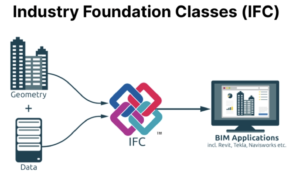
| IFC Industry Foundation Classes |
An open, vendor-neutral format for exchanging building models between platforms | Dubai Municipality has moved toward requiring BIM model submission in IFC for building permits |
| IDS Information Delivery Specification |
A machine-readable way to state exactly what information a model must contain, so it can be checked automatically | Turns “the model must carry the right data” into an automated pass or fail |
| BCF BIM Collaboration Format |
An open format for exchanging issues with location, viewpoint, comment thread, owner and status | The mechanism that turns clash reports into tracked, assignable issues |
| bSDD buildingSMART Data Dictionary |
A shared library of classifications and properties so different parties mean the same thing by the same term | Underpins consistent data across a supply chain using different tools |
BIM and Code Requirements in Saudi Arabia
The Kingdom’s regulatory picture has moved substantially in the last two years, and most international BIM standards articles have not caught up.
The Saudi Building Code
The SBC governs the technical content of what is designed and submitted. Several changes matter:
- The SBC 2024 edition replaced the 2018 version and became mandatory from 30 June 2025, following a 180-day transitional period.
- The 2024 edition introduced three new structural codes: a Saudi seismic design code for steel, a code for the repair, rehabilitation and treatment of existing concrete structures, and a code for reinforced concrete using glass fibre reinforced polymer.
- The National Committee for the Saudi Building Code was institutionally transformed into the Saudi Building Code Center by Council of Ministers Decision No 656, dated 4 March 2025, with administrative authority migrating from SASO to the Ministry of Municipalities and Housing.
- Council of Ministers Decision No 286 of 9 October 2024 amended Article 9 of the SBC Implementation Law to require the occupancy certificate as a prerequisite for full activation of electrical current — a significant tightening of compliance enforcement, because it links the code directly to whether a completed building can actually be used.
- A Saudi Green Building Code sits alongside the main series.
Enforcement has real teeth
Non-compliance carries mandatory correction within a specified period, suspension of construction, prohibition on occupying the building until issues are resolved, fines reported at up to SAR 1,000,000 per violation, and suspension or revocation of the operating licence for periods reported from one month to one year.
The code is applied in phases by building type — government buildings, high-rises above a stated height, hospitals and hotels in the first phase, with mosques, schools, sports facilities, commercial complexes, industrial buildings and others following, and service, entertainment and residential buildings later.
BIM specifically
Industry reporting indicates that BIM has been made compulsory for new construction projects managed by the Ministry of Municipal and Rural Affairs and Housing, with a commencement date reported as 1 January 2024. In practice, BIM requirements across the Kingdom are also driven heavily by client and programme — large developers and giga-project programmes routinely specify BIM deliverables, information requirements and BIM Execution Plans as contract conditions regardless of any statutory obligation.
BIM Requirements in the UAE
There is no single federal BIM regime, so requirements are set emirate by emirate — and Dubai has one of the longest-established mandates in the world.
Dubai
- Dubai Municipality introduced BIM as a requirement for defined categories of project through a circular in 2013, expanded by a further circular in 2015 which widened the scope and placed responsibility for application on the consulting offices. Those circulars mandated the use of BIM without stipulating a minimum LOD.
- More recently, Dubai Municipality moved from mandating the process to requiring the deliverable: a circular issued in October 2023 introduced BIM model submission for new building permits, with IFC as the submission format, taking effect from the start of 2024.
- Dubai Municipality has publicly aligned with open standards — ISO 19650, IFC, IDS and BCF — as the basis for permit review.
Abu Dhabi
Abu Dhabi Municipality publishes CAD and BIM submission requirements covering naming conventions, coordinate systems and file formats, together with compliance requirements referencing ISO 19650 and related standards. A separate model quality document addresses naming standards, model coordination and clash detection protocols, designed to standardise the quality and health of submitted BIM models.
That combination is worth noting: Abu Dhabi does not only require BIM, it specifies how the model must be structured and how coordinated it must be before it is accepted. Clash detection in that context is a submission requirement, not an internal quality step.
Elsewhere in the UAE
Other emirates and free zone authorities operate their own requirements and design review processes, and major clients and developers frequently impose BIM requirements contractually regardless of any statutory obligation.
Submitting an IFC model for a Dubai or Abu Dhabi permit?
We structure models for authority submission — classification, property sets, naming and coordinate systems — and coordinate Architecture, Structure and MEP in a federated model before the IFC export is ever tested.
See How We Model Send Us Your DrawingsMaster Developer and Giga-Project Standards
On master-planned communities and the large development programmes across Saudi Arabia and the UAE, there is usually a further layer. These developments commonly publish their own BIM standards, information requirements and model quality criteria, and operate an internal review that runs alongside statutory approval.
Three practical points:
- The developer standard usually wins. Where a developer’s naming convention or classification differs from a national annex or an authority guide, the contract normally makes the developer’s version binding for the project.
- Requirements can exceed statutory minimums, particularly on model quality, asset data and handover deliverables.
- Read it at appointment stage. Retrofitting a naming convention or classification system across a model that is already substantially built is days of work with no design value.
Reading Your Project’s Standards Stack
This is the section that resolves most of the confusion. Any given project sits under a stack of up to five layers, each narrowing the one above it.
| Layer | What it provides | Example |
|---|---|---|
| 1. International standard | The framework: concepts, roles, processes | ISO 19650 Parts 1–6 |
| 2. National annex or local guidance | Country-specific detail — naming conventions, status codes, classification | National implementation guidance where adopted |
| 3. Government or authority mandate | Whether BIM is required at all, and on which projects | Dubai Municipality circulars |
| 4. Authority submission guide | Exactly how the model must be named, structured, coordinated and exported | Abu Dhabi Municipality CAD/BIM submission requirements |
| 5. Client or developer standard | The project-specific requirements that override the general case | Master developer BIM standard and EIR |
Naming Conventions and Status Codes
The most visible day-to-day expression of ISO 19650, and the one most often implemented inconsistently.
File naming under the ISO 19650 approach is structured rather than descriptive: a sequence of coded fields identifying the project, the originator, the volume or system, the level, the type, the role and a number. The exact fields and their permitted values come from the national annex, the authority guide or the client standard — not from the ISO text itself, which describes the principle rather than dictating the codes.
Status codes govern what a piece of information may be used for. The CDE workflow moves information through defined states — work in progress, shared for coordination, published and authorised for use, and archived — and the code carried by a file tells the recipient whether they may build from it, coordinate against it, or only look at it.
Two rules prevent most of the problems:
- Fix the convention before production starts, in the BEP. Retrofitting naming across a completed model set is pure cost.
- Never issue outside the CDE. A file emailed directly carries no status, and a file without a status is a file someone will build from at the wrong moment.
How to Implement on a Live Project
- Read the contract and the EIR first. Identify what information the client actually requires, in what format, at what milestones, and who is responsible.
- Map the standards stack. Establish which international standard, national annex, mandate, authority guide and client standard apply, and where they conflict. Resolve conflicts in writing before production.
- Write a BEP that responds to the EIR point by point. A generic BEP that does not answer the client’s actual requirements is a document nobody will use.
- Set up the CDE with its status codes and permissions before the first model is issued, not after the first version-control incident.
- Fix naming, classification and coordinates. Shared origin, coordinate system, classification system and file naming agreed and published to every task team.
- Define Level of Information Need per purpose. State what each deliverable is for and specify exactly the geometry and data required to serve it — no more.
- Build the delivery plans. Master and task information delivery plans naming who produces what, by when, to which milestone.
- Test the authority export early. If an IFC submission is required, produce and check a test export in the first weeks, not at submission.
- Audit at every milestone. Check naming, status, classification, property completeness and coordination against the requirements, and record the result.
ISO 19650 Certification: What It Actually Means
A recurring source of confusion, and one worth stating plainly.
Certification schemes against ISO 19650 assess organisations — whether a company’s information management processes conform to the standard. They are not a personal qualification, and a project is not “ISO 19650 certified” in the way a company can be.
Individual credentials do exist through training providers and professional bodies, and they demonstrate that a person has been assessed against the standard’s content. That is a useful thing for a CV and a reasonable thing for a client to ask about. It is not the same as organisational certification, and neither one automatically makes a specific project compliant — compliance on a project is demonstrated by the information management on that project.
Seven Compliance Failures
| Failure | What it causes | The fix |
|---|---|---|
| Treating ISO 19650 as a mandate | A team producing ISO documents on a project whose actual requirement is an authority submission guide they never read | Map the standards stack at appointment stage |
| Naming convention fixed late | Days of retrofitting across a completed model set, with no design value | Fix naming, classification and coordinates in the BEP before production |
| Generic BEP | A document that does not answer the client’s EIR and that nobody uses | Respond to the EIR point by point |
| IFC export tested at submission | Classification and property failures discovered with no time to fix them | Test the authority export in the first weeks and at every milestone |
| Issuing outside the CDE | Files with no status circulating; someone builds from work in progress | Single CDE, enforced, with status codes on everything |
| Client standard discovered mid-project | A conflict with the national or authority convention already embedded in the model | Read the client and developer standards before the first model is created |
| Assuming an old circular still applies | Planning deliverables against a superseded requirement | Verify current requirements with the authority at project start |
Frequently Asked Questions
What are BIM standards?
The term covers three different things. A standard such as ISO 19650 is a framework describing how project information should be managed. A mandate is a government or authority requirement to use BIM on defined categories of project. A submission guide sets out exactly how a model must be named, structured and delivered to a specific reviewer. A project in Saudi Arabia or the UAE typically has to satisfy all three, plus a client standard.
What is ISO 19650?
ISO 19650 is the international standard family for managing information using building information modelling across the life cycle of a built asset. It sets out the concepts, roles and processes for specifying, producing, exchanging, checking and securing project information, and it is the successor to the UK’s BS 1192 and PAS 1192 standards.
How many parts does ISO 19650 have?
Six. Part 1 covers concepts and principles and Part 2 the delivery phase, both first published in 2018. Part 3 covers the operational phase and Part 5 security-minded information management, both published in 2020. Part 4 covers information exchange, published in 2022. Part 6 covers health and safety information and was published in 2025. Many guides still describe four or five parts because the series has been published progressively.
Is ISO 19650 a software standard?
No. It does not require Revit, Navisworks or any other platform. It governs how information is specified, produced, exchanged, checked and secured. A team can be compliant on one software stack and non-compliant on another, because compliance is a matter of process and information rather than tooling.
What is the difference between EIR and BEP?
The Exchange Information Requirements are issued by the client or appointing party and state what information must be delivered, when and in what form. The BIM Execution Plan is the supply chain’s response, setting out how those requirements will be met — software, federation strategy, common data environment, naming, classification, coordination cycle and delivery plans. The EIR asks; the BEP answers.
Is BIM mandatory in Dubai?
Dubai Municipality has required the use of BIM on defined categories of project since 2013, expanded by a further circular in 2015. A circular issued in October 2023 introduced BIM model submission in IFC format for new building permits from the start of 2024. Scope, thresholds and formats have changed over time, so confirm current requirements with the authority before planning deliverables.
Is BIM mandatory in Saudi Arabia?
Industry reporting indicates BIM has been made compulsory for new construction projects managed by the Ministry of Municipal and Rural Affairs and Housing, with a commencement date reported as 1 January 2024. In practice, BIM requirements across the Kingdom are also driven heavily by client and programme, with large developers and giga-project programmes specifying BIM deliverables contractually. Confirm the current statutory position with the relevant ministry or municipality rather than relying on secondary reporting.
What is the Saudi Building Code position in 2026?
The SBC 2024 edition replaced the 2018 version and became mandatory from 30 June 2025 after a 180-day transitional period, introducing three new structural codes. The National Committee for the Saudi Building Code was transformed into the Saudi Building Code Center by Council of Ministers Decision No 656 of 4 March 2025, with authority moving from SASO to the Ministry of Municipalities and Housing. A separate decision in October 2024 made the occupancy certificate a prerequisite for full activation of electrical current.
What does Abu Dhabi require for BIM submissions?
Abu Dhabi Municipality publishes CAD and BIM submission requirements covering naming conventions, coordinate systems and file formats, with compliance requirements referencing ISO 19650. A separate model quality document addresses naming standards, model coordination and clash detection protocols, intended to standardise the quality and health of submitted models — which means coordination is a submission requirement rather than an internal quality step.
What are IFC, IDS, BCF and bSDD?
They are openBIM standards governing data rather than process. IFC is an open, vendor-neutral format for exchanging building models between platforms. IDS is a machine-readable specification of what information a model must contain, so it can be checked automatically. BCF is an open format for exchanging issues with location, viewpoint and status. bSDD is a shared dictionary of classifications and properties so different parties mean the same thing by the same term.
Can an individual be ISO 19650 certified?
Certification schemes against ISO 19650 assess organisations and their information management processes. Individual credentials exist through training providers and professional bodies and demonstrate assessed knowledge of the standard, but they are a different thing from organisational certification. Neither automatically makes a specific project compliant — that is demonstrated by the information management on the project itself.
Which standard takes precedence if they conflict?
Normally the contract decides, and in practice the client or master developer standard is usually binding for the project, with the authority submission guide governing whether a deliverable will be accepted. Read the client requirements and the authority guide first, then use the international standard and national guidance to fill the gaps. Resolve any conflict in writing before production begins rather than discovering it mid-project.
Conclusion
Most confusion about BIM standards comes from collapsing three different things into one word. ISO 19650 is a framework for managing information. A mandate is what makes BIM compulsory. A submission guide is what determines whether your model is accepted. On a project in Saudi Arabia or the UAE you will typically be working under all three at once, with a client or master developer standard sitting on top of them.
The regional picture is also moving faster than most published guidance reflects. Dubai has shifted from mandating the process to requiring the model itself in IFC. Abu Dhabi specifies model quality and coordination as a submission condition. Saudi Arabia has restructured the authority governing its building code, tightened enforcement, and brought a new code edition into force. Map the stack that applies to your project at appointment stage, verify it directly with the authority rather than from an article, and fix naming, classification and coordinates before the first model is created.
Let’s get your models built to the standard that will actually review them.
AMC Engineer delivers federated LOD 300–500 BIM modeling, clash detection and construction documentation for contractors, consultants and developers across Saudi Arabia and the UAE — structured for the submission requirements that apply to your project.
BIM Modeling Services Book a Strategic Meeting