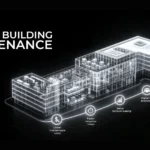
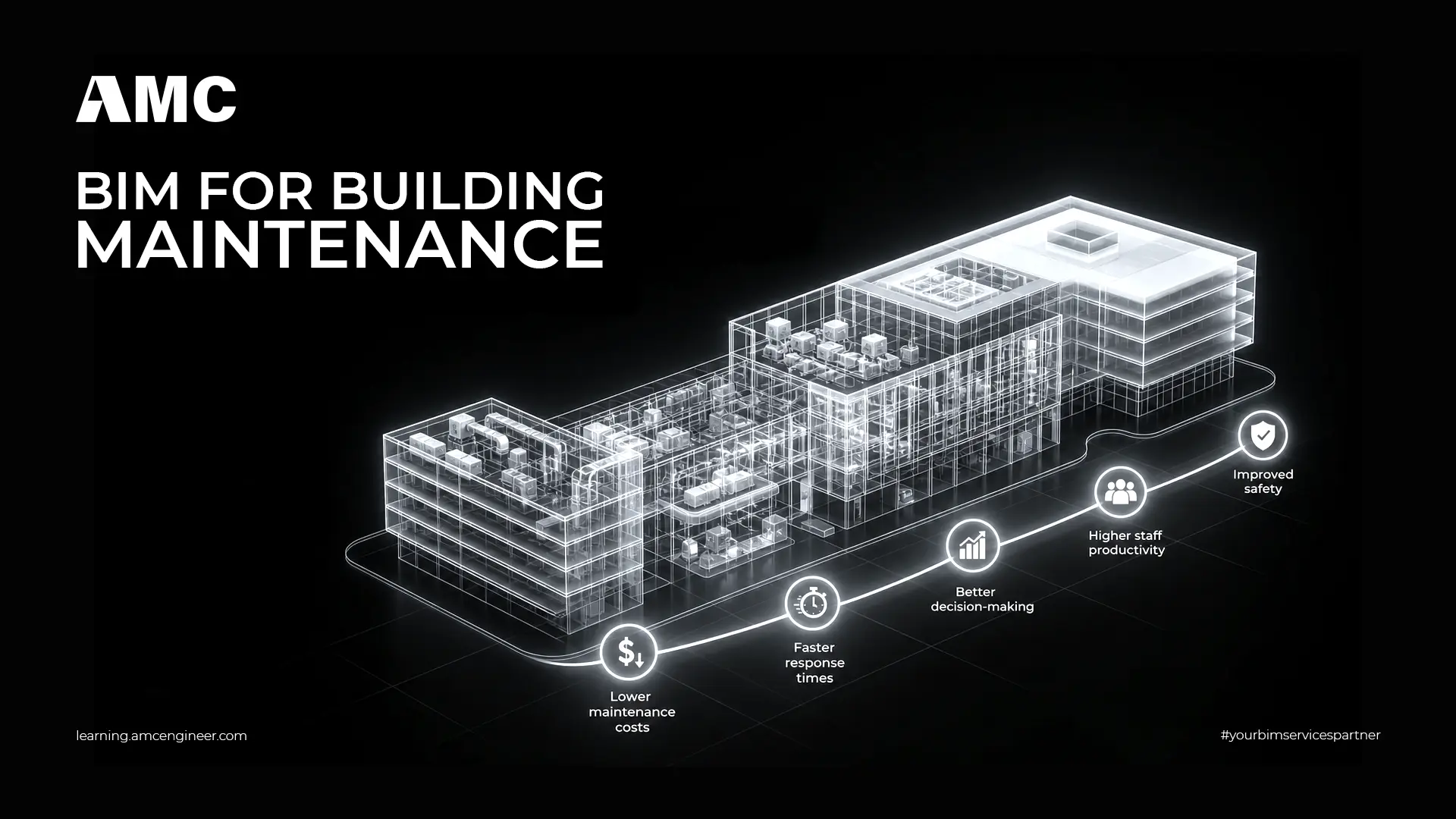
Buildings lose value when maintenance runs on paper and guesswork. BIM for building maintenance fixes this by turning every wall, pipe, and pump into a clickable, data-rich component inside a single 3D model—giving facility managers instant access to manuals, service history, and inspection schedules without ever opening a file box.
What Is BIM for Building Maintenance?
Building Information Modeling (BIM) is a digital approach to creating and managing all the data tied to a building across its entire life cycle — from design and construction through to operation and, eventually, demolition.
Instead of treating a project as a stack of disconnected documents, BIM links everything to an intelligent 3D model where each wall, door, pump, and fire extinguisher carries its own information.
When BIM is applied specifically to the operation and maintenance (O&M) phase, it’s often called 6D BIM. The extra dimension is a layer of facility management data attached directly to the components it describes:
- Warranties and operating manuals.
- Inspection schedules.
- Equipment specifications.
- Historical maintenance records.
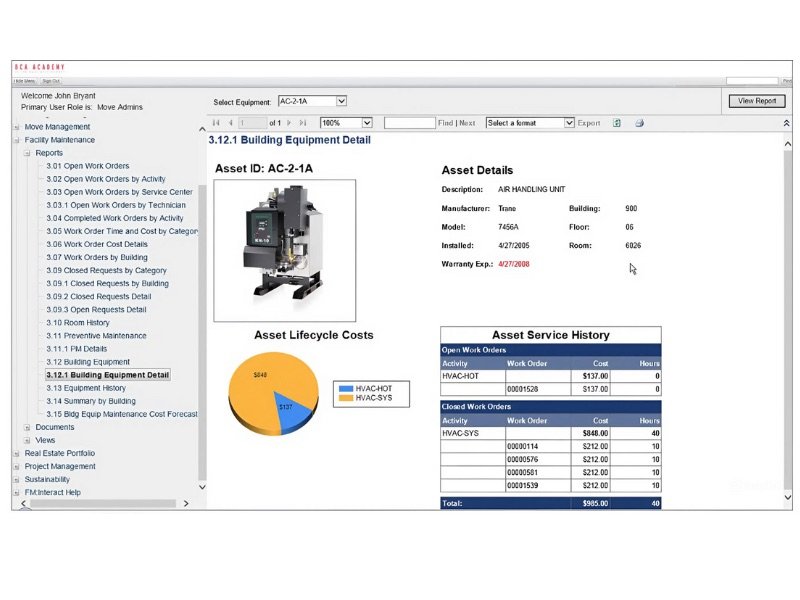
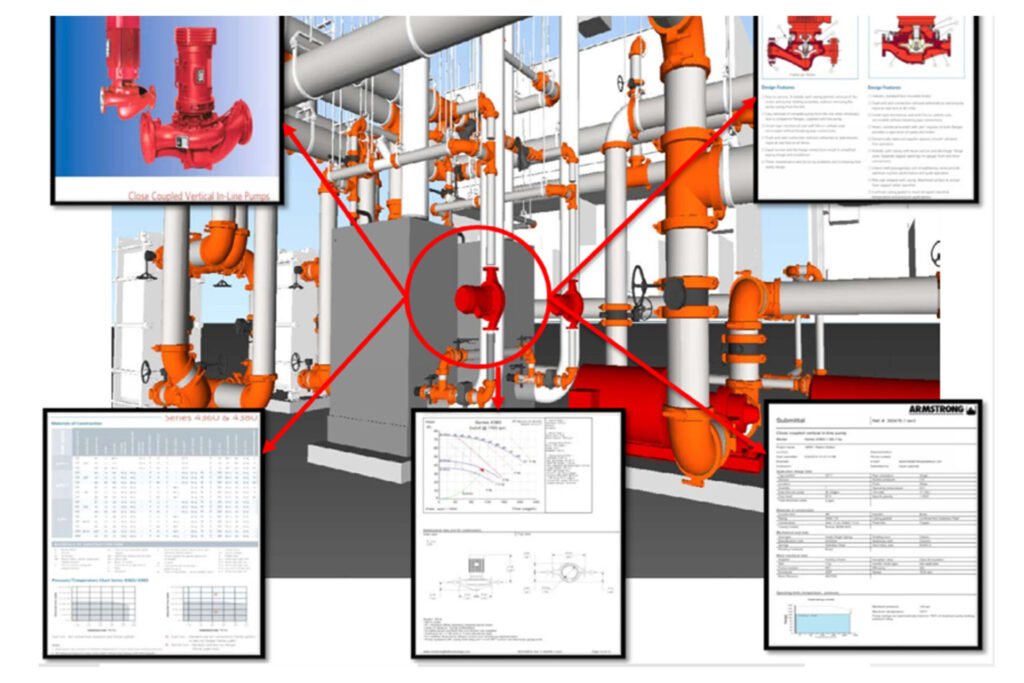
In simple terms: instead of asking “where did we file the manual for the rooftop heat pump?”, a facility manager clicks the heat pump in the model and the manual, its warranty, and its last service date appear instantly.
Why Traditional Building Maintenance Falls Short
Most building owners are legally and practically responsible for keeping their assets safe and functional. Yet a huge share of facility management still runs on paper — and that gap between responsibility and capability creates predictable, costly problems:
- Scattered information. Drawings, inspection logs, manuals, and reports live in different formats and locations, often handwritten and easy to lose.
- Wasted time. Maintenance teams spend hours searching through file boxes and 2D plans instead of fixing problems.
- Poor decisions. When data is missing or outdated, managers make repair and replacement calls with incomplete information.
- Reactive instead of proactive. Without organized records, teams default to corrective maintenance — fixing things only after they break.
A 2023 case study published in the E3S Web of Conferences examined this exact gap in government buildings in Iraq, where maintenance data was still largely paper-based. The facility managers faced:
- Ageing assets with no accessible history.
- Low energy efficiency.
- A chronic lack of findable information.
The researchers concluded that this fragmented approach leads directly to inefficient maintenance management and unnecessary cost.
This challenge is especially relevant across the Gulf and wider MENA region. Rapidly expanding facility portfolios — driven by programs like Saudi Vision 2030 and large-scale developments in the UAE and Egypt — make scalable, data-driven maintenance a strategic priority rather than a nice-to-have.
How BIM for Building Maintenance Transforms Maintenance Management
The power of BIM for building maintenance comes from consolidating everything into one integrated, visual platform. Here’s how the typical BIM-FM (BIM–Facility Management) workflow comes together.
1. Build an As-Built BIM Model
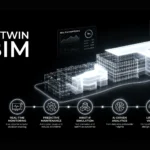
The process starts by creating a digital twin of the existing building that reflects how it was actually constructed — not just how it was designed. Using authoring software like Autodesk Revit, teams model:
- Architectural elements such as walls, floors, doors, and windows, with real dimensions, materials, and finishes.
- MEPF systems (mechanical, electrical, plumbing, and fire protection), including water pipes, ventilation ducts, HVAC units, fire extinguishers, and alarms.
Each element is modeled with a defined Level of Detail (LOD) appropriate to the facility manager’s needs — capturing type, dimensions, materials, and location.
2. Assemble the Disciplines
The separate models — architecture, plumbing, HVAC, and fire protection — are federated into a single coordinated as-built model. This unified model becomes the central source of truth for the whole building.
3. Connect BIM to an FM Platform
A 3D model alone isn’t enough for maintenance. The model needs to be transferred into a dedicated facility management platform — software like EcoDomus — designed to integrate with:
- Computerized maintenance management systems (CMMS).
- Computer-aided facility management (CAFM) tools.
This bridge between BIM and FM software is where the model becomes a working maintenance tool.
4. Attach Documents and Data
Within the FM platform, every component gets its supporting documents attached — typically saved as searchable PDFs linked to the model:
- Maintenance manuals.
- Warranties.
- Technical sheets.
- Historical service data.
The result is an integrated maintenance plan tied to the physical reality of the building.
The BIM for Building Maintenance Workflow in Action
Once the system is live, day-to-day maintenance looks completely different. A technician on site can:
- Navigate the 3D model using view, filter, and search functions to locate a component visually.
- Find a component by its tag or ID number, then immediately see its specs, service history, and attached manuals.
- Receive work orders from the maintenance manager and update tasks directly from a phone or tablet on site.
- Complete digital inspection checklists — for example, a structured checklist for inspecting a water tank — replacing handwritten forms that get lost.
This shifts the whole operation from reactive firefighting toward planned, preventive maintenance — catching issues before they become failures.
Key Benefits of BIM for Building Maintenance
Adopting a BIM-FM approach delivers measurable advantages over the traditional paper-based process. The table below summarizes the contrast at each stage of the maintenance information flow:
| Aspect | Traditional Process | BIM-FM Process |
|---|---|---|
| Presenting information | Paper-based, 2D CAD | 3D visual model with COBie data standard |
| Recording tasks | Paper reports | Tracked digitally in the BIM-FM framework |
| Storing data | Physical file boxes | Centralized cloud storage |
| Finding information | Searching paper reports | Tag/ID search, model filtering, linked files |
COBie (Construction Operations Building information exchange) is an internationally recognized data standard that organizes facility information into a structured, software-readable format — making it the backbone of clean BIM-to-FM data handover.
Beyond the table, the broader benefits include:
- Lower maintenance costs and an extended service life for building components.
- Faster response times, since information is one click away — in the office or on site.
- Better decision-making thanks to a complete, integrated historical record of every asset.
- Higher staff productivity, because technicians stop wasting time hunting for documents.
- Improved safety, particularly for critical systems like fire protection, where documented inspection is essential.
Common Barriers to Adopting 6D BIM
BIM for building maintenance is powerful, but it isn’t plug-and-play. Organizations commonly run into several obstacles worth planning for before any rollout:
- Legacy data. Existing buildings often have only paper plans, so creating an accurate as-built model takes time and effort.
- Software interoperability. Getting BIM authoring tools and FM platforms to communicate cleanly can be technically challenging.
- Initial cost and skills. Modeling, software licenses, and training are an upfront investment, and teams need new skills.
- Stakeholder buy-in. Owners and managers used to paper workflows may resist changing established habits.
- Data quality dependency. The model is only as useful as the data fed into it; inaccurate input undermines the whole system.
Recognizing these barriers early — and planning data collection and training accordingly — is the difference between a BIM-FM rollout that sticks and one that stalls.
The Bottom Line
The case for BIM for building maintenance is straightforward. It replaces scattered, paper-bound information with a single, intelligent, visual database that any authorized team member can access instantly.
The government facility case study in Iraq proved the point: even for an existing building, creating an as-built BIM model and linking it to an FM platform measurably improved maintenance efficiency and productivity.
For owners and facility managers still relying on file boxes and 2D drawings, the message is clear:
- The technology to manage buildings proactively already exists.
- It cuts costs and extends asset life today, not someday.
- The only real question is how quickly you can put it to work.
Ready to bring 6D BIM into your facility? AMC Engineer helps owners and facility managers across KSA, the UAE, and Egypt build accurate as-built models and connect them to working FM platforms. Talk to our BIM team to see what a digital twin of your building could do for your maintenance operation.
Frequently Asked Questions about BIM for Building Maintenance
What is 6D BIM?
6D BIM is the application of Building Information Modeling to the operation and maintenance phase of a building’s life cycle. It adds a layer of facility management data — warranties, manuals, inspection schedules, and service history — directly to each component in the 3D model.
Is BIM only for new buildings?
No. While BIM is easiest to implement on new projects, existing buildings can be brought into a BIM-FM workflow by creating an as-built model (often using laser scanning or scan-to-BIM) that reflects how the building was actually constructed.
What is the difference between BIM and a CMMS?
A CMMS manages maintenance tasks, work orders, and schedules. BIM provides the visual, data-rich 3D model. In a 6D BIM-FM setup, the two are connected so the model feeds accurate asset data into the maintenance system.
How does BIM reduce maintenance costs?
By centralizing asset information, enabling preventive rather than reactive maintenance, cutting the time technicians spend searching for documents, and supporting better repair-or-replace decisions that extend component service life.
Does BIM for building maintenance require expensive software?
There is an upfront investment in authoring tools, FM platforms, and training. However, for medium and large facilities, the long-term savings in maintenance efficiency, reduced downtime, and extended asset life typically outweigh the initial cost.
What are the best BIM software solutions for building maintenance in Saudi Arabia?
The best BIM software for building maintenance combines a modeling tool with a facility-management or digital-twin platform. The leading 2026 solutions are:
- Autodesk Revit — the standard for creating accurate as-built models.
- Autodesk Tandem — a cloud digital-twin platform that connects BIM models to live facility operations.
- Archibus — an IWMS with strong BIM integration for portfolios, assets, and maintenance.
- IBM Maximo — enterprise asset management for large, multi-site operators.
- Dalux FM — mobile-first BIM-based inspections and work orders.
For most Saudi facility owners, the practical stack is Revit for modeling + Tandem, Archibus, or Maximo for operations.
What are the core benefits of integrating BIM for Building Maintenance?
Integrating BIM with facility management creates a single source of truth where every asset’s data lives in one model. Core benefits:
- Faster information retrieval — find specs, manuals, and service history by clicking a component.
- A shift from reactive to preventive maintenance.
- Lower operating costs and longer asset service life.
- Better repair-or-replace decisions backed by complete historical data.
How can BIM improve facility management workflows in commercial buildings?
BIM streamlines commercial facility management by replacing 2D plans and paper with a live, visual model:
- Technicians locate components visually in the 3D model.
- Work orders are issued, tracked, and closed digitally from a phone or tablet.
- Inspection checklists go digital, so records are never lost.
- HVAC, plumbing, electrical, and fire systems are coordinated in one federated model.
- Maintenance is scheduled proactively, reducing emergency downtime.
Which companies offer BIM-based building maintenance services near Riyadh?
AMC Engineer provides BIM-based building maintenance and facility management services in Riyadh and across Saudi Arabia, including:
- As-built and scan-to-BIM modeling of existing buildings.
- Federating architectural and MEPF disciplines into one coordinated model.
- Linking the model to FM/CMMS platforms for live maintenance management.
- Attaching manuals, warranties, and inspection data to every asset.
When choosing a provider near Riyadh, look for proven Revit expertise, FM-platform integration experience, and a clear, COBie-compliant data-handover process.
What are the key benefits of using BIM for facility management in large complexes?
For large complexes, BIM centralizes data across thousands of assets in one model. Key benefits:
- Centralized data across hundreds or thousands of assets.
- Easier coordination between buildings, floors, and systems.
- Scalable preventive maintenance scheduling across the whole portfolio.
- Improved safety compliance for critical systems like fire protection.
- Stronger lifecycle cost control across the entire facility.
How can BIM improve preventive maintenance schedules for commercial buildings?
BIM enables truly preventive scheduling because maintenance data lives inside the model:
- Each component carries its own inspection interval and service history.
- The FM platform auto-generates work orders before assets fail, not after.
- Warranty and equipment data trigger timely servicing.
- Technicians complete and log scheduled checks digitally on site.
- Managers see at a glance what’s due, overdue, or recently serviced.
Which companies offer BIM implementation services for existing buildings in the UAE?
AMC Engineer delivers BIM implementation for existing buildings across the UAE, Saudi Arabia, and Egypt. For existing-building projects the workflow covers:
- Scan-to-BIM and as-built modeling reflecting how the building was actually constructed.
- Capturing MEPF systems at the right Level of Detail (LOD).
- Connecting the model to a facility management platform.
- Structured data handover so maintenance teams can use it from day one.
For existing structures, prioritize a provider with scan-to-BIM capability and clean BIM-to-FM data handover.
Ready to bring BIM into your facility?
AMC Engineer helps owners and facility managers across KSA, the UAE, and Egypt build accurate as-built models and connect them to working FM platforms. Talk to our BIM team →