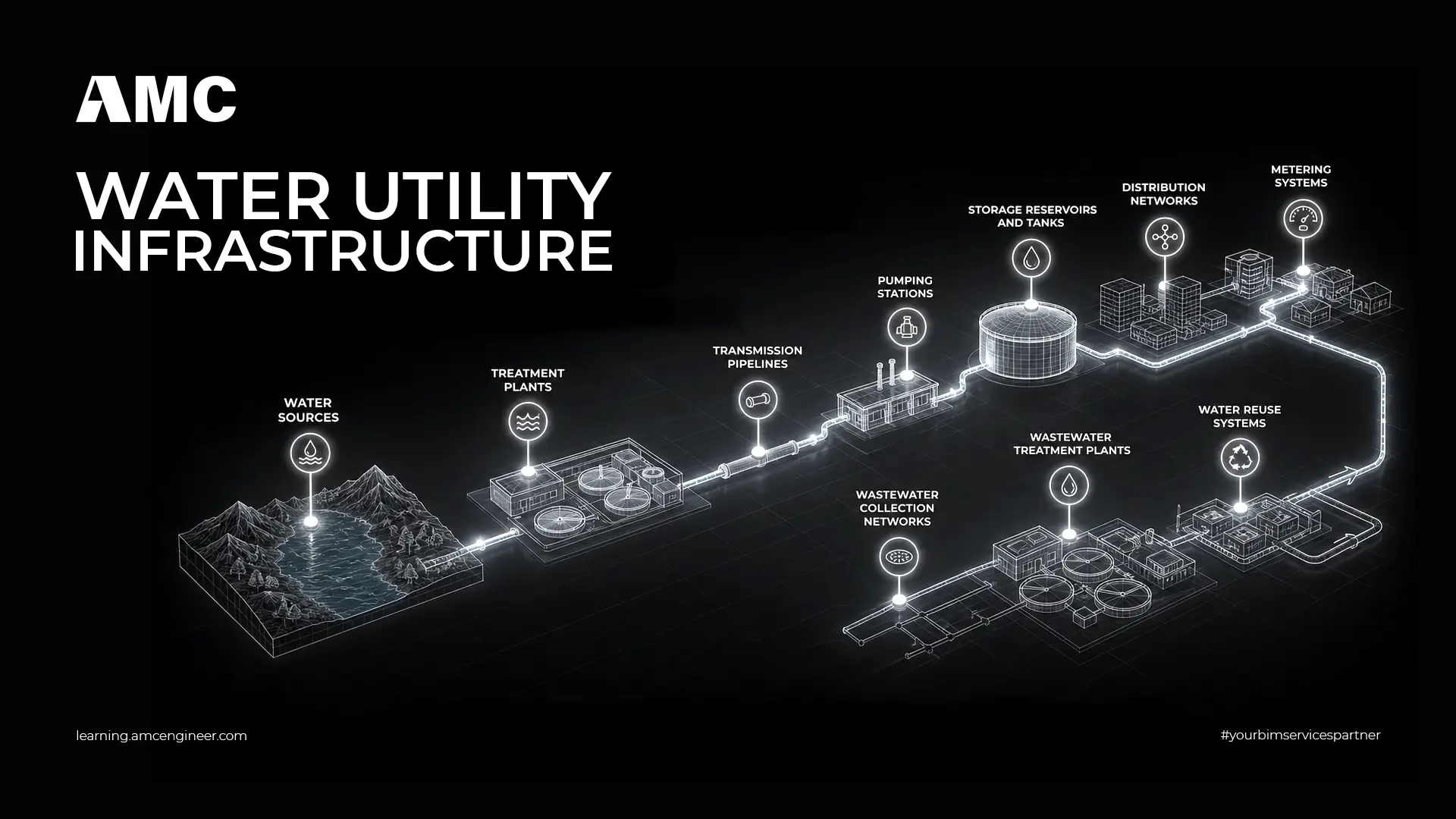
In one of the driest countries on earth, water utility infrastructure isn’t just pipes and pumps — it’s the system that keeps cities running, industries producing, and communities safe. This guide breaks down what water utility infrastructure is, how it works in Saudi Arabia, the challenges of building it at scale, and how smart, integrated systems turn scarce water into a reliable national asset.
Why Water Utility Infrastructure Matters in Saudi Arabia
Saudi Arabia has built the world’s largest desalination capacity for a reason—reliable water utility infrastructure is the foundation of everything else:
- Public health depends on clean, continuous supply.
- Economic growth requires water for industry, construction, and commerce.
- Agriculture in an arid climate is impossible without engineered supply.
- Giga-projects like NEOM and the Red Sea Project cannot function without water networks built ahead of demand.
The scale is staggering. Saudi Arabia’s daily desalinated water production capacity reached 16 million cubic meters by the end of 2025 — a 247.8% increase compared to 2016. The Kingdom accounts for approximately 22% of global desalination capacity, making it the world’s largest producer. Every drop that leaks or goes to waste in this environment is expensive to replace — making efficient water utility infrastructure both an environmental and an economic imperative.
What Is Water Utility Infrastructure?
Water utility infrastructure is the complete network of facilities and systems that collect, treat, store, distribute, and recycle water. It spans the entire journey — from source to tap, and from used water back to safe disposal or reuse.
This includes two sides:
- Supply side — sourcing and treating water, then delivering it to users.
- Wastewater side — collecting used water, treating it, and either returning it to the environment or reusing it.
In Saudi Arabia, where natural freshwater is extremely limited, water utility infrastructure leans heavily on desalination and, increasingly, on the treatment and reuse of wastewater to stretch every drop further.
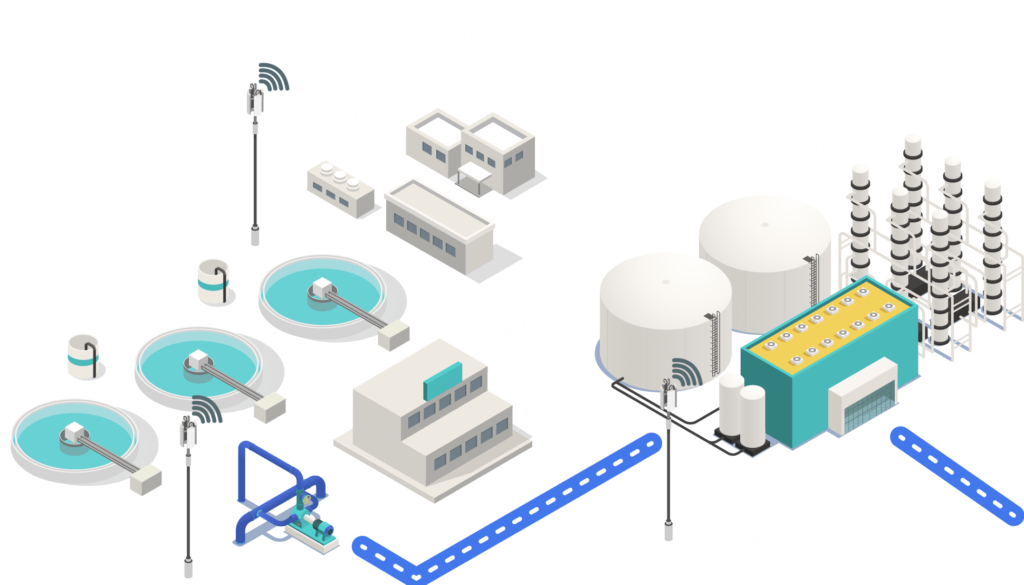
Water Utility Infrastructure Components
A complete water utility system is made up of several interconnected components. These fall into two categories:
Supply-side components
| Component | Function |
|---|---|
| Water sources | Desalination plants, groundwater wells, surface water — desalination dominant in Saudi Arabia |
| Treatment plants | Make raw water safe and compliant with quality standards |
| Transmission pipelines | Move treated water over long distances (e.g., coastal plants to inland cities like Riyadh) |
| Pumping stations | Push water across distance and elevation |
| Storage reservoirs and tanks | Buffer supply against peak demand and emergencies |
| Distribution networks | Deliver water to homes, businesses, and industry |
| Metering systems | Measure consumption, support billing, and detect leaks |
Wastewater-side components
| Component | Function |
|---|---|
| Collection networks | Sewers that carry used water away safely |
| Wastewater treatment plants | Clean used water to environmental standards |
| Reuse systems | Treat wastewater to quality suitable for irrigation, industry, or landscaping |
These components only work as a system. A new development needs supply, distribution, wastewater, and reuse infrastructure planned and built together — not bolted on in phases.
The Importance of Investing in Water Utility Infrastructure
Few investments deliver returns as broad as water utility infrastructure. The case for Saudi Arabia is especially strong:
- Water security is a national strategic priority — central to Vision 2030 and the Kingdom’s long-term stability.
- Rapid urban growth demands capacity ahead of need. New cities and mega-developments cannot wait for retrofitted networks.
- Every lost liter is expensive to replace. In a country that desalinates the majority of its drinking water, leaks and inefficiency carry a higher cost than almost anywhere else.
- Reliable water underpins all other infrastructure. Healthcare, housing, industry, and agriculture all fail without it.
- Investment reduces long-term operating costs. Well-engineered networks lose less water, fail less often, and cost less to maintain over decades.
Challenges in Water Utility Infrastructure Development
Developing water utility infrastructure in the Kingdom comes with distinct challenges:
- Water scarcity. Limited natural freshwater forces reliance on energy-intensive desalination.
- Energy and cost intensity. Desalination and large-scale pumping consume significant energy—tying water planning closely to power and carbon goals.
- Non-revenue water. Leaks and losses across distribution networks waste precious, costly water. Reducing non-revenue water is a major priority.
- Rapid demand growth. Urbanization and new developments require fast, large-scale capacity expansion.
- Climate resilience. Extreme heat and occasional flash flooding demand robust, well-designed systems.
- Capital intensity. Large facilities and long-distance pipelines require substantial, long-term investment.
- Coordination complexity. Aligning multiple authorities and developers — especially in greenfield giga-projects — is complex.
Addressing these requires not just construction, but smart engineering and lifecycle thinking from the outset.
Management of Water Utility Systems
Building water utility infrastructure is only half the task. Managing it well over decades is what delivers value. Effective water utility management relies on:
- SCADA and IoT monitoring — real-time visibility of flow, pressure, and water quality across the network.
- Smart metering — accurate consumption data that supports billing, demand management, and early leak detection.
- Non-revenue water programs — systematically detecting and reducing leaks to conserve water and revenue.
- Asset management — tracking the condition of pipes, pumps, and plants to plan maintenance and replacement before failures occur.
- GIS and digital twins — accurate digital records of networks that support planning, operations, and rapid response.
- Water quality monitoring — continuous testing to ensure safe, compliant water at every point in the network.
- Demand management — using data and pricing to encourage efficient use, critical in a water-scarce country.
Well-managed systems lose less water, fail less often, and serve users more reliably — turning water utility infrastructure into a dependable, long-term asset.
How Integrated Infrastructure Supports Clean Water Goals
Clean, secure water is achieved not by individual facilities but by integrated systems working together. Integration supports clean water goals in several ways:
- Closing the loop. Connecting supply, wastewater, and reuse creates a circular water economy—treated wastewater supplements freshwater for irrigation and industry.
- Coordinated planning. Designing supply and wastewater networks together ensures capacity matches demand and avoids costly gaps.
- Smart, data-driven operation. Integrated monitoring across the whole system catches problems early and maintains quality from source to tap.
- Sustainability alignment. Integration improves efficiency, reduces energy and water waste, and supports the Kingdom’s water-security and environmental ambitions under Vision 2030.
The outcome is reliable access to safe water, less waste, and a system resilient enough to support Saudi Arabia’s growth for generations.
Engineering Water Security for the Kingdom
Water utility infrastructure is the lifeline of every community and the foundation of Saudi Arabia’s development. From desalination and treatment to distribution, wastewater, and reuse, delivering it well demands integrated planning, smart management, and engineering expertise suited to the Kingdom’s climate and scale.
AMC Engineer delivers water utility infrastructure solutions across Saudi Arabia — from network design and treatment facilities to integrated supply, wastewater, and reuse systems built for reliability and water security. Talk to our team about your next water infrastructure project.
Frequently Asked Questions
What is water utility infrastructure?
It is the complete network that collects, treats, stores, distributes, and recycles water, covering water supply, wastewater management, and reuse systems.
Why is investing in water infrastructure important in Saudi Arabia?
The Kingdom’s arid climate makes water security a strategic priority. Reliable water utility infrastructure supports public health, economic growth, and Vision 2030 goals, while reducing the high cost of water lost to leaks and inefficiency.
What are the main components of water infrastructure?
Water sources (including desalination plants), treatment facilities, transmission pipelines, pumping stations, storage reservoirs, distribution networks, metering systems, and wastewater collection, treatment, and reuse systems.
What is non-revenue water?
Water that is produced and treated but lost before reaching the customer — mainly through leaks in the distribution network. Reducing non-revenue water is a key goal in water-scarce regions because every lost liter is expensive to replace.
What is the role of desalination in Saudi water utility infrastructure?
Desalination is the backbone of Saudi Arabia’s water supply. The kingdom is the world’s largest producer of desalinated water, with capacity exceeding 16 million cubic meters per day. It supplies the majority of municipal and industrial demand in major cities.
How are digital twins used in water utility management?
Digital twins create accurate virtual models of the water network—pipes, pumps, treatment plants, and reservoirs. Connected to live sensor data, they help operators monitor performance, detect leaks faster, plan maintenance, and simulate scenarios before making changes to the real system.
What is integrated water infrastructure?
Integrated water infrastructure means designing and operating supply, distribution, wastewater, and reuse systems as one connected network rather than separate silos. This approach ensures capacity is matched to demand, reduces waste, and supports circular water use—where treated wastewater is reused for irrigation, landscaping, and industry.