Digital collaboration is no longer optional in construction — it is the backbone of how modern projects are delivered. Yet without a shared rulebook, BIM data quickly becomes inconsistent, insecure, and impossible to trust across dozens of stakeholders. That is exactly the problem the ISO BIM standards 19650 were created to solve.
This guide breaks down what ISO 19650 is, how it is structured, the benefits it delivers for BIM workflows, and how your firm can implement it on real construction projects in Saudi Arabia, the UAE, and beyond.
What is ISO 19650?
ISO 19650 is an international standard series that defines how information is organized, managed, and exchanged across the entire lifecycle of a built asset using Building Information Modelling (BIM) — from concept and design through construction, operation, and end-of-life.
In simple terms, it is the globally recognized framework for managing BIM information so that everyone involved — clients, designers, contractors, and operators — works from accurate, up-to-date, and reliable data.
Key facts to know:
- Developed by the International Organization for Standardization (ISO/TC 59/SC 13).
- Built on the foundation of the pioneering British standards BS 1192 and PAS 1192.
- A voluntary standard — not a law — but increasingly required by contract on public and major private projects.
- Designed to be applied globally, regardless of project size or procurement strategy.
ISO 19650 is not just about producing 3D models. It is about governing the information behind those models so it stays consistent, secure, and interoperable.
Key Principles of ISO 19650
The entire standard is built on a handful of core principles that drive collaboration and data quality:
- Information requirements first — every project begins by defining what information is needed, when, and to what level of detail.
- Clearly defined roles — the appointing party (client), lead appointed party (main contractor/consultant), and appointed parties (task teams).
- A Common Data Environment (CDE) — a single, agreed source of truth for collecting, managing, and sharing every information container.
- The information delivery cycle — a structured flow of producing, checking, reviewing, approving, and delivering information.
- Whole-life thinking — information is managed not just for delivery, but for operation and maintenance decades later.
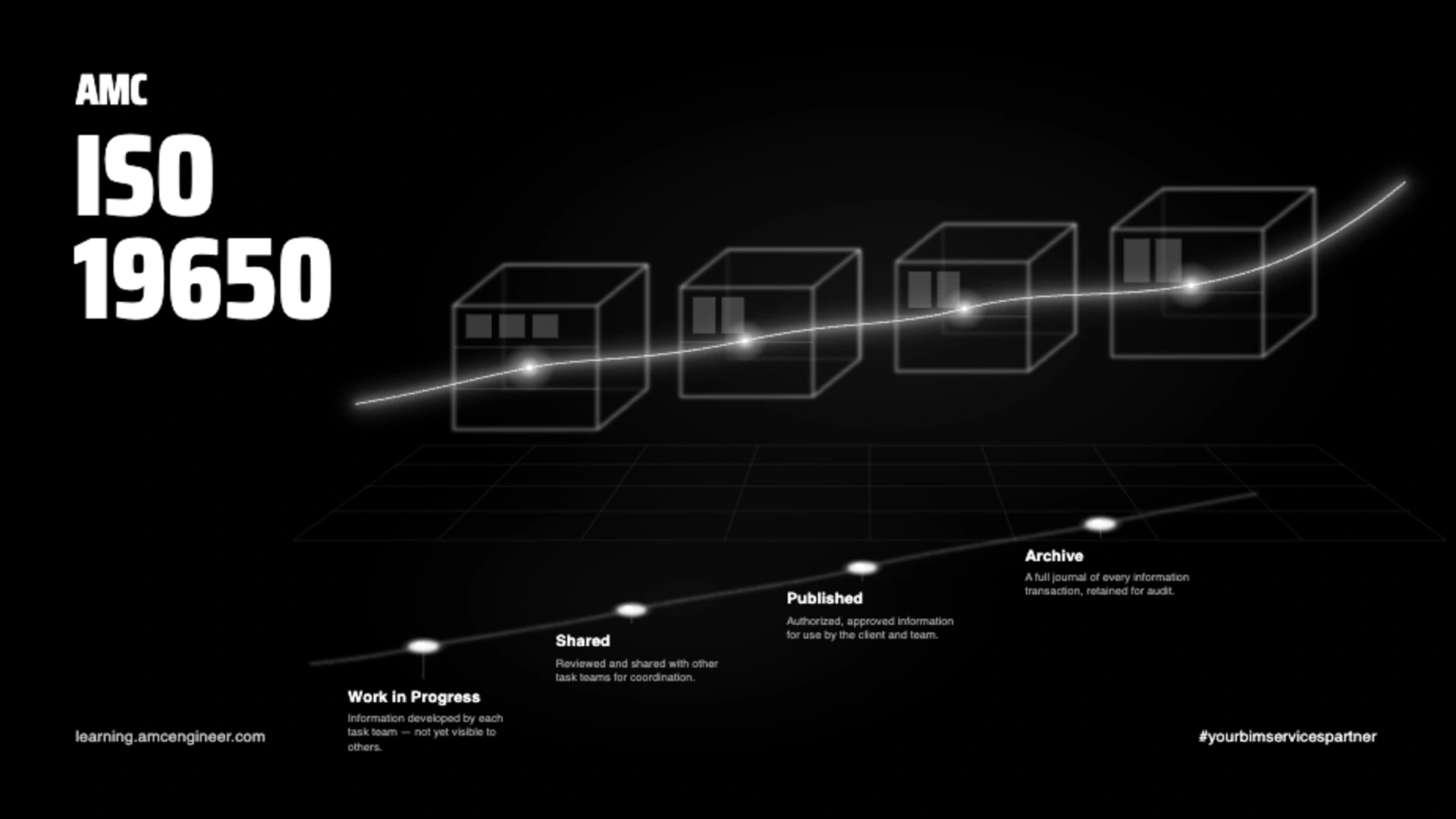
The CDE sits at the heart of it all. It controls information through four clear states: Work in Progress (WIP) → Shared → Published → Archived — with status codes that define exactly how each file can be used.
The Structure of iso bim standards 19650
The series is made up of six published parts, each addressing a different stage or concern of the information lifecycle:
| Part | Focus | Status |
|---|---|---|
| ISO 19650-1 | Concepts and principles | Published 2018 |
| ISO 19650-2 | Delivery phase (design & construction) | Published 2018 |
| ISO 19650-3 | Operational phase (asset management) | Published 2020 |
| ISO 19650-4 | Information exchange (quality criteria) | Published 2022 |
| ISO 19650-5 | Security-minded information management | Published 2020 |
| ISO 19650-6 | Health and safety information | Published 2025 |
Worth knowing for 2026: Parts 1, 2, and 3 are under active revision. A Draft International Standard (DIS) entered public consultation in early 2026, with proposals to merge Parts 2 and 3 into a single end-to-end process. The current published versions remain the standard to implement until any revision is formally adopted (expected late 2026).
Benefits of ISO 19650 for BIM Workflows
Adopting ISO 19650 transforms how teams handle data inside a BIM environment. The standard delivers measurable advantages across the project:
- A single source of truth — no more conflicting file versions or lost revisions.
- Reduced risk and rework — clear status codes prevent teams from acting on draft or unapproved information.
- Stronger collaboration — standardized roles and processes mean every party knows their responsibilities.
- Better data quality — defined acceptance and verification criteria (Part 4) keep models accurate.
- Built-in security — Part 5 embeds protection for sensitive project and asset data.
- Smoother handover — structured information flows seamlessly into the Asset Information Model for operations.
For organizations relying on professional BIM modeling services, ISO 19650 is the framework that turns raw models into trustworthy, contract-ready deliverables.
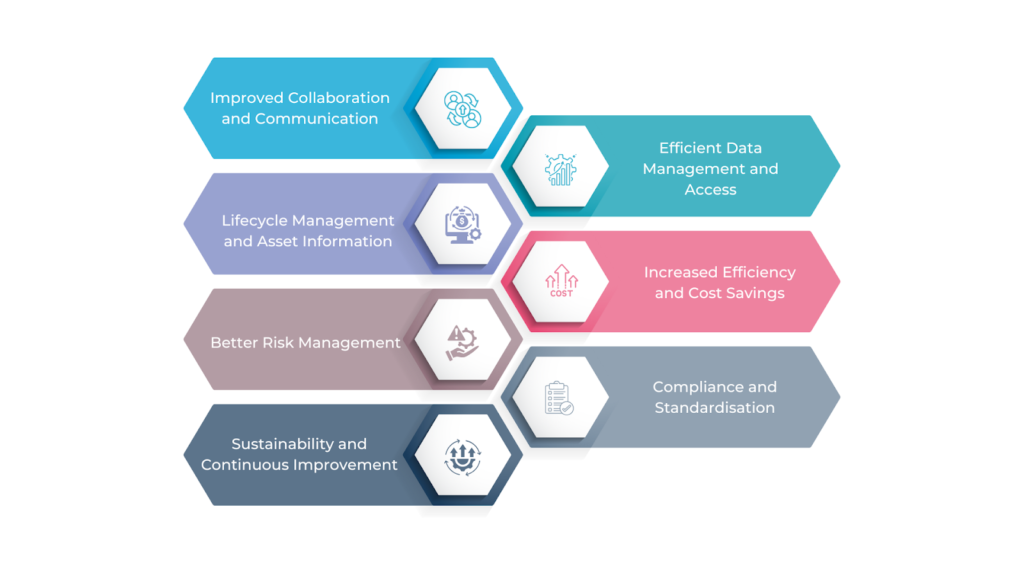
Real-world impact: across European states that embedded ISO 19650 into procurement, firms reported cost savings of 5–10%, carbon reductions of 15–20%, and significantly fewer disputes over a five-year period.
How to Implement ISO 19650 in Construction Projects
Implementing the standard does not have to be overwhelming. Here is a practical, step-by-step path:
- Read the standards first — start with Parts 1 and 2 to understand the core concepts.
- Identify your role — are you the appointing, lead appointed, or appointed party?
- Define information requirements — set the OIR, AIR, PIR, and crucially the Exchange Information Requirements (EIR).
- Create a BIM Execution Plan (BEP) — document how the team will meet the requirements.
- Establish the Common Data Environment (CDE) — configure it for version control and status workflows.
- Build delivery plans — the Master Information Delivery Plan (MIDP) and Task Information Delivery Plans (TIDPs).
- Manage information through the cycle — produce, coordinate, check, approve, and deliver.
- Hand over into the Asset Information Model — ready for the operational phase.
The most common failure point is skipping the upfront requirements stage and jumping straight into modelling. ISO 19650 works precisely because it forces clarity before production begins.
Industries That Benefit from ISO 19650
While born in the AEC sector, ISO 19650 delivers value far beyond traditional buildings:
- Construction & infrastructure — bridges, highways, tunnels, and utility networks.
- Real estate development — large mixed-use and residential megaprojects.
- Government & public sector — increasingly mandated in public procurement.
- Facility & asset management — owners managing assets over a 30–50 year lifecycle.
- Oil, gas & energy — complex assets with strict security and compliance needs.
- Healthcare & education — high-stakes facilities where data accuracy is critical.
In the Gulf, ISO 19650 aligns directly with Saudi Vision 2030 and the UAE’s digital construction agenda, where BIM mandates are accelerating across giga-projects and government tenders.
ISO 19650 vs. Other BIM Standards
How does ISO 19650 compare to what came before and what sits alongside it?
- vs. BS 1192 / PAS 1192 (UK) — ISO 19650 is the international successor, extending the UK BIM Level 2 suite to a global stage.
- vs. National BIM mandates—many countries (UK, Germany, Norway) now align their public BIM requirements with ISO 19650 rather than replacing it.
- vs. ISO 7817 (Level of Information Need) — a complementary standard that defines how much detail is needed, supporting ISO 19650’s requirements.
- vs. ISO 9001 / 55000 / 21500 — ISO 19650 connects to these quality, asset, and project management standards for a complete governance picture.
The takeaway: ISO 19650 is not a competing standard — it is the central framework that other standards plug into.
The Future of ISO 19650 in Digital Construction
ISO 19650 is evolving in step with the industry:
- The 2026 revision proposes a unified 9-step process, combining the delivery and operational phases for a true whole-life approach.
- Clearer implementation guidance is coming for both simple and complex projects.
- Integration with digital twins is making ISO 19650 the backbone of live, data-rich asset management.
- Tighter security and “golden thread” requirements are reinforcing accountability, especially for higher-risk buildings.
As BIM adoption deepens across the Middle East, ISO 19650 will increasingly be the dividing line between firms that win tenders and those that fall short on compliance.
Why Your Firm Should Adopt ISO 19650
For any firm serious about competing on modern construction projects, ISO 19650 is no longer a “nice to have” — it is a baseline expectation. Adopting it means:
- Winning more work — meeting client and government BIM mandates with confidence.
- Protecting your reputation — delivering accurate, auditable, dispute-resistant information.
- Future-proofing your processes — aligning with where global construction is heading.
- Maximizing ROI on BIM — turning your modelling investment into reliable, lifecycle-long value.
At AMC Engineer, we help AEC firms across Saudi Arabia and the UAE implement ISO 19650-compliant workflows — from setting up your CDE and EIRs to delivering fully coordinated, standard-aligned models.
Explore our full range of engineering and BIM services or speak directly with our team to get started.
📞 Call us now: 01008985801 — let’s make your next project ISO 19650-ready.
FAQ About ISO 19650
How to be certified in ISO 19650?
Certification works on two levels. Individuals earn it by completing accredited training and passing an assessment through recognised providers (such as BSI, BRE Academy, or RICS-aligned courses), which proves personal competence. Organisations get certified by first implementing ISO 19650-compliant processes — a working CDE, defined roles, EIRs, a BEP—and then passing an independent third-party audit against the standard (for example, the BSI Kitemark for BIM). Note that ISO 19650 is a process framework, so “certification” verifies that your information-management practices meet it, rather than certifying a product.
What are the different types (parts) of ISO 19650?
There are six published parts: Part 1 (concepts and principles), Part 2 (delivery phase — design and construction), Part 3 (operational phase — asset management), Part 4 (information exchange), Part 5 (security-minded management), and Part 6 (health and safety information, published 2025).
Is BIM better than CAD?
They serve different purposes, but BIM is the more capable approach for modern projects. CAD produces geometric drawings — lines and shapes. BIM produces data-rich, intelligent models where every element carries information (materials, cost, scheduling, and maintenance data) and changes coordinate automatically across views. For collaboration, clash detection, and whole-lifecycle management, BIM clearly outperforms CAD. CAD still has its place for quick 2D detailing, but for complex, multi-team projects BIM is the industry direction — and ISO 19650 exists precisely to govern that BIM information.
What is the purpose of ISO 19650?
Its purpose is to standardise how information is managed across an asset’s entire life when working with BIM—ensuring data is produced, checked, exchanged, secured, and handed over in a consistent, reliable way. The goal is fewer errors, less rework, stronger collaboration, and information you can trust from design through to operation.
What is the main focus of ISO?
ISO (the International Organization for Standardization) develops voluntary international standards across nearly every industry to promote quality, safety, efficiency, and interoperability worldwide. If you mean the focus of ISO 19650 specifically, that is information management throughout the lifecycle of built assets using BIM.
What is ISO 19650 Part 4 mostly about?
Part 4 focuses on information exchange—specifically the quality, verification, and acceptance criteria that information must meet when it’s passed between parties. It helps teams check that what’s being exchanged is accurate, complete, and fit for purpose before it’s accepted into the workflow.
What is the ISO 19650 Common Data Environment?
The Common Data Environment (CDE) is the single, agreed channel for storing, managing, and issuing all project information. It controls files through four states — Work in Progress, Shared, Published, and Archived — each with a status code defining how the file may be used, so everyone always works from information at a known, trusted status.
What is the standard of 19650 / what is ISO 19650?
ISO 19650 is the international standard series that defines how project information is organised and managed across a built asset’s lifecycle using BIM. Built on the UK’s earlier BS 1192 and PAS 1192 standards, it sets out the roles, processes, and the CDE that keep digital construction data consistent, secure, and interoperable.