Construction remains one of the most hazardous industries in the world, and as Saudi Arabia builds at giga-project scale — NEOM, Qiddiya, the Red Sea, and beyond — the cost of getting safety wrong has never been higher. 8D BIM flips traditional, reactive safety management on its head: it embeds safety directly into the digital model so risks are designed out before a single worker steps on site.
This guide covers what 8D BIM is, how it builds on the lower BIM dimensions, the tools and principles behind it, where it fits against Saudi HSE regulation, and how project teams can implement it to deliver safer, lower-risk, more profitable projects.
Key takeaways
- 8D BIM is the safety dimension of BIM, built on Prevention through Design (PtD) — it designs hazards out before construction starts, instead of reacting to them on site.
- It isn’t a separate product. It’s a methodology layered onto your existing BIM stack: model federation, 4D scheduling, safety-tagging tools, and a Common Data Environment (CDE).
- The dimensions above 5D aren’t rigidly standardized industry-wide, but 8D is widely understood as the safety and accident-prevention layer.
- On Saudi giga-projects, 8D BIM is becoming a practical way to meet demanding client and regulatory HSE expectations while protecting large, multilingual, fast-moving workforces.
- Five principles make it work: safety as data, a single source of truth, lifecycle thinking, early collaboration, and full traceability.
What Is the 8D in BIM?
8D BIM is the safety dimension of Building Information Modeling. Where lower dimensions add layers of information to the 3D model — time, cost, sustainability, operations — the eighth dimension layers in health and safety data.
Its central philosophy is Prevention through Design (PtD): using the model to identify, assess, and eliminate hazards during design and planning, rather than managing them reactively once work is already underway on site.
It’s worth being precise here: the BIM dimensions above 5D aren’t rigidly standardized, and different organizations assign 6D, 7D, and 8D in slightly different ways. What the industry increasingly agrees on is that 8D is the dimension dedicated to safety and accident prevention — that’s the definition this guide uses, and it’s the primary focus of everything below.
From 3D to 8D: How the Dimension Stack Works
8D doesn’t replace the other dimensions — it sits on top of them. Each dimension adds a layer of intelligence to the same federated BIM model:
| Dimension | What It Adds |
|---|---|
| 3D | The geometric model — spaces, structures, and systems |
| 4D | Time — links model elements to the construction schedule and sequencing |
| 5D | Cost — connects elements to budgets and quantities |
| 6D | Sustainability — energy and environmental performance |
| 7D | Operations & facility management — the asset data used to run the building |
| 8D | Safety — hazard data, risk assessments, and prevention strategies tied to elements and sequence |
Because 8D draws on the 3D geometry and the 4D schedule, it can show where and when a hazard arises during construction — for example, flagging a fall risk at a specific edge during a specific week of the program. Safety stops being an abstract checklist and becomes a spatial, time-aware part of the model.
8D BIM and Site Safety
On site, 8D BIM turns the model into a living safety planning tool. Project teams can:
- Visualize high-risk activities before they happen and rehearse them in the model.
- Plan safe access routes, exclusion zones, and crane/lifting operations against real geometry.
- Sequence work to keep trades separated and reduce congestion.
- Communicate hazards visually in toolbox talks — far more effective than text-only method statements, especially across the multilingual workforces common on Saudi sites.
The result: safety planning moves from a paper exercise into a shared, visual conversation everyone on the project can understand.
8D BIM Software: What’s Actually in the Tool Stack
There’s no single product called “8D BIM software.” In practice, 8D is a methodology delivered across a stack of BIM tools rather than one application:
- Model federation and coordination tools to combine disciplines and run clash and constructability checks — the same logic used for clashes can flag safety conflicts.
- 4D simulation tools to link the model to the schedule and play back the build sequence to spot when hazards emerge.
- Safety-specific plugins and modules that let teams tag hazards, attach risk assessments, and generate safety reports directly from model objects.
- Common Data Environments (CDEs) to keep safety information versioned and accessible to the whole team.
The right combination depends on your project size and existing workflows. The goal isn’t to buy a magic tool — it’s to connect safety data to the model in a way your team will actually use.
Prevention Through Design: 8D BIM Tools for Accident Prevention
Prevention through Design is where 8D earns its value. Using the model, designers and planners can:
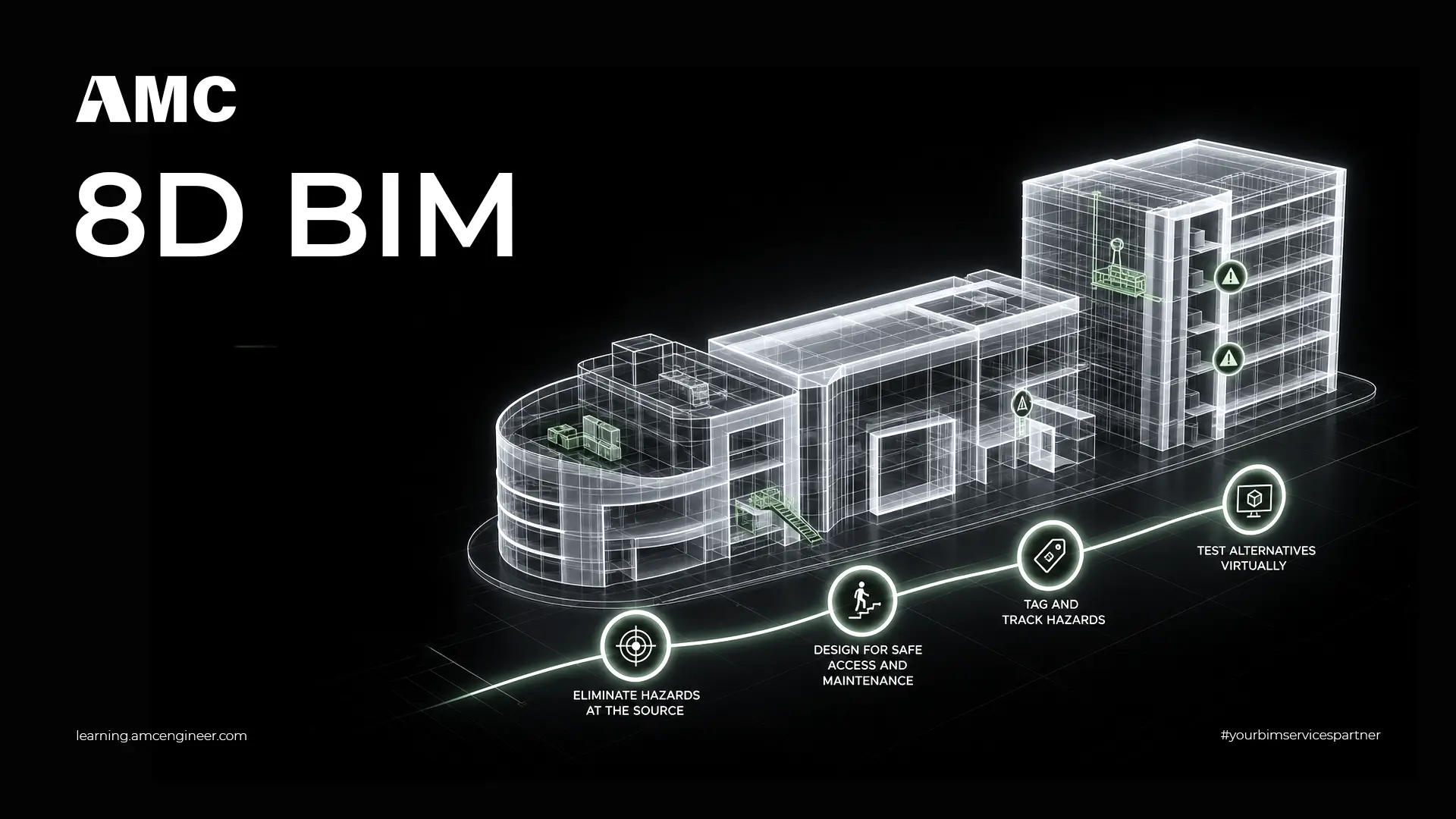
- Eliminate hazards at the source — for example, designing in permanent edge protection, or specifying prefabrication so high-risk work happens in a controlled factory rather than at height on site.
- Design for safe access and maintenance — ensuring plant, roofs, and façades can be reached and serviced safely throughout the building’s life.
- Tag and track hazards against specific elements so each risk has an owner, an assessment, and a recorded mitigation.
- Test alternatives virtually — comparing the safety implications of different sequences or methods before committing.
The principle is simple: the cheapest and safest place to remove a hazard is on a screen, long before it exists on site.
The Mindset Shift Behind 8D — and the Principles That Make It Work
At its core, 8D BIM represents a shift from managing accidents to preventing them. Conventional HSE practice reacts to risks as they appear in the field, where options are limited and changes are expensive. 8D pushes that responsibility upstream, into design and planning, where decisions are cheap to change and have the greatest influence on outcomes.
This reflects the well-established hierarchy of controls, which prioritizes eliminating hazards over relying on personal protective equipment as a last line of defense. 8D BIM gives that hierarchy a digital home, making elimination and substitution practical choices rather than aspirations.
Five principles underpin effective 8D BIM:
- Safety is data, not a document. Hazard information is structured and attached to model objects, not buried in standalone PDFs.
- A single source of truth. Designers, contractors, HSE, and the client all work from the same federated model and risk information.
- Lifecycle thinking. Safety is considered from design through construction and into operation and maintenance — not just during the build.
- Collaboration by design. Designers and constructors engage early so buildability and safety inform decisions before they’re locked in.
- Traceability. Every identified hazard is recorded, assigned, mitigated, and auditable.
Proactive Design Strategies Enabled by 8D BIM
8D BIM makes a range of proactive strategies practical:
- Off-site and modular construction to remove dangerous activities from the live site.
- Sequence optimization using 4D to avoid trade clashes and reduce time spent in high-risk conditions.
- Designed-in fall protection — parapets, anchor points, and guarded openings modeled from the start.
- Logistics and site-setup planning — modeling crane positions, deliveries, and pedestrian/vehicle separation before mobilization.
- Emergency planning — mapping escape routes and muster points within the model.
Each of these moves a risk decision earlier in the project, where it’s safest and least costly to address.
Measuring Safety Performance Using 8D BIM
What gets measured gets managed. 8D BIM supports a more data-driven approach to safety performance through:
- Digital risk registers linked to model elements, giving a live view of open and closed hazards.
- Leading indicators — such as the number of hazards designed out before construction — rather than relying only on lagging indicators like incident counts after the fact.
- Sequence-based exposure analysis to quantify how long workers spend in high-risk zones and target reductions.
- Audit trails that demonstrate due diligence and support compliance reporting.
For Saudi projects subject to strict client and regulatory HSE expectations, this auditable, model-based evidence is increasingly valuable.
Saudi HSE Regulations: Where 8D BIM Fits
Saudi construction safety is enforced by the Ministry of Human Resources and Social Development (HRSD), and increasingly aligned with the international ISO 45001 standard for occupational health and safety management. Contractors are generally required to maintain a dedicated safety officer and a documented risk management plan for each project.
Compliance monitoring is also moving digital: inspections and violation records are increasingly tracked through platforms such as Qiwa and Mudad, which can in turn affect a contractor’s Nitaqat rating.
This is exactly where 8D BIM earns its keep. Instead of a static risk-management PDF submitted once and forgotten, 8D gives a contractor a live, model-linked risk register — hazards tagged to real elements, assigned an owner, and tracked to closure — that’s far easier to keep current and far easier to demonstrate during an audit.
Integration with Digital Twins and Future Trends
8D BIM is the foundation for a new generation of safety technology:
- Digital twins that carry safety data into the operational phase, keeping risk information live for the building’s whole life.
- IoT and wearables that feed real-time location and environmental data — heat stress, proximity to plant, restricted-zone breaches — back against the model. In the Saudi climate, heat-stress monitoring is particularly significant.
- AI-driven hazard detection that scans designs and site imagery to flag risks automatically.
- VR and AR safety training that immerses workers in a high-risk scenario virtually before they face it in reality.
Saudi giga-projects are already acting as testbeds for these technologies, setting safety expectations that will spread across the wider market.
Benefits of 8D BIM for Construction
- Fewer accidents and injuries through hazards eliminated at the design stage.
- Lower project risk and cost — incidents cause delays, claims, and reputational damage that proactive design avoids.
- Stronger compliance with Saudi safety regulations and demanding client HSE requirements.
- Better communication of risk across multilingual, multi-trade teams.
- Improved productivity — safer, better-sequenced sites lose less time to disruption.
- A safer asset for life — designing in safe maintenance access protects operators long after handover.
Implementing 8D BIM on Your Project
Rolling out 8D BIM works best as a structured, six-step process:
- Set safety information requirements early — define what hazard data you need and at what stage, ideally within your project’s BIM execution plan.
- Engage HSE from day one — bring safety expertise into design coordination, not just site management.
- Choose a practical tool stack — federation, 4D, and safety-tagging tools your team can realistically adopt.
- Integrate safety into coordination reviews — run safety checks alongside clash detection in regular model reviews.
- Train the team — designers, planners, and site staff all need to understand how to read and act on the model’s safety data.
- Keep the model current — update hazards and mitigations as the design and build evolve.
How to Get the Most Out of 8D BIM
Treat 8D BIM as a culture, not a checkbox. Start early — the value comes from influencing design decisions, so waiting until construction wastes most of the benefit. Keep safety data structured and connected to the model rather than scattered across documents. Involve the people who actually do the work, since their input makes the model’s hazard assessments realistic. And measure leading indicators so you can prove safety is improving, not just count incidents after they happen.
Most importantly, work with a partner who understands both BIM and construction safety in the Saudi context — the regulations, the climate, and the realities of large, fast-moving sites.
Build Safer From the First Line on Screen
8D BIM proves a powerful idea: the safest, cheapest place to prevent an accident is in the model, long before it could ever happen on site. By layering safety data onto the BIM workflow, Saudi contractors and developers can design out risk, protect their workforce, satisfy demanding HSE requirements, and deliver projects with fewer costly disruptions.
AMC Engineer helps construction teams across Saudi Arabia integrate safety into their BIM workflows — from Prevention through Design and 4D safety sequencing to model-based risk management. Talk to our BIM team to make your next project safer by design →
FAQs
What does 8D mean in BIM, and what’s its primary focus?
8D refers to the safety dimension of BIM. Its primary focus is using the model to identify and eliminate hazards through Prevention through Design, before and during construction — rather than managing accidents reactively after they occur.
Is 8D BIM an official standard?
The dimensions above 5D aren’t rigidly standardized, but 8D is widely understood across the industry as the safety and accident-prevention dimension.
Do I need special software for 8D BIM?
There’s no single “8D” product. It’s delivered through a combination of model federation, 4D scheduling, and safety-tagging tools within your existing BIM environment.
How is 8D BIM different from normal site safety?
Traditional safety is largely reactive and managed on site. 8D BIM is proactive — it designs hazards out before work begins, using the model to plan and visualize risk.
What are the core principles behind 8D BIM for project safety?
Five principles: treating safety as structured data rather than documents, maintaining a single source of truth across all parties, thinking across the full building lifecycle, collaborating early between designers and constructors, and keeping every hazard traceable from identification to closure.
How does 8D BIM improve risk assessment in building projects?
It ties hazards directly to specific model elements and schedule dates, so risk assessments become spatial and time-aware rather than generic checklists. Teams can see exactly where and when a hazard will arise, track it through a live digital risk register, and measure leading indicators instead of waiting for incident reports.
What are the main benefits of integrating 8D BIM in large-scale Saudi projects?
On giga-project-scale work, 8D BIM reduces accidents and the delays/claims that follow them, strengthens compliance with Saudi HSE expectations, improves risk communication across large multilingual workforces, and supports safer long-term operation of the finished asset.
What are the best 8D BIM tools for clash detection and scheduling?
There’s no single named “8D tool” — clash detection typically runs through model federation and coordination software, while scheduling runs through 4D simulation tools linked to the same model. Safety-specific plugins then layer hazard tagging and risk assessments on top of both.
How do you implement 8D BIM principles on a large-scale project?
Define safety information requirements in the BIM execution plan, involve HSE from the design stage, select a tool stack your team will actually use, fold safety checks into existing clash-detection reviews, train everyone on reading the model’s safety data, and keep hazards and mitigations updated as the project evolves.
Which companies offer 8D BIM services in Saudi Arabia?
Look for a provider that combines genuine BIM modeling capability with construction-safety/HSE expertise and experience on Saudi projects specifically — the value of 8D comes from that combination, not from either skill set alone. AMC Engineer offers this combined service across Saudi Arabia; get in touch to discuss your project.