What Does a Construction Business Consultant Do? A Complete Guide for KSA & UAE Projects
A construction business consultant is the independent expert an owner brings in to protect a project’s cost, schedule, and quality — from feasibility through handover. In a region where NEOM, the Red Sea, and Qiddiya are redefining the pace of delivery, choosing the right consultant is no longer optional. This guide explains exactly what these consultants do, how they differ from contractors and project managers, how modern BIM-enabled consulting changes the outcome, and how to select and engage one for a project in Saudi Arabia or the UAE.
Key takeaways
- A construction business consultant provides independent, owner-side advice across feasibility, cost, scheduling, risk, contracts, and technical review.
- They are not the contractor and not always the project manager — the distinction matters for accountability.
- BIM-enabled consulting (coordination, clash detection, model-based quantities) is now a core differentiator, not a nice-to-have.
- The right time to engage is early — decisions made in the first stages control most of the final cost.
- Selection should weigh sector track record, credentials, BIM capability, KSA/UAE experience, and fee transparency — not price alone.
On this page
- What is a construction business consultant?
- Consultant vs. contractor vs. project manager
- What a construction consultant actually does
- Types of construction consultants
- How BIM-enabled consulting changes the game
- When do you need a construction consultant?
- How to choose the right consultant
- Engagement models & cost
- Construction consulting in Saudi Arabia & the UAE
- Frequently asked questions
What Is a Construction Business Consultant?
A construction business consultant is an experienced professional — or a firm — engaged by a project owner, developer, or investor to provide independent expert guidance on how a construction project is planned, procured, and delivered. Unlike parties who profit from the build itself, a good consultant’s only stake is the success of the project, which is precisely what makes their advice valuable.
Their remit spans the full project lifecycle: testing whether an idea is financially and technically viable, shaping the budget and programme, reviewing designs, structuring contracts, monitoring progress, and stepping in when disputes or delays threaten the outcome. In practice, they act as the owner’s technical conscience — asking the hard questions before money is committed rather than after.
In short: the contractor builds the project, and the consultant makes sure it is the right project, built the right way, for the right cost.
Consultant vs. Contractor vs. Project Manager
These three roles are often blurred, yet they carry very different responsibilities and incentives. Understanding the difference is the first step to assembling the right team.
| Role | Primary responsibility | Whose side they’re on | Typical output |
|---|---|---|---|
| Construction consultant | Independent advice on feasibility, cost, risk, quality, and contracts | The owner / investor | Reports, recommendations, reviews, risk registers |
| Contractor | Physically delivering the works to the agreed scope | Their own commercial interest | The built asset |
| Project manager (PM) | Day-to-day coordination of time, cost, and scope | Usually the owner, sometimes embedded | Schedules, progress control, decisions log |
A consultant may also provide project management, but the reverse is not always true. When the same party both advises on and profits from the works, independence is compromised — which is why owners on complex projects keep the advisory role separate.
What Does a Construction Consultant Actually Do?
The value of a consultant is concentrated in a handful of high-leverage activities that recur across the project lifecycle:
Feasibility & concept validation
Before capital is committed, the consultant tests whether the project stacks up — site constraints, budget realism, regulatory fit, and return on investment. This is where the cheapest and most powerful decisions are made.
Cost planning & quantity surveying
Accurate early estimates, elemental cost plans, and a defensible bill of quantities keep the budget under control. Robust cost estimation at concept stage is the single biggest guard against overruns.
Scheduling & project controls
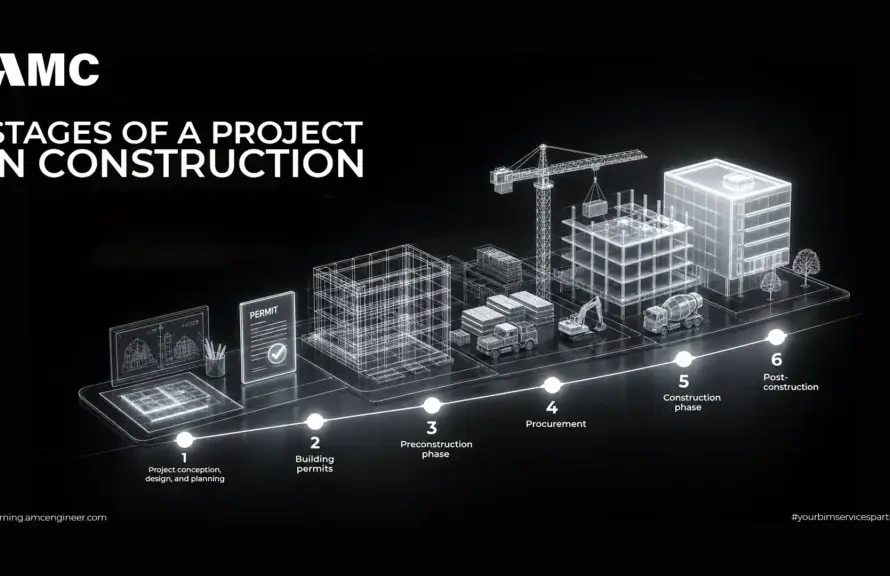
The consultant builds and stress-tests the programme, identifies the critical path, and monitors progress against it. Sound construction planning across the project stages is what turns a target date into a realistic one.
Design review & technical assurance
They scrutinise drawings and specifications for buildability, coordination clashes, and compliance — catching errors on paper, where they cost a fraction of what they would on site.
Risk management
A live risk register — probability, impact, and mitigation for each threat — turns vague worry into managed exposure, from ground conditions to supply-chain and cash-flow risk.
Contracts & claims
From procurement strategy and tender evaluation to change orders and dispute support, the consultant makes sure the contract protects the owner and that claims are properly evaluated rather than simply paid.
Not sure where the risk is hiding in your project?
AMC Engineering provides independent, BIM-driven consulting for developers and contractors across Saudi Arabia and the UAE — from feasibility and cost control to model-based coordination.
Types of Construction Consultants
“Construction consultant” is an umbrella term. Most projects need several specialisms — sometimes under one firm, sometimes assembled individually.
| Type | Focus | Typical deliverables |
|---|---|---|
| Project management consultant | Time, cost, and scope coordination | Programme, progress reports, decisions log |
| Cost consultant / quantity surveyor | Budgets, cost plans, valuations | Cost plan, BOQ, payment certificates |
| BIM consultant | Model development, coordination, information management | Federated models, clash reports, BEP |
| MEP consultant | Mechanical, electrical & plumbing systems | Systems design review, coordination |
| Sustainability consultant | Energy, certification (LEED / Mostadam) | Compliance strategy, ratings support |
| Claims & disputes consultant | Delay analysis, contract disputes | Claims reports, expert opinion |
How BIM-Enabled Consulting Changes the Game
The clearest line between a modern consultant and a traditional one is BIM. When advice is grounded in a coordinated 3D information model rather than 2D drawings and spreadsheets, the owner gets earlier certainty and fewer surprises on site.
Model-based BIM coordination and clash detection surface conflicts between structural, architectural, and MEP systems before a single component is installed — the difference between a design correction and an expensive site rework. Quantities pulled straight from the model make cost plans faster and more accurate, and the same model carries value long after handover into facility management and asset management.
Why it matters in the Gulf: Saudi and UAE clients on major and government-backed projects increasingly mandate BIM deliverables. A consultant without genuine BIM capability can no longer meet the requirements on the region’s flagship work.
When Do You Need a Construction Consultant?
The instinct is to bring in help when something has already gone wrong. The evidence says the opposite: the earlier a consultant is engaged, the more influence they have over the outcome, because the decisions with the largest cost impact are made at the very start.
- Concept / feasibility stage — to confirm the project is viable before capital is committed.
- Design stage — to review buildability, coordination, and compliance.
- Procurement / tender stage — to structure contracts and evaluate bids objectively.
- Construction stage — to monitor cost, programme, and quality, and to manage change.
- Handover & operation — to close out claims and hand over reliable asset information.
You especially need one when the project is large or technically complex, when internal expertise is thin, when funding or regulatory scrutiny is high, or when a project is already slipping and you need an independent read on why.
How to Choose the Right Construction Consultant
This is where owners most often go wrong — defaulting to the lowest fee or the most familiar name. Weigh the following instead:
- Relevant sector track record — have they delivered projects of your type, scale, and complexity?
- Credentials & independence — qualified staff, and no conflict of interest with contractors on your job.
- Genuine BIM capability — ask to see coordination and clash-detection deliverables, not just a claim.
- KSA / UAE experience — familiarity with local codes, authorities, and approval workflows saves months.
- Fee transparency — a clear scope and a clear basis of charge, with no vague “extras.”
- Communication — reporting you can actually act on, at a cadence that fits your governance.
Red flags: a fee that looks too good to be true, reluctance to define scope in writing, no verifiable local references, and BIM claims with nothing to show behind them.
Construction Consultant Engagement Models & Cost
Consultants are engaged in several ways, and the right model depends on how well the scope is defined and how much certainty the owner needs.
| Model | How it works | Best when |
|---|---|---|
| Lump sum / fixed fee | A set price for a defined scope | Scope is clear and stable |
| Percentage of project value | Fee scales with construction cost | Full-lifecycle involvement |
| Retainer | Ongoing monthly advisory | Long programmes or portfolios |
| Time-based / hourly | Charged against time spent | Scope is open-ended or advisory-only |
Fees are driven by project size and complexity, the depth of scope, the level of BIM deliverables, and programme duration. Rather than anchoring on a headline rate, judge cost against value: catching a single major coordination clash or a flawed cost assumption early can pay for the entire engagement many times over. Reliable numbers should always come from a scoped proposal — treat any figure quoted without a defined scope with caution.
Construction Consulting in Saudi Arabia & the UAE
Nowhere is the case for strong construction consulting clearer than the Gulf. Saudi Arabia’s Vision 2030 giga-projects — NEOM, Red Sea Global, and Qiddiya — together with the UAE’s continuous development pipeline, have created a market defined by scale, speed, and technical ambition.
That environment raises the stakes on every project decision. Local codes (Saudi Building Code), authority approvals, sustainability frameworks such as Mostadam, and increasingly mandatory BIM deliverables all demand a consultant who knows the regional terrain — not just construction in the abstract. A firm that combines engineering depth, real BIM capability, and on-the-ground KSA/UAE experience is best placed to turn that complexity into a delivered, defensible outcome.
Planning a project in Saudi Arabia or the UAE?
Get independent, BIM-driven construction consulting from a team that knows the region’s codes, authorities, and giga-project standards. Request a consultation or a sample deliverable to see how we work.
Frequently Asked Questions
What does a construction business consultant do?
A construction business consultant provides independent, owner-side advice across a project’s lifecycle — feasibility, cost planning, scheduling, design review, risk management, and contracts. Their role is to protect the project’s cost, schedule, and quality rather than to build it, giving the owner objective guidance at every major decision point.
What is the difference between a construction consultant and a contractor?
The contractor physically delivers the works and profits from the build. The consultant advises the owner independently on whether the project is viable and how to control cost, time, quality, and risk. Keeping the two roles separate preserves the consultant’s independence, which is why owners on complex projects don’t rely on the contractor for objective advice.
When should I hire a construction consultant?
As early as possible — ideally at the feasibility or concept stage, because the decisions with the biggest cost impact are made at the start. You especially need one for large or technically complex projects, when internal expertise is limited, when regulatory or funding scrutiny is high, or when a project is already slipping and you need an independent diagnosis.
How much does a construction consultant cost?
It depends on the engagement model — lump sum, a percentage of project value, a retainer, or time-based — and on the project’s size, complexity, BIM scope, and duration. Reliable pricing should always come from a scoped proposal. The better measure is value: early advice that prevents a single major clash or cost error can pay for the whole engagement several times over.
Why is BIM capability important when choosing a consultant?
BIM lets a consultant base advice on a coordinated 3D information model rather than 2D drawings, so clashes between structural, architectural, and MEP systems are caught before installation, quantities are more accurate, and asset data carries into operation. On major Saudi and UAE projects, BIM deliverables are increasingly mandatory, so genuine BIM capability is now essential rather than optional.
Do I need a local consultant for projects in Saudi Arabia or the UAE?
Local experience is a major advantage. A consultant familiar with the Saudi Building Code, authority approval workflows, sustainability frameworks such as Mostadam, and regional BIM mandates can prevent costly delays and rework. Combining that local knowledge with engineering and BIM depth gives owners the strongest footing on the region’s fast-moving projects.