MEP drafting is the production work that turns engineering intent into the drawings a contractor installs from — modelling the mechanical, electrical and plumbing systems, coordinating them against structure and each other, and extracting plans, sections, riser diagrams, shop drawings and schedules from the result. It is also the part of an engineering workload that firms most often struggle to staff, which is why it is so commonly outsourced. This guide covers what MEP drafting actually delivers, the Revit workflow behind it, how quality is controlled, the engagement models available, and the Gulf code requirements a drafting partner has to understand before a single duct is modelled.
- What MEP drafting is
- Drafting vs design vs detailing vs modelling
- The deliverables
- The Revit MEP workflow
- 2D CAD vs model-based drafting
- Conversions: CAD, PDF and scan to BIM
- Quality control: what actually gets checked
- Gulf code compliance as part of the service
- Engagement models
- In-house vs outsourced: the real comparison
- Working across time zones
- Twelve questions to ask a drafting partner
- Seven ways MEP drafting goes wrong
- Frequently asked questions
What Is MEP Drafting?
MEP drafting is the production of the drawings and models that define a building’s mechanical, electrical and plumbing systems — ductwork, pipework, containment, equipment, fixtures and fire protection — developed to the point where a contractor can install from them. In current practice it is almost always model-based: systems are modelled in Revit, coordinated against the architectural and structural models, and the drawings are extracted from that coordinated model rather than drawn independently.
It sits between engineering and construction. The engineer decides the system, the sizes and the performance. The drafter builds it in the model, routes it through the real building, resolves it against everything else in the same space, and produces the documentation the site works from.
Drafting vs Design vs Detailing vs Modelling
Four words used interchangeably in project conversation, and worth separating because they describe different scopes with different liabilities.
| Term | What it covers | Who normally holds it |
|---|---|---|
| Design | Sizing, load calculation, system selection, performance and code compliance decisions | The engineer of record |
| Modelling | Building the 3D representation of the systems in the authoring tool | BIM technician or modeller |
| Drafting | Producing the drawing set from the model — views, sections, annotation, schedules, sheets | Drafter, often the same person as the modeller |
| Detailing | Developing fabrication-level information — supports, connections, spool breaks, installation sequence | Contractor, subcontractor or fabricator |
The Deliverables
| Deliverable | What it contains | Used by |
|---|---|---|
| Discipline floor plans | Mechanical, electrical, plumbing and fire protection layouts per level with sizes and routing | Site installation, review |
| Riser diagrams | Vertical schematics showing how systems connect between floors | Verifying sizing as load accumulates |
| Sections and elevations | Cuts through congested areas showing vertical relationships | Proving services fit the void |
| Composite / coordinated layouts | All disciplines overlaid with levels and offsets | The drawing that proves it all fits |
| Shop drawings | Fabrication and installation detail with real products, supports and fixings | Workshop and installation crews |
| Penetration and builder’s work drawings | Sleeve sizes and positions through structure and rated barriers | Structural contractor — needed before pours |
| Equipment schedules | Capacities, ratings, models, electrical loads, performance data | Procurement and compliance review |
| Quantity takeoffs | Material quantities extracted from the model | Estimating and procurement |
| As-built drawings | Record of what was actually installed | Handover, operation, future works |
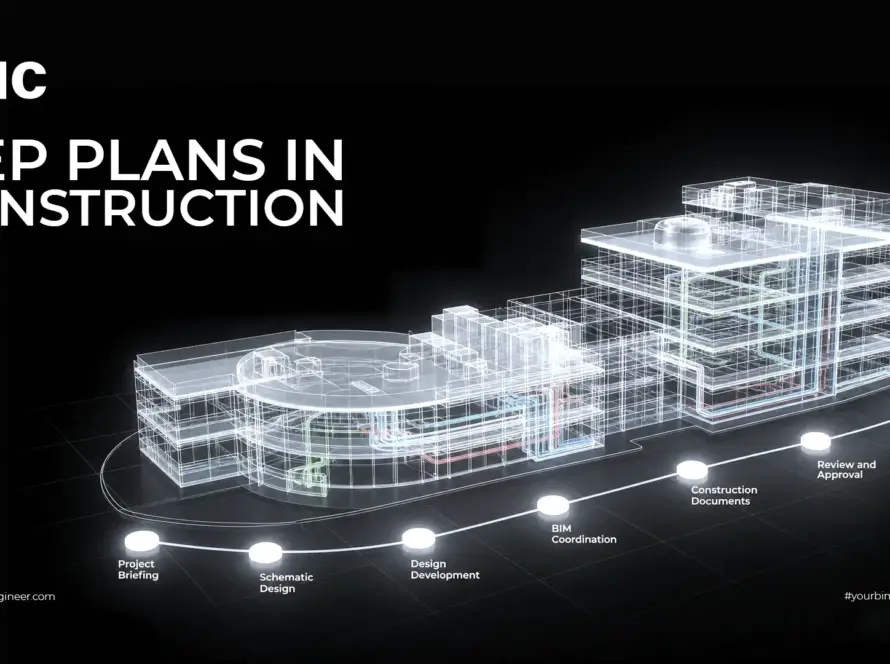
The two most often missing from a package are composite layouts and penetration drawings — and they are the two that decide whether the installation is buildable. Our guide to MEP plans in construction covers what a complete drawing set contains and how to read one.
Need MEP drafting capacity without adding headcount?
AMC Engineer delivers HVAC and plumbing design, ASHRAE load calculations, LOD 300–400 Revit MEP models, Navisworks coordination and SMACNA-compliant construction documentation for projects across Saudi Arabia and the UAE.
The Revit MEP Workflow: From 2D Input to Fabrication Output
- Input receipt and review. Take in the architectural and structural models or drawings, the MEP design drawings, the specification and the equipment schedules. Confirm revisions, and flag gaps before modelling starts rather than modelling around them.
- Project setup. Shared coordinates, levels, grids, worksets, view templates, system naming and classification, and the family library. Setup decisions taken now persist for the life of the project.
- System modelling. Model each discipline — ductwork, pipework, containment, fire protection — with correct sizes and connected system logic, not disconnected geometry that happens to look right.
- Ceiling and shaft space allocation. Agree a spatial budget per discipline before detailed routing, so coordination starts from an allocation rather than a negotiation.
- Internal coordination. Resolve conflicts within and between the MEP systems before anything is issued for multi-discipline coordination.
- Federated coordination and clash detection. Federate against architecture and structure, run structured tests, classify results and resolve in priority order. See our guides to BIM coordination and clash detection.
- Development to the required LOD. Take the model to the level the deliverable requires — LOD 350 for coordination sign-off, LOD 400 where shop drawings are the output. Our guide to levels of development covers what each level includes.
- Extraction. Generate plans, sections, riser diagrams, schedules, penetration drawings and quantities from the resolved model, so drawings and model cannot diverge.
- Sheet assembly and issue. Compose sheets with consistent titles, scales and status, and issue through the common data environment with revision applied.
Automation sits alongside this rather than replacing it. Dynamo scripts and add-ins handle repetitive tasks — batch renaming, parameter population, sheet creation, hanger placement, schedule formatting — and their value is consistency as much as speed.
2D CAD vs Model-Based Drafting
Plenty of MEP work is still produced as 2D CAD, and the difference is not stylistic.
A 2D drawing represents systems as lines and symbols on independent layers. Nothing in the file knows that a duct has a physical depth, that a pipe needs a fall, or that a cable tray needs bend radius and access. Three consequences follow, and they compound:
- Geometric deviation. What is drawn in plan does not necessarily fit in section, because no software checked it.
- Inaccurate prefabrication. Spools and assemblies fabricated from 2D information carry dimensional risk that only appears at installation.
- Incorrect site verification dimensions. The field measurement is taken against a drawing that was never spatially validated.
A model-based approach removes that class of error, because the drawing is a view of a three-dimensional object that has already been checked against everything around it. It does not remove all error — a model can be wrong — but it removes the errors that come from the drawing method itself.
Conversions: CAD to BIM, PDF to BIM, Scan to BIM
A large share of MEP drafting work starts from something other than a model.
| Conversion | Input | Watch for |
|---|---|---|
| CAD to BIM | AutoCAD drawings, usually of a completed or in-progress design | Layer discipline in the source; missing information that 2D allowed to stay ambiguous |
| PDF to BIM | Scanned or exported drawings with no vector data | Scale verification, illegible annotation, and the need to query rather than assume |
| Scan to BIM | Point cloud from laser survey of an existing building | Registration accuracy, occluded areas above ceilings, and agreeing what tolerance the model represents |
Quality Control: What Actually Gets Checked
Every drafting provider claims high quality. Almost none publish what that means. Here is what a real QC process contains.
Model checks
- Shared coordinates, levels and grids match the reference models exactly
- Systems are connected and correctly classified, not disconnected geometry
- Sizes match the design drawings and equipment schedules
- Slopes and falls are applied where required
- Element naming and parameters follow the agreed convention
- Model warnings reviewed, with anything significant reported
- File performance within workable limits
Coordination checks
- Clash-free against architecture and structure at the agreed tolerance
- Clearance and maintenance access zones respected, not just physical fit
- Ceiling void and shaft allocations respected
- Penetrations identified and dimensioned
Drawing checks
- Every sheet carries correct title block, scale, status and revision
- Annotation complete, with specification references rather than generic names
- Legend and abbreviations present and consistent with the drawing content
- Schedules reconcile with the model
- Cross-discipline references correct
- Printed output legible at issue scale
The process around the checks
Three things separate a QC process from a QC claim: a named checker who is not the author, a recorded checklist per issue rather than an informal review, and a comment response sheet showing how each comment was closed. Without those three, quality control is an assertion.
Want to see the standard before you commit?
Our workflow runs from load calculations and system design through 3D Revit modelling, Navisworks coordination, detailed documentation and commissioning support — and we will produce a sample from your own drawings so you can assess the output directly.
Gulf Code Compliance as Part of the Service
This is the difference between a drafting supplier and an engineering partner, and it is where almost every provider ranking for this service falls short — because almost all of them are working from outside the region.
A drawing set that is technically well produced but does not carry what the reviewing authority expects will still be returned. On projects here that means:
Saudi Arabia
- Saudi Building Code — SBC 401 for electrical installations, SBC 501 for mechanical and HVAC, SBC 701 for plumbing and drainage, and SBC 801 for fire protection, which is substantially NFPA-derived.
- International references applied alongside it as the specification directs — ASHRAE for load calculation and ventilation, SMACNA for duct construction, NFPA for fire protection, IEC for electrical equipment.
- Municipal submission requirements, which differ between cities.
United Arab Emirates
- UAE Fire and Life Safety Code of Practice, with fire-related scope reviewed by Civil Defence and certification references expected on the drawings.
- Dubai Municipality requirements, including BIM submission for defined project categories and IFC as a permit submission format following a circular issued in October 2023.
- Abu Dhabi Department of Municipalities and Transport, which publishes CAD and BIM submission requirements covering naming conventions, coordinate systems and file formats, alongside model quality requirements addressing coordination and clash detection.
- Utility regulations such as DEWA’s, which constrain electrical drawings independently of the building code.
- Green building requirements under Al Sa’fat in Dubai or Estidama in Abu Dhabi where a rating is targeted.
Engagement Models
How the work is contracted matters as much as who does it, and different situations call for different structures.
| Model | How it works | Best when | Watch for |
|---|---|---|---|
| Per project / fixed scope | Defined deliverables, defined price, defined programme | Scope is clear and stable | Change control — agree how variations are priced before starting |
| Dedicated team | Named resources allocated full time, billed monthly | Continuous workload across multiple projects | Ramp-up time; the team needs project knowledge to be productive |
| Overflow / on demand | Capacity called on when internal load spikes | Peaky workload, tender surges, deadline compression | Availability is not guaranteed unless retained |
| Hybrid | Production work outsourced; design and coordination decisions kept in-house | Firms wanting capacity without ceding design control | Interface discipline — the split must be explicit in the scope |
The hybrid model deserves particular attention because it addresses the objection most firms actually have. The concern is rarely quality — it is loss of control over design decisions. Outsourcing production tasks such as modelling, drafting and clash resolution support while retaining design authority and final coordination decisions internally gives capacity on demand and lower fixed cost without handing over the part of the work that carries the professional risk.
In-House vs Outsourced: The Real Comparison
Most published comparisons on this subject use US salary data, which tells a firm in Riyadh or Dubai very little. The useful comparison is structural rather than numerical.
| Cost factor | In-house | Outsourced |
|---|---|---|
| Salary | Fixed, paid whether or not there is work | Variable, paid against output |
| Software licences | Per seat, annual, regardless of utilisation | Carried by the provider |
| Hardware | Workstation refresh cycle | Carried by the provider |
| Recruitment | Agency fees, time to hire, risk of a bad hire | None |
| Visas and mobilisation | Significant for expatriate hires in the Gulf | None |
| Training and upskilling | Ongoing cost and lost billable time | Carried by the provider |
| Management overhead | Supervision, appraisal, HR | Reduced but not zero — someone must manage the relationship |
| Utilisation risk | Cost continues through quiet periods | Cost stops |
| Capacity ceiling | Fixed until you hire again | Scales with demand |
| Institutional knowledge | Retained internally | Requires deliberate handover discipline |
| Design control | Complete | Depends entirely on how the scope is structured |
Working Across Time Zones
Most providers ranking for MEP drafting services operate from outside the region, and distance has practical consequences that price comparisons do not capture.
- Overlap hours determine turnaround. A query raised at the end of your day that is answered at the start of theirs costs a day. Fewer overlap hours means more of those.
- Working weeks differ. Saudi Arabia works Sunday to Thursday. UAE federal working moved to Monday to Friday in 2022, with private sector practice varying. A provider working a different week again may share only three or four common working days.
- Holiday calendars differ, which matters most around deadlines.
- Regional familiarity is not transferable. Knowing which packages Civil Defence reviews, what a municipality expects in a submission, and how a regional consultant marks up a drawing is knowledge built by working here.
None of this makes a distant provider unusable — a great many projects are delivered that way. It does mean the comparison should include turnaround reality and regional knowledge alongside rate.
Twelve Questions to Ask a Drafting Partner
- Who are the named people on my project, and what is their experience level?
- What is your QC process, who checks the work, and can I see a blank checklist?
- Can you produce a paid or free sample from my own drawings before we commit?
- Which codes and authority requirements have you worked to in this region?
- What LOD do you deliver at, and what exactly does that include and exclude?
- How do you handle revisions, and how are they priced?
- What software and versions do you work in, and how do you handle version mismatches?
- How do you receive and issue files — which CDE, and who controls it?
- What are your overlap hours with my team, and what is your working week?
- Who owns the model and the intellectual property at the end?
- What happens if the model needs changes after final delivery?
- Can you show work on a comparable project type and scale?
Seven Ways MEP Drafting Goes Wrong
| Failure | What it causes | The fix |
|---|---|---|
| Modelling starts before inputs are reviewed | Weeks of work against a superseded revision or an ambiguous design | Formal input review with gaps flagged before modelling begins |
| Project setup rushed | Coordinates, naming and templates fixed late, requiring rework across every sheet | Setup as a discrete gated step with sign-off |
| Geometry modelled instead of systems | Elements that look right but carry no system logic; schedules and flows meaningless | Model connected systems with correct classification |
| QC by the author | The same blind spots that created the error miss it | Named independent checker with a recorded checklist |
| Coordination treated as a final step | Wholesale rerouting after the drawings are already produced | Coordinate progressively; allocate ceiling space before detailed routing |
| Drawings maintained separately from the model | Drawings and model diverge; nobody knows which is correct | Extract all documentation from the resolved model |
| Code requirements discovered at submission | Rejected package with no float remaining | Establish the authority requirement list at project start |

Frequently Asked Questions
What is MEP drafting?
MEP drafting is the production of the drawings and models defining a building’s mechanical, electrical and plumbing systems to the point where a contractor can install from them. In current practice it is model-based: systems are modelled in Revit, coordinated against architecture and structure, and the drawings are extracted from the coordinated model rather than drawn independently.
What is the difference between MEP drafting and MEP design?
Design covers sizing, load calculation, system selection and code compliance decisions, and is held by the engineer of record with professional liability attached. Drafting is the production work of building the model and generating the drawing set from it. A drafting partner produces what the engineer specified; it does not assume the engineer’s role.
What deliverables does MEP drafting produce?
Discipline floor plans, riser diagrams, sections and elevations, composite coordinated layouts, shop drawings, penetration and builder’s work drawings, equipment schedules, quantity takeoffs and as-built drawings. Composite layouts and penetration drawings are the two most often missing, and the two that decide whether the installation is buildable.
Why is model-based drafting better than 2D CAD?
Because a 2D drawing has no depth. Nothing in the file knows a duct has a physical section, a pipe needs a fall, or a tray needs bend radius and access. That produces geometric deviations between plan and section, inaccurate prefabrication, and site verification dimensions taken against a drawing that was never spatially validated. A model-based approach removes that whole class of error.
What LOD should MEP drafting be delivered at?
It depends on the purpose. LOD 300 supports construction documentation and tender quantities. LOD 350 is needed for meaningful coordination sign-off, because supports, hangers and access zones exist at that level. LOD 400 is required where shop drawings and fabrication are the output. Agree the level per deliverable rather than as a single project-wide number.
What should a drafting provider’s QC process include?
Model checks covering coordinates, system connectivity and classification, sizes against the design, slopes, naming and warnings. Coordination checks covering clash-free status, clearance and maintenance access, void allocations and penetrations. Drawing checks covering title blocks, annotation with specification references, legends, schedule reconciliation and printed legibility. Around all of it: a named independent checker, a recorded checklist per issue, and a comment response sheet.
What is CAD to BIM conversion?
Rebuilding an existing 2D CAD drawing set as a coordinated 3D model. PDF to BIM does the same from drawings with no vector data, and Scan to BIM builds from a laser survey point cloud of an existing building. All three surface questions that 2D allowed to remain ambiguous, so a query cycle should be budgeted rather than treated as an obstacle.
Which engagement model is best for MEP drafting?
Per project suits clear stable scope. A dedicated team suits continuous workload across multiple projects. Overflow capacity suits peaky demand and tender surges. The hybrid model — outsourcing production work while keeping design authority and final coordination decisions in-house — addresses the objection most firms actually have, which is loss of design control rather than quality.
Is outsourcing MEP drafting cheaper than hiring?
Not automatically. It converts a fixed cost into a variable one, which is valuable when workload fluctuates and less so when it is steady and predictable. The full comparison includes salary, software licences, hardware, recruitment, visas and mobilisation, training, management overhead, utilisation risk during quiet periods, and the capacity ceiling that fixed headcount imposes.
Which codes apply to MEP drawings in Saudi Arabia and the UAE?
In Saudi Arabia, the Saudi Building Code — SBC 401 electrical, SBC 501 mechanical and HVAC, SBC 701 plumbing and drainage, SBC 801 fire protection — with ASHRAE, SMACNA, NFPA and IEC applied as the specification directs. In the UAE, the UAE Fire and Life Safety Code with Civil Defence review, plus municipal requirements in Dubai and Abu Dhabi, utility regulations such as DEWA’s, and green building requirements where a rating is targeted.
Does the time zone of a drafting provider matter?
It affects turnaround more than most rate comparisons capture. A query raised at the end of your day and answered at the start of theirs costs a day, and fewer overlap hours means more of those. Working weeks also differ — Saudi Arabia works Sunday to Thursday and UAE federal working moved to Monday to Friday in 2022 — so a distant provider may share only three or four common working days.
How do I evaluate a drafting partner before committing?
Ask for a sample produced from your own drawings to your own standards. Portfolios are curated; a sample is not. Alongside it, ask who the named people on your project will be, what the QC process is and whether you can see the checklist, which regional codes they have worked to, how revisions are priced, which CDE is used, what the overlap hours are, and who owns the model at the end.
Conclusion
MEP drafting looks like production work and behaves like risk management. The drawing set is where design intent becomes something a crew installs, and every ambiguity left in it becomes an RFI, a rework, or a fabricated component that does not fit.
Choosing how to resource it is a structural decision rather than a staffing one. What separates providers is rarely software — everyone runs Revit. It is whether there is a real QC process with an independent checker, whether the coordination happens progressively or as an afterthought, and whether the team understands what a Civil Defence reviewer or a municipal submission actually expects. Ask for a sample from your own drawings, and judge on that.
Let’s start with a sample from your own drawings.
AMC Engineer provides MEP engineering and drafting for contractors, consultants and developers across Saudi Arabia and the UAE — load calculations, Revit MEP modelling to LOD 300–400, Navisworks coordination, and construction documentation compliant with the codes that will review it.