Construction planning is the foundational process of defining, scheduling, and organizing the resources, activities, and goals required to bring a construction project from concept to successful completion. It serves as a comprehensive roadmap that outlines how a project will be executed, ensuring that scope, budget, and timelines are effectively managed.
What is construction planning?
Construction planning involves identifying every necessary step to build a structure, breaking complex projects into manageable tasks, and determining the required labor, materials, and equipment. It is the meticulous process of defining what needs to be done, who is responsible, and the methods used to achieve the project’s objectives.
Why is construction planning important?
Construction planning is critical because it is the most cost‑effective way to control time, money, and quality from day one. Without a clear plan, even small oversights can snowball into delays, rework, and budget overruns. A robust plan helps teams:
- Control productivity by setting realistic targets and work rates.
- Stay within budget through early cost estimation and resource control.
- Ensure quality standards are embedded in each activity.
- Identify risks (weather, supply‑chain issues, design changes) and prepare contingency plans.
- Streamline communication between owners, designers, contractors, and subcontractors.
In short, planning is not overhead—it is the first step to reducing risk and maximizing project value.
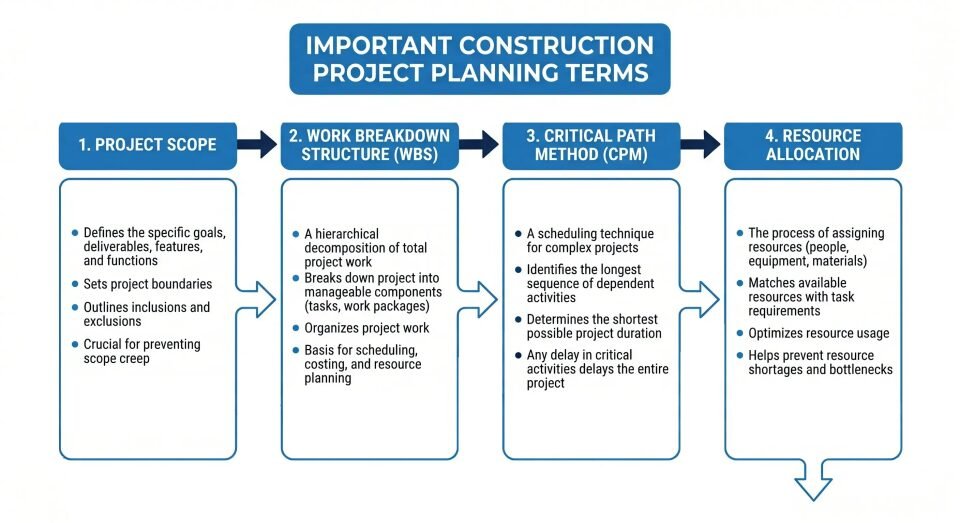
Important construction project planning terms
Need a professionally planned construction project with BIM support?
Contact AMC Engineering today to discuss your construction planning, BIM management, and coordination needs.
Get a free consultation – Contact us now.
Key Construction Plan Components
- Project objectives – A clear statement of purpose: what the project must achieve (e.g., a 20‑story office with LEED certification) and the expected return on investment for the owner.
- Schedules – Detailed timelines showing task sequences, durations, dependencies, and milestones, often visualized as Gantt charts or network diagrams.
- Budget and cost control plan – A breakdown of estimated costs (labor, materials, equipment, overhead, contingencies) with a mechanism to track actual spending against the baseline.
- Risk management plan – A structured process to identify risks (design changes, weather, permits), assess their impact, and define mitigation and contingency actions.
Together, these components form a living document that evolves as the project progresses.
Stages of construction planning
- Pre‑design / initiation
The project starts with feasibility studies, site analysis, and objective setting. Planners assess location, codes, budget, and market demand, then prepare a project charter or brief that gains approval to move forward. - Design / pre‑construction
Architects and engineers refine drawings, models, and specifications. The team finalizes layouts, structural systems, MEP design, and construction methods, while also preparing cost estimates and timelines. - Procurement
The project selects contractors, subcontractors, and suppliers through bidding or negotiated contracts. Material orders, rental schedules for equipment, and prefabrication plans are locked in according to the proposed sequence of work. - Construction and monitoring
Physical work begins on site. The planner’s schedule is now a live control tool; progress is tracked weekly or daily, deviations are analyzed, and updates are made to keep the project on track. - Post‑construction / closeout
The project undergoes final inspections, commissioning of systems, snag lists, and handover to the owner. All documentation, warranties, record drawings, and as‑built BIM models are compiled for future operations and maintenance.
Construction planning techniques
- Gantt charts – Bar‑style timelines where each task is shown against the calendar, making it easy to visualize overlaps, gaps, and milestones.
- Critical Path Method (CPM) – A network‑based technique that calculates the shortest possible project duration by focusing on the longest chain of dependent tasks.
- Q‑scheduling (Quantity‑based scheduling) – A method that links work progress to quantities (e.g., linear meters of trench, cubic meters of concrete) and location, ideal for repetitive work like roads or housing.
- PERT (Program Evaluation and Review Technique) – A probabilistic scheduling tool that uses optimistic, pessimistic, and most‑likely durations to estimate time ranges for uncertain tasks or projects with high variability.
Many modern teams combine these with digital tools and BIM to get real‑time visibility over the schedule.
How to make a construction plan
- Start by defining the full project scope and stakeholder expectations.
- Break the project into phases and work packages using a WBS.
- Estimate durations for each activity based on historical data, crew sizes, and site conditions.
- Build a master schedule (Gantt or network) that links activities with dependencies and shows critical tasks.
- Overlay labor, equipment, and material needs onto the schedule to check feasibility.
- Align the resulting plan with the project budget and financial milestones.
To make construction planning more accurate and clash‑free, integrate it with a professional BIM management service that coordinates models, schedules, and quantities from design to handover.
Types of construction project planning
- Strategic Planning: High-level activity that sets long-term goals, project objectives, and resource requirements.
- Operational Planning: Tactical execution focusing on day-to-day tasks, performance metrics, and specific action steps.
- Business Planning: Focuses on the financial aspects, including bids, contracts, and risk analysis at the project’s start.
Steps to develop a construction plan
- Define the project scope and identify all stakeholders.
- Create a Work Breakdown Structure (WBS) to organize tasks.
- Estimate costs and required resources (labor and materials).
- Develop a detailed schedule identifying critical dependencies.
- Assess risks and establish contingency plans.
- Secure necessary permits and final approvals.
Who is Responsible for Construction Planning?
Responsibility typically falls on the construction project manager, who leads the effort to define execution strategies and coordinate stakeholders. They work closely with engineers, architects, and site supervisors to ensure the plan is practical and aligned with the owner’s expectations.
Construction Project Management with BIM
Building Information Modeling (BIM) acts as a powerful tool in construction planning by allowing for 3D visualization, clash detection, and accurate material takeoffs. By integrating BIM into the planning stage, teams can simulate construction sequences, optimize MEP coordination, and minimize on-site conflicts before physical work begins.
conclusion
Construction planning is the foundation of a successful project, keeping costs, time, and quality under control. With the right techniques and BIM support, AMC Engineering helps turn your construction plan into an accurate, buildable reality.
FAQ About Construction Planning
1. What is the meaning of construction planning?
It is the meticulous process of defining tasks, schedules, resources, and goals to ensure a project moves smoothly from inception to completion.
2. What are the types of construction planning?
The three primary types are strategic (high-level goals), operational (tactical task management), and business (financial and contractual) planning.
3. What are the 5 stages of the construction process?
The standard stages include pre-design, design/pre-construction, procurement, construction/monitoring, and post-construction/closeout.
4. How to prepare a construction planning schedule?
List all tasks, break them into phases, estimate durations based on capacity, and use a tool like a Gantt chart to map dependencies.
5. Why is planning important in construction?
Planning is the most cost-effective way to ensure projects stay on time, within budget, and meet quality standards.
6. What are the first steps of planning a construction project?
The first steps involve defining project objectives, conducting feasibility studies, and establishing the project scope.
7. What about construction without planning permission?
Proceeding without proper permits can lead to legal issues, heavy fines, mandatory demolition of completed work, and significant project delays.