Construction planning defines what will be built and how it will be executed — scope, sequence, resources, risk. Scheduling is the part of it that maps activities to a timeline using critical path logic. Both are well documented internationally, and almost all of that documentation is written for a working calendar that does not exist in the Gulf. This guide covers the planning fundamentals, the scheduling methods and when each applies, the regional constraints that change activity durations in Saudi Arabia and the UAE, and how linking the schedule to a BIM model turns a Gantt chart into something a site team can actually see.
- Planning vs scheduling
- The work breakdown structure
- Sequencing and dependencies
- Why the structural frame drives the critical path
- Scheduling methods and when to use each
- The baseline schedule
- The Gulf working calendar
- Hot weather concreting and the pour window
- Procurement lead times as schedule inputs
- Submittals and approvals on the critical path
- Linking the schedule to the model: 4D
- Lookahead planning and the weekly cycle
- Delay, float and claims
- Seven planning failures
- Frequently asked questions
Planning vs Scheduling
The two words are used interchangeably and they are not the same thing. Getting the distinction right is what stops a project from producing a beautiful Gantt chart that nobody can build to.
| Construction planning | Construction scheduling | |
|---|---|---|
| Question it answers | What needs to be done, how will it be done, what resources are required? | When does each activity happen, in what order, what is the critical path? |
| Scope | Scope, budget, resources, risk, communication, execution approach | Activities, durations, logic, milestones, float |
| Primary output | Work breakdown structure, execution approach, resource plan | A CPM schedule |
| Relationship | The broader discipline | A component of it |
Planning comes first and scheduling implements it. A schedule built without a planning stage is a list of activities with dates attached and no underlying logic about how the work will actually be delivered — which is why it collapses the first time reality intervenes.
The Work Breakdown Structure
The WBS translates scope into manageable pieces. It is the foundation for the schedule, the cost plan and progress measurement, and getting it wrong propagates into all three.
The four levels
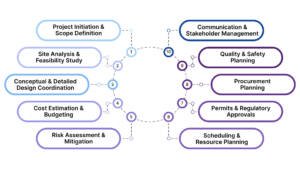
- Project level — the overall scope and objectives.
- Phase level — major stages such as design, procurement and construction.
- Deliverable level — the tangible outcomes required to complete each phase.
- Task level — the specific activities that produce those deliverables.
Three rules that make a WBS work
- The 100% rule. The WBS must encapsulate 100% of the project scope. Anything not in the WBS is not planned, not scheduled and not costed — and will appear later as a surprise.
- Mutually exclusive elements. Each element is distinct, with no overlap between branches. Overlapping elements produce double-counted cost and disputed progress.
- Measurable work packages. A common guideline is that terminal elements should represent roughly 8 to 80 hours of work — small enough that progress means something, large enough that tracking does not become micromanagement.
Sequencing and Dependencies
Once the work is broken down, the question becomes what must happen before what. Dependencies come from three sources, and confusing them is where schedules become unrealistic:
- Physical dependencies. Framing before first fix; slab before blockwork. These are non-negotiable.
- Resource dependencies. Two activities need the same crane, the same crew or the same work front. These are negotiable, but only by adding resource.
- Preferential dependencies. A sequence chosen for convenience or productivity rather than necessity. These are the ones to challenge when a schedule needs compressing.
A schedule that does not distinguish between them cannot be compressed intelligently, because nobody can tell which links are real.
Why the Structural Frame Drives the Critical Path
On most building projects the structure is the critical path for the majority of the construction programme, and everything else is planned around its rhythm. Three characteristics make it so.
The cycle time is the programme
A typical floor cycle — formwork, reinforcement, pour, cure, strike, move up — repeats identically for every level. On a tower, shaving a day off the floor cycle multiplies across every floor above it, which is why cycle time gets more planning attention than almost any other single number. Everything downstream, from envelope to fit-out, starts when the frame releases the floor.
Curing and stressing cannot be compressed
Concrete gains strength on its own schedule. Formwork cannot be struck before the concrete reaches the required strength, and post-tensioned elements cannot be stressed before the specified strength is achieved. These are the hardest durations in the whole schedule — they cannot be shortened by adding labour, only by changing the design, the mix or the temperature regime.
Steel erection sequence is a design output, not a site decision
For steel frames, the erection sequence is developed alongside the connection design: what is lifted in what order, what needs temporary bracing, where the crane stands, and how stability is maintained at every intermediate stage. Reinforcement detailing has the same property — a congested joint that cannot be assembled in the order the drawing implies becomes a schedule problem, not just a detailing one. Our guide to rebar detailing covers the buildability side of that.
Planning a project where the frame drives the programme?
AMC Engineer delivers coordinated LOD 300–500 BIM models across Architecture, Structure, MEP, Electrical, Infrastructure and Landscape — the coordinated model a realistic sequence has to be built on. Free LOD 200 sample from your own drawings in 24 hours.
Scheduling Methods and When to Use Each
| Method | What it does | Best for | Weakness |
|---|---|---|---|
| CPM Critical Path Method |
Identifies the longest sequence of dependent activities that determines project duration, and the float on everything else | The default for almost all projects; essential where dependencies are complex | Only as good as the logic behind it; a poorly linked network produces a meaningless critical path |
| PERT | Uses optimistic, likely and pessimistic estimates to analyse duration probabilistically | Projects with genuine duration uncertainty — novel methods, unfamiliar conditions | Heavier to build and maintain; overkill for routine work |
| Line of Balance LOB |
Synchronises production rates across repetitive units so crews flow without collision | Highly repetitive work — identical floors, housing units, long linear infrastructure | Poor fit for one-off, non-repetitive work |
| Q Scheduling | Location-based scheduling managing overlapping activities by quantity and work location | Projects where several trades occupy the same zones and interference is the main risk | Less widely supported by mainstream tools than CPM |
| Last Planner System LPS |
Commitment-based planning through master, phase and weekly work planning, focused on removing constraints | Collaborative delivery and lean environments; improving reliability of short-term commitments | Requires genuine buy-in; fails if imposed as paperwork |
| Resource-oriented | Sequences work around resource availability rather than pure logic | Constrained labour, plant or work-front availability | Can obscure the true critical path |
In practice most Gulf projects run CPM as the contractual schedule — usually in Primavera P6 — with LOB or location-based thinking applied inside repetitive packages, and lookahead planning layered on top for short-term control. Gantt charts are the presentation layer for all of them, not a method in themselves.
The Baseline Schedule
The baseline — the approved CPM schedule before construction starts — is the most important document the planning team will produce. Every future performance measurement, every delay claim and every recovery plan is measured against it.
A baseline that will stand up contains:
- Complete scope, traceable to the WBS, with nothing left out.
- Logic, not dates. Activities linked by real dependencies rather than constrained to fixed dates, so the network recalculates properly when something moves.
- Realistic durations, derived from productivity data and the actual working calendar — not from a default five-day week.
- Resource loading where the contract requires it.
- Procurement and approval activities included as real activities with real durations, not assumed away.
- A documented basis — the assumptions, productivity rates, calendars and exclusions the schedule was built on.
- Formal acceptance under the contract, with the acceptance recorded.
The Gulf Working Calendar
This is where international planning guidance stops being useful, and it is the section most likely to change your durations.
Summer outdoor work restrictions
Both Saudi Arabia and the UAE restrict outdoor work during specified midday hours across the peak summer months. The restriction is set by ministerial decision, applies to work under direct sun, and is enforced with penalties. For a project with substantial external works — structure, envelope, external services, landscaping — it removes a block of hours from the middle of every working day for a significant part of the year.
The planning consequences are direct:
- Activity durations for external work increase across the affected months, and a schedule using a single productivity rate all year is wrong for a third of it.
- Shift patterns change. Early starts and night working become the norm for external trades, which affects supervision, lighting, plant and inspection availability.
- Internal work is unaffected, which makes envelope completion a much more valuable milestone here than in a temperate climate — it converts restricted external work into unrestricted internal work.
Ramadan
Statutory working hours are reduced during Ramadan. Output per day falls, and the reduction applies across the whole project for a full month. A programme that treats Ramadan as an ordinary month will show an unexplained slip every year.
Eid holidays and public holidays
Both Eid al-Fitr and Eid al-Adha bring multi-day site shutdowns, and their dates move through the Gregorian calendar each year. Around them, labour mobilisation and demobilisation cost additional days at either end, particularly where a significant part of the workforce travels.
Hajj season and regional logistics
In Saudi Arabia, the Hajj period affects labour availability, road access and logistics in and around the affected regions. On projects in or near those areas it is a planning input, not a footnote.
The working week itself
Saudi Arabia works a Sunday to Thursday week. UAE federal working moved to a Monday to Friday pattern in 2022, with private sector practice varying. Where a project team spans both countries, or is supported from outside the region, the common working days between any two parties can be fewer than five — which affects review cycles, approvals and coordination meetings more than it affects site production.
Hot Weather Concreting and the Pour Window
A constraint that is structural, environmental and programme-critical at the same time, and one that no international planning guide addresses for this region.
Concrete placed at high ambient temperature loses workability faster, sets faster, and is at greater risk of plastic shrinkage cracking and reduced long-term strength. Specifications therefore commonly impose a maximum fresh concrete temperature at placement, and achieving it in a Gulf summer requires deliberate measures: chilled mixing water or ice, cooled aggregates, shading and cooling of the pour area, and admixtures that extend working time.
The planning consequences:
- Large pours move to night. Night pouring becomes standard for major slabs and rafts through the summer, which changes crew rosters, lighting, supervision, testing availability and plant scheduling.
- Batching plant capacity becomes a constraint when everyone in the city wants the same night window.
- Curing regimes are more onerous, and curing duration sits directly on the floor cycle.
- Pour size may be limited by the ability to place and finish within the working time available, which changes pour sequencing and construction joint positions — a structural decision with a programme consequence.
Sequencing depends on a model you can trust
We deliver federated, clash-checked LOD 300–500 models across all disciplines, so pour sequences, work fronts and access routes are planned against coordinated geometry rather than assumptions.
Procurement Lead Times as Schedule Inputs
On Gulf projects the schedule is frequently set by procurement rather than by production. Long-lead items — major MEP plant, switchgear, façade systems, lifts, specialist finishes — are predominantly imported, and the path from order to site has more steps than a temperate-market equivalent.
A realistic lead time models order to site, not order to port:
- Submittal preparation and consultant approval
- Order placement and manufacturing slot
- Manufacture
- Shipping
- Port arrival, customs clearance and, for regulated products, conformity registration
- Inland haulage to site — significant for inland projects
Teams that model steps 2 to 4 and treat the rest as noise routinely lose weeks per import package. The material side of this — quantities, suppliers, waste factors and conformity flags — belongs in the construction bill of materials, which is where required-on-site dates should originate.
Submittals and Approvals on the Critical Path
The most commonly under-planned activities on a Gulf project, because they are administrative and therefore feel like they should be fast.
- Shop drawing submittals run on a contractual review period and frequently take several cycles. Fabrication cannot start until they close, so for every fabricated package the submittal cycle sits ahead of production on the critical path. Our guide to shop drawings in construction covers the cycle and the review outcomes.
- Material submittals must close before orders are placed, which pushes them ahead of procurement lead time rather than alongside it.
- Authority approvals — municipal review, Civil Defence for fire-related packages, utility approvals — arrive after consultant review, so a package that only just cleared internal review has no float when the authority responds.
Build the submittal register backwards from the required-on-site dates, and show the review durations as real activities in the schedule with real predecessors. A schedule that assumes instantaneous approval is not optimistic; it is wrong.
Linking the Schedule to the Model: 4D
4D is the practice of attaching time to a coordinated 3D model: every modelled element is linked to an activity in the schedule, so the simulation shows the project building itself in the order it will actually be built.
How it is produced
Activities from the CPM schedule — typically Primavera P6 or MS Project — are linked to model elements or element sets, and the simulation is generated in a tool such as Navisworks or a dedicated 4D platform. The output is a time-scaled animation plus the ability to interrogate the model at any date.
What it actually finds
- Out-of-sequence work. Activities scheduled in an order that is physically impossible — the classic being an element scheduled before its support exists.
- Work-front collisions. Two trades scheduled in the same zone at the same time, which a Gantt chart cannot show because it has no spatial dimension.
- Site logistics problems. Crane coverage, access routes, laydown areas and temporary works competing with permanent work — particularly valuable on constrained urban sites.
- Phasing and occupancy issues on projects where part of the building stays in use during construction.
The prerequisite everyone skips
4D is only as good as the model it runs on. A simulation built on an uncoordinated model animates conflicts rather than revealing them, and the sequence it validates is one that cannot be built. The model should be coordinated and clash-checked before 4D linking starts — see our guides to BIM coordination and clash detection.
The second prerequisite is model structure. Elements have to be organised so they can be linked to activities at the right granularity — by zone, by level, by pour, by system. That is a modelling decision taken at setup, which is why 4D ambitions belong in the BIM Execution Plan rather than raised after the model is built.

Lookahead Planning and the Weekly Cycle
The CPM baseline governs the project. It does not govern next week. Short-term control comes from lookahead planning.
- The lookahead window — commonly three to six weeks — extracts the upcoming work from the master schedule at a level of detail crews can act on.
- Constraint removal is the actual work of the lookahead: identifying what would stop each activity starting — approval, material, access, information, labour, plant — and clearing it before the activity is due.
- Weekly work planning commits to what will be done, and the commitment is measured. Tracking the percentage of planned activities actually completed is what turns planning into a feedback loop rather than a forecast.
- The update cycle feeds actual progress back into the master schedule on a fixed cadence, so the critical path reflects reality rather than intent.
Delay, Float and Claims
Most substantial contracts in Saudi Arabia and the UAE are based on a FIDIC form with amended particular conditions, and the schedule is the primary evidence in any time-related dispute.
Three things determine whether a delay position is arguable:
- An accepted baseline with a documented basis. Without it there is nothing to measure against.
- Regular, contemporaneous updates. A schedule updated retrospectively when a claim arises carries far less weight than one updated on cadence throughout.
- Records that tie cause to effect — the submittal register, the correspondence, the coordination log, the site records. A delay shown in a schedule but not evidenced in records is an assertion.
Float ownership is a recurring flashpoint: whether float belongs to the contractor, the employer or the project is a contractual question that the particular conditions frequently address explicitly, and assumptions about it cause disputes.
Seven Planning Failures
| Failure | What it causes | The fix |
|---|---|---|
| A calendar built on a five-day temperate year | An unexplained slip every summer and every Ramadan | Build the project calendar from current official work-restriction and holiday announcements |
| Approvals assumed to be instantaneous | Fabrication starts late on every package | Model submittal and review durations as real activities with predecessors |
| Lead time modelled as order to port | Weeks lost per import package at clearance and haulage | Model order to site, including conformity registration and inland transport |
| Date constraints instead of logic | The network stops recalculating; the critical path becomes fiction | Link activities by real dependencies; use constraints sparingly and document them |
| WBS mirroring the drawing set | Activities that cannot be handed to a crew or measured | Structure the WBS by zone, level and trade package |
| 4D run on an uncoordinated model | A simulation that validates a sequence which cannot be built | Coordinate and clash-check before linking the schedule |
| No documented basis of schedule | No defensible position when the programme is challenged | Record calendar, productivity rates, lead times and exclusions at baseline |
Frequently Asked Questions
What is construction planning?
Construction planning is the discipline of defining what will be built and how the project will be executed — scope, budget, resources, risk and communication. Its main outputs are a work breakdown structure, an execution approach and a resource plan. Scheduling is a component of it that maps activities to a timeline using critical path logic.
What is the difference between construction planning and scheduling?
Planning answers what work needs to be done, how it will be done and what resources are required. Scheduling answers when each activity happens, in what order, and what the critical path is. Planning is the broader discipline; the schedule is the timeline that implements it.
What is a work breakdown structure?
A hierarchical decomposition of the project into manageable pieces, typically across four levels: project, phase, deliverable and task. It must cover 100% of the scope, its elements must be mutually exclusive, and terminal work packages should be small enough to measure meaningfully — a common guideline is 8 to 80 hours of work.
Which scheduling method should be used?
CPM is the default for almost all projects and is normally the contractual schedule. Line of Balance suits highly repetitive work such as identical floors or housing units. Q Scheduling suits location-based problems where trades interfere in shared zones. PERT suits genuine duration uncertainty. Last Planner suits collaborative environments and short-term reliability. Most Gulf projects run CPM with location-based thinking inside repetitive packages.
Why is the baseline schedule so important?
Because every future performance measurement, delay claim and recovery plan is measured against it. A baseline needs complete scope, logic rather than date constraints, realistic durations built on the actual working calendar, procurement and approval activities included, and a written basis recording the assumptions it was built on.
How do summer work restrictions affect a construction schedule?
Both Saudi Arabia and the UAE restrict outdoor work during specified midday hours across the peak summer months, set by ministerial decision. That removes hours from every working day for external trades over a significant part of the year, increases activity durations for external work, and pushes teams toward early starts and night working. Internal work is unaffected, which makes envelope completion a far more valuable milestone here than in a temperate climate.
Does Ramadan need to be planned for separately?
Yes. Statutory working hours are reduced during Ramadan, so daily output falls across the whole project for a month, and the dates move through the Gregorian calendar each year. A programme that treats it as an ordinary month will show an unexplained slip annually. Eid holidays either side add multi-day shutdowns plus mobilisation and demobilisation time.
Why do large concrete pours move to night in the Gulf?
Because specifications commonly limit the temperature of fresh concrete at placement, and meeting that limit in summer daytime conditions is difficult. Night pouring, combined with chilled water or ice, cooled aggregates and retarding admixtures, is standard practice for major pours. It changes crew rosters, lighting, supervision, testing availability and batching plant scheduling, and it affects pour size and construction joint positions.
How should procurement lead times be modelled?
As order to site, not order to port. A realistic lead time includes submittal preparation and approval, order placement and manufacturing slot, manufacture, shipping, port arrival and customs clearance, conformity registration for regulated products, and inland haulage. Teams that model only manufacture and shipping routinely lose weeks per import package.
What is 4D BIM?
4D BIM links schedule activities to elements in a coordinated 3D model so the construction sequence can be simulated over time. It reveals out-of-sequence work, work-front collisions between trades, site logistics problems such as crane coverage and access, and phasing issues — none of which a Gantt chart can show, because a Gantt chart has no spatial dimension.
What is needed before 4D simulation can be useful?
A coordinated, clash-checked model, and a model structured so elements can be linked to activities at the right granularity — by zone, level, pour or system. A 4D simulation built on an uncoordinated model animates conflicts rather than revealing them, and validates a sequence that cannot actually be built.
What makes a delay claim defensible?
An accepted baseline with a documented basis, contemporaneous schedule updates on a fixed cadence rather than retrospective ones, and records that tie cause to effect — the submittal register, correspondence, coordination log and site records. Entitlement, float ownership and the required analysis method are determined by the contract, so take specialist advice on anything with real exposure.
Conclusion
The fundamentals of construction planning are the same everywhere: break the scope down properly, sequence it by real dependencies, build the schedule on logic rather than dates, and measure against a documented baseline.
What differs in Saudi Arabia and the UAE is the calendar the whole thing sits on. Summer work restrictions remove hours from every day for external trades. Ramadan reduces output across the project for a month. Concrete temperature limits push major pours into the night and change the floor cycle. Import lead times run longer than the manufacture-plus-shipping figure suggests. None of that appears in international planning guidance, and a baseline built without it is wrong on the day it is issued. Build the calendar from the current official announcements, model approvals and procurement as real activities, and validate the sequence against a coordinated model before you commit to it.
Let’s make sure the sequence you plan is one you can build.
AMC Engineer delivers federated LOD 300–500 BIM modelling, clash detection and construction documentation for contractors, consultants and developers across Saudi Arabia and the UAE — the coordinated basis a 4D sequence and a realistic programme depend on.