Let’s Fix the Terminology First
BIM maturity levels (0–3) describe how collaboratively an organization or project uses BIM. Level 0 is unmanaged CAD, Level 2 is collaborative working with shared models, Level 3 is full integration. This scale stops at 3 — there is no “BIM Level 500” in the maturity framework.
Level of Development / Level of Detail (LOD 100–500) describes how reliable and detailed a single model element is. This is the scale that actually includes 500.
So when people search “BIM Level 500,” they almost always mean LOD 500 — the highest point on the Level of Development scale. We’ll use the correct term, LOD 500, from here on, while keeping the popular phrasing in mind since that’s how most people search for it.
The LOD Scale: From Concept to As-Built
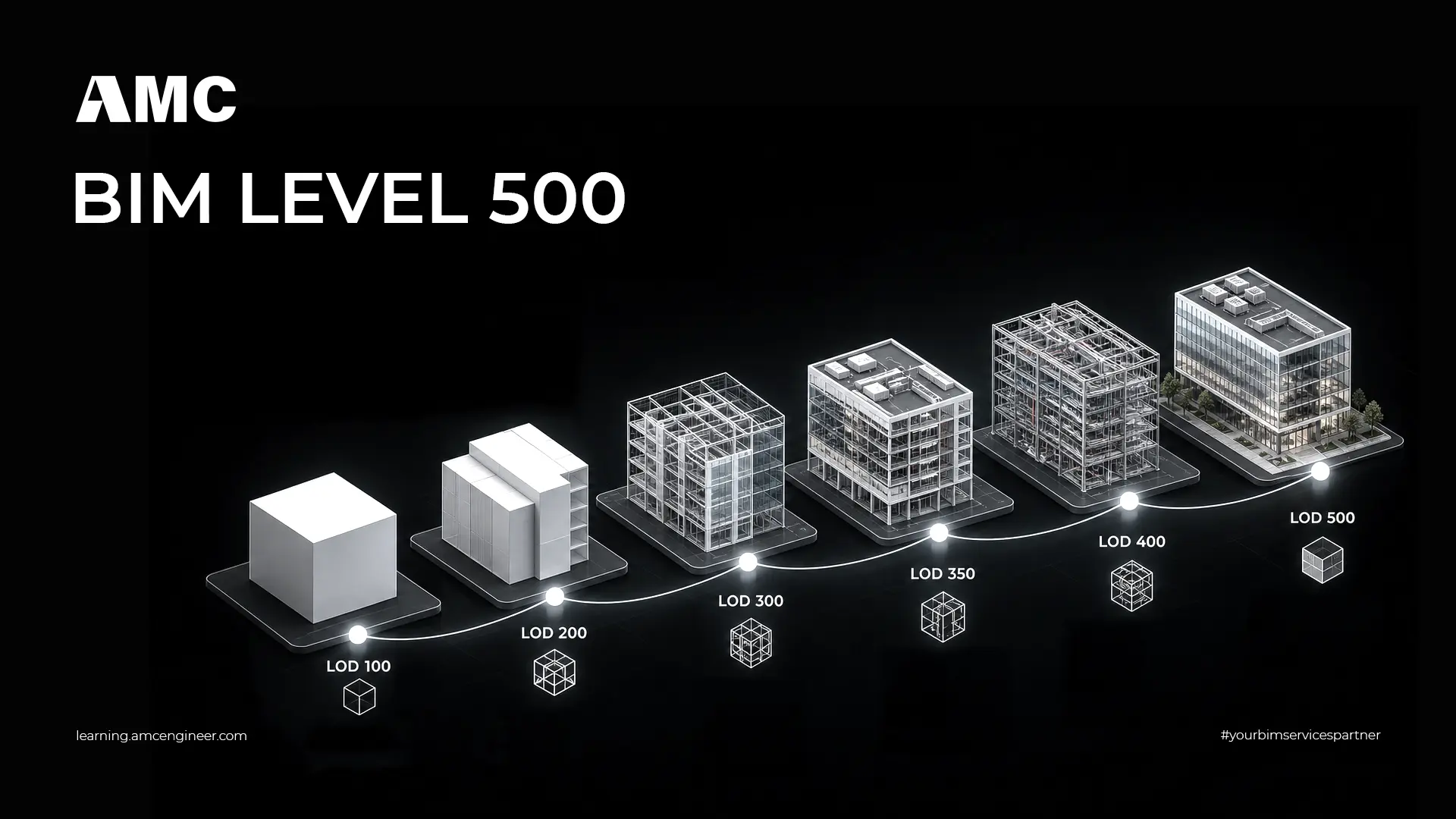
The Level of Development framework, formalized by the American Institute of Architects (AIA) and maintained today by BIMForum, defines how much you can rely on a model element at each stage.
| LOD | What It Represents |
|---|---|
| LOD 100 | Conceptual — a basic symbol or massing, no precise geometry |
| LOD 200 | Approximate geometry — a generic placeholder with rough size and location |
| LOD 300 | Precise geometry — accurate size, shape, and location |
| LOD 350 | LOD 300 plus interfaces and connections to other elements |
| LOD 400 | Fabrication and assembly detail — ready for manufacturing and installation |
| LOD 500 | Field-verified, as-built representation |
From LOD 100 to LOD 400, each step adds more geometric and informational detail tied to design and construction intent. LOD 500 is different in kind, not just degree — it’s the only level defined by verification against the finished building rather than by how much was drawn.
What BIM Level 500 (LOD 500) Actually Means
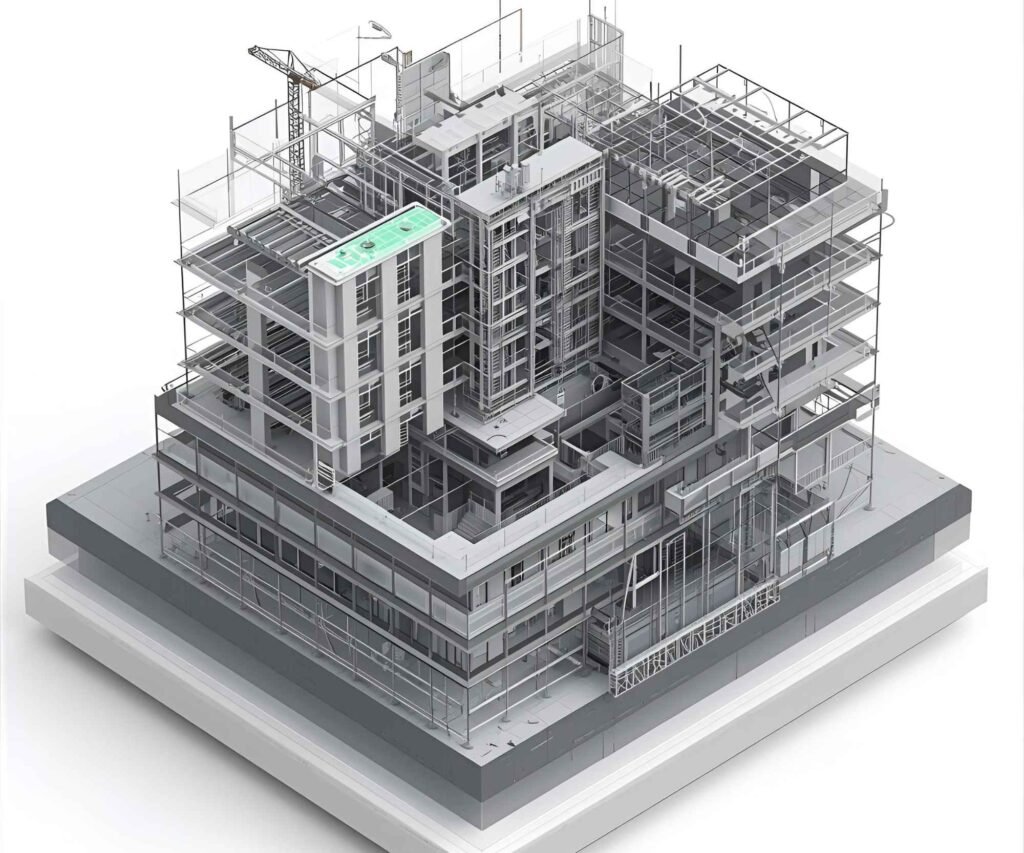
LOD 500 is not about more detail — it’s about verification. A model element at LOD 500 is a field-verified representation of what was actually built, confirmed on site for size, shape, location, quantity, and orientation. It reflects reality, not design or fabrication intent. That’s why LOD 500 is so often equated with the as-built model.
Put simply:
- LOD 400 says: “This is how the component should be fabricated and installed.”
- LOD 500 says: “This is the component as it truly exists in the finished building — we checked.”
That verification step — surveying, measuring, confirming actual conditions — is what separates a genuine LOD 500 element from a highly detailed design model. A model can be visually rich and still fail to qualify as LOD 500 if no one has confirmed it matches the real building.
LOD 500 vs. As-Built: Is There a Real Difference?
This is one of the most debated points in BIM. In practice, LOD 500 and “as-built” are used almost interchangeably — both describe a model verified against the constructed facility. Some practitioners draw a finer line: LOD 500 specifically implies field-verified elements, while “as-built” sometimes gets used more loosely, capturing redlines and change markups without full verification.
Practical takeaway: if you’re commissioning an LOD 500 model, define exactly what verification you expect — which elements, to what tolerance, confirmed by whom. The label alone doesn’t guarantee the rigor you might assume; that has to be written into the BIM Execution Plan or scope of work.
Why BIM Level 500 Matters for Facility Management
This is where LOD 500 stops being academic and starts saving money. The biggest beneficiary of a field-verified as-built model is the operation and maintenance (O&M) phase — the longest stretch of a building’s life.
When a facility management team inherits an accurate LOD 500 model, they get a reliable digital twin of the building as it really stands. Linked to a [INTERNAL LINK: facility management platform service page], that model lets them:
- Locate any component visually and confirm it actually exists where the model says it does.
- Retrieve verified specifications, dimensions, and materials without second-guessing whether the model matches reality.
- Attach manuals, warranties, and maintenance records to elements they can trust.
- Plan preventive maintenance and work orders on accurate, current data.
Published research backs this up directly. A 2023 study in E3S Web of Conferences documented an as-built BIM model of a school building — architectural, plumbing, HVAC, and fire protection systems modeled to match how the facility was actually constructed, then connected to an FM platform. The accuracy of that as-built data was exactly what made the model useful: a facility manager could find the type and dimensions of a failed door, window, or piece of equipment directly, without digging through paper records. (See note above — please verify and link the exact source before publishing.) That’s the LOD 500 promise in action.
BIM Level 500 in Saudi Arabia, the UAE, and Egypt: Regional Outlook
Demand for field-verified, as-built models is rising fast across the region — though the regulatory picture differs by country.
United Arab Emirates
Since January 1, 2024, Dubai Municipality has required a 3D BIM submission for a wide range of planning applications: architectural BIM for buildings over 20 floors or developments over 20,000 m², structural BIM for buildings over 40 floors or developments over 30,000 m², plus all hospitals, universities, and government projects (Global Construction Review; Tecon). That mandate covers design-stage BIM — it doesn’t explicitly require LOD 500 — but owners of large or safety-critical assets increasingly ask for a field-verified as-built model at handover specifically to support FM.
Saudi Arabia
There’s no single nationwide BIM mandate yet, but Vision 2030’s giga-projects — NEOM and similar developments — are driving heavy adoption of BIM, IoT, and digital-twin technology as part of the Kingdom’s broader push into smart, sustainably operated assets. With the Saudi construction market projected to grow from roughly USD 104.76 billion (2024) to USD 174.37 billion by 2030, master developers on these long-horizon projects are increasingly specifying LOD 500 handover models contractually, even without a formal national rule requiring it.
Egypt
Egypt doesn’t currently mandate BIM at a national level either, but adoption is building, particularly on large state-backed developments like the New Administrative Capital. Industry research has called for BIM to become a core technological pillar of Egypt’s sustainable construction strategy, and as more state and private projects move toward long-term facility management, demand for verified as-built handover data is following the same trajectory seen in the UAE and Saudi Arabia.
The pattern across all three markets: mandate or not, LOD 500 is becoming a competitive differentiator for consultants and contractors bidding on state-backed and giga-projects, simply because owners want a building they can actually operate from day one.
When You Actually Need LOD 500
LOD 500 is powerful, but it isn’t free — getting there requires field surveys and verification effort. It pays to be selective.
You likely need LOD 500 when:
- You’re handing over a building for long-term facility and asset management.
- You’re creating an as-built record for renovation, retrofit, or future expansion.
- You manage safety-critical systems (fire protection, MEP) where accuracy is non-negotiable.
- You operate a portfolio where a reliable digital twin reduces operating costs over decades.
You probably don’t need it when:
- You’re still in early design — LOD 100–300 is appropriate there.
- The element is non-critical and changes frequently.
- The cost of field verification outweighs the operational benefit.
Smart project teams specify LOD per element, not per whole model. The structural frame and major MEP equipment might warrant LOD 500, while minor finishes don’t.
Common Misconceptions About BIM Level 500
Myth: “LOD 500 just means a really detailed model.” Reality: it means a verified model. Detail without verification isn’t LOD 500.
Myth: “LOD 500 includes all maintenance data automatically.” Reality: not inherently. LOD describes element reliability; facility data (manuals, warranties, schedules) is attached separately — sometimes informally called 6D BIM.
Myth: “Every project should aim for LOD 500.” Reality: inefficient. LOD should match the use case for each element, not be maximized everywhere by default.
Myth: “BIM Level 500 is part of the BIM maturity levels.” Reality: no — maturity levels stop at 3. LOD 500 belongs to the separate Level of Development scale.
How to Achieve a Reliable LOD 500 Model
Getting to a genuine LOD 500 model typically involves five steps:
- Define requirements early in the BIM Execution Plan — specify which elements need LOD 500 and the verification method.
- Capture actual conditions through field surveys, laser scanning, or point clouds.
- Update the model to reflect verified real-world geometry and attributes.
- Confirm and document that elements match the built facility.
- Hand over the verified model to the owner or FM team, ideally linked to a [INTERNAL LINK: facility management platform service page].
Conclusion
The buzz around BIM Level 500 makes more sense once you see what it really is: not the most decorated model, but the most trustworthy one — an as-built digital twin verified against the real building. That trustworthiness is exactly what makes LOD 500 so valuable for facility management, where accurate information drives lower costs, smarter decisions, and longer asset life.
So next time someone promises you a “Level 500 model,” ask the real question: has it been field-verified? In BIM, verified reality — not raw detail — is what delivers value.
FAQ About BIM Level 500
What is BIM Level 500?
“BIM Level 500” almost always refers to LOD 500 (Level of Development 500), the highest level on the LOD scale. It represents a field-verified, as-built model element confirmed to match the real building in size, shape, location, quantity, and orientation.
Is LOD 500 the same as an as-built model?
They’re closely related and often used interchangeably. LOD 500 specifically emphasizes field verification, while “as-built” is sometimes used more loosely. Both describe a model that reflects the building as actually constructed.
Does BIM Level 500 mean the most detailed model?
Not exactly. LOD 500 is about verified accuracy, not maximum geometric detail. A model can be highly detailed yet not qualify as LOD 500 if it hasn’t been verified against real conditions.
Why is LOD 500 important for facility management?
Because it gives facility teams a trustworthy as-built digital twin. Linked to an FM platform, it lets them locate components, access verified data, and plan maintenance confidently — reducing costs across the building’s operational life.
What’s the difference between BIM maturity levels and LOD 500?
BIM maturity levels (0–3) describe how collaboratively BIM is used on a project. LOD 500 belongs to a separate scale (LOD 100–500) describing the reliability of individual model elements. There is no “Level 500” in the maturity framework.
What are the key features of BIM Level 500?
Three things define an LOD 500 element: it’s been physically verified on site (not just modeled), it matches the real building in size, shape, location, quantity, and orientation, and it represents current as-built condition rather than design or fabrication intent.
How do you create as-built models that meet LOD 500 standards?
Define which elements need LOD 500 and how they’ll be verified in the BIM Execution Plan, capture real conditions with field surveys or laser scanning, update the model to match what was actually built, document the verification, and hand the model over linked to an FM platform.
What are the benefits of using BIM Level 500 for project management?
Beyond facility management, a verified LOD 500 model reduces disputes at handover (because there’s an agreed record of what was actually built), speeds up renovation and retrofit planning, and gives owners a defensible baseline for warranty claims and future capital planning.