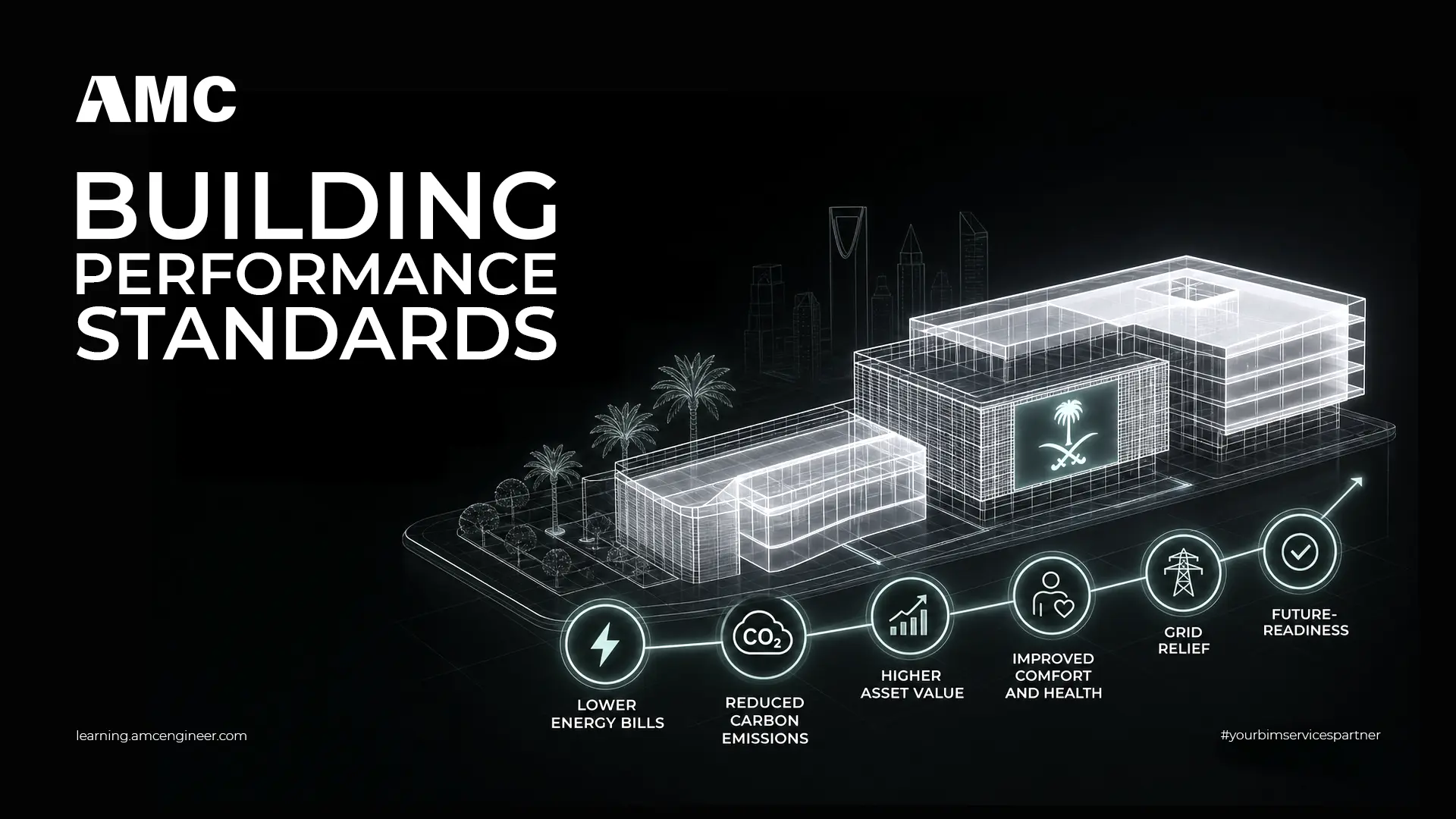
Buildings consume a large share of the world’s energy and produce a significant portion of its carbon emissions — and in a hot climate like Saudi Arabia’s, where cooling drives enormous electricity demand, the stakes are even higher. Building Performance Standards (BPS) are the policy tool designed to close one specific gap: improving the energy and carbon performance of buildings that are already standing, not just the new ones being designed today.
This guide explains what BPS are, how they work, their benefits and compliance requirements, the role they play in cutting emissions, and how they relate to Saudi Arabia’s own building-efficiency framework.
Key takeaways
- BPS set measurable energy or carbon targets for existing buildings—codes mostly govern new construction, leaving a gap BPS are designed to fill.
- Saudi Arabia pursues the same outcome through its own framework: the Saudi Building Code’s energy provisions (SBC 601/602), the Saudi Energy Efficiency Center (SEEC), and the Mostadam green-building rating system.
- The buildings sector accounts for roughly 30% of Saudi Arabia’s total primary energy consumption, making existing-building performance a major lever for the Kingdom’s net-zero-by-2060 target.
- Internationally, BPS programs carry real financial teeth — from per-ton carbon fines in New York to per-square-foot penalties in Washington, DC—and more than 40 US cities will have one in place by 2026.
- Improving performance follows a repeatable cycle: benchmark, audit, prioritize, upgrade, monitor, repeat.
What Are Building Performance Standards?
Building performance standards are policies that set measurable energy or carbon-emissions performance targets for existing buildings, requiring them to meet—and progressively improve toward—those targets over time. Unlike a one-time design requirement, a BPS applies throughout a building’s operating life, pushing owners to continually reduce energy use and emissions.
As a distinct regulatory model, BPS are most developed internationally—particularly across a growing list of US cities and states. New York’s Local Law 97 caps carbon emissions for buildings over 25,000 sq ft, with penalties of roughly $268 per metric ton of CO2 over the cap; Washington DC’s BEPS ties compliance to a minimum ENERGY STAR score, with penalty exposure up to $10 per square foot; Boston’s BERDO 2.0 has levied $1,000-per-day fines on non-compliant buildings over 35,000 sq ft since 2025. More than 40 US cities are expected to have an active BPS by 2026.
Saudi Arabia pursues building energy performance through its own framework rather than a single law called “BPS”: the energy conservation requirements of the Saudi Building Code (SBC 601 for commercial buildings, SBC 602 for residential), the Saudi Energy Efficiency Center (SEEC), minimum energy performance standards for equipment, and the Mostadam green-building rating system — all aligned with Vision 2030 and the Kingdom’s net-zero-by-2060 ambition. Understanding the BPS approach helps Saudi owners prepare for where building-efficiency expectations are clearly heading, and the financial exposure international peers have already faced for non-compliance is a useful preview of what tightening standards can mean.
Why Existing Buildings Are the Real Target
This is the defining feature of BPS and what sets them apart from conventional building codes. Codes mostly govern new construction and major renovations — they shape a building at the moment it is designed and built. Once a building is complete, codes have little ongoing influence over how it performs.
BPS fill that gap by regulating the existing building stock. Most of the buildings that will exist a decade from now have already been built, so improving only new construction cannot meaningfully cut a country’s building-related energy use and emissions. By setting performance targets that existing buildings must meet over successive compliance periods, BPS drive retrofits and operational improvements across the buildings already in use — exactly the segment Saudi Arabia’s own framework is increasingly turning its attention to as the building stock matures.
Building Performance Standards Technical Assistance
Performance targets alone are not enough — owners need support to meet them. Effective BPS programs are paired with technical assistance, typically including benchmarking tools to measure and compare a building’s energy use, guidance documents explaining requirements and compliance pathways, training and accredited service providers to carry out audits and retrofits, and financial incentives to help fund efficiency upgrades.
Saudi Arabia already offers comparable support. SEEC, established by a Council of Ministers decision in 2010, publishes guidance on energy efficiency requirements, operates a licensing scheme for energy efficiency service providers to ensure quality, and runs an Energy Use Intensity (EUI) platform that issues certificates and labels letting owners and buyers compare residential units by energy consumption. Given that buildings account for roughly 30% of Saudi Arabia’s total primary energy consumption, this infrastructure is a meaningful lever — and it makes it far easier for owners to understand and improve their buildings’ performance, often with BIM-based modeling used to simulate retrofit options before committing capital.
Benefits of Building Performance Standards
Improving building performance delivers wide-ranging benefits:
| Benefit | What It Means in Practice |
|---|---|
| Lower energy bills | More efficient buildings cost significantly less to operate — particularly valuable given the cooling loads of the Saudi climate |
| Reduced carbon emissions | Less energy use means a smaller carbon footprint |
| Higher asset value | Efficient, well-performing buildings are more attractive and command stronger value |
| Improved comfort and health | Better insulation, ventilation, and systems create more comfortable indoor environments |
| Grid relief | Lower peak demand reduces strain on the power network |
| Future-readiness | Buildings that perform well today are better positioned for tightening standards tomorrow |
For owners, the financial case is often compelling on its own — efficiency upgrades typically pay back through reduced operating costs over time, before any regulatory pressure even factors in.
Building Performance Standards Compliance Requirements
While specifics vary by jurisdiction, BPS compliance generally follows a recurring cycle:
| Step | What It Involves |
|---|---|
| 1. Benchmark and report | Measure and disclose the building’s energy use or emissions, often annually |
| 2. Meet performance targets | Usually expressed as energy use intensity (EUI, energy per square meter) or greenhouse-gas intensity, by set deadlines |
| 3. Improve over successive periods | Targets tighten over time, requiring ongoing investment |
| 4. Face enforcement | Penalties or fines apply to buildings that fail to comply |
In the Saudi context, the most direct compliance reference today is the Saudi Building Code’s energy conservation requirements (SBC 601/602), which set minimum prescriptive and performance-related provisions for energy-efficient buildings. Owners should treat strong energy performance not just as compliance, but as sound long-term asset strategy — the penalty regimes seen internationally show how quickly “optional” efficiency can become a hard requirement.
What Role Do BPS Play in Carbon Emission Reduction?
BPS are one of the most powerful tools available for cutting building-sector emissions, because they target the existing stock that codes cannot reach. Buildings account for a substantial share of energy-related carbon emissions, and the only way to reduce that share at scale is to improve the buildings already in operation — not just the new ones.
By requiring measurable, ongoing improvement, BPS drive the retrofits, system upgrades, and operational changes that steadily lower emissions over time. This aligns directly with Saudi Arabia’s climate commitments, including its target of reaching net zero by 2060 and the broader sustainability goals of Vision 2030. Decarbonizing the building stock is essential to meeting those targets, and improving existing-building performance is central to it.
Key Features of Building Performance Standards
Effective BPS share a set of common features:
| Feature | Why It Matters |
|---|---|
| Clear performance metrics | Typically energy use intensity (EUI) or greenhouse-gas intensity per unit area |
| Defined targets by type and use | Buildings are measured against realistic benchmarks for their category |
| Progressive tightening | Targets become more demanding over successive compliance periods |
| Regular benchmarking and reporting | Tracks performance transparently over time |
| Compliance timelines | Give owners time to plan and invest rather than scramble |
| Enforcement mechanisms | Ensure the standards have teeth and credibility |
| Flexibility pathways | Alternative routes to compliance, such as phased upgrades or credits |
Together, these features make performance measurable, accountable, and improvable over time.
How to Design a Useful Building Performance Standards
A well-designed BPS balances ambition with practicality. The most effective ones share several design principles:
- Realistic but ambitious targets. Goals must drive real improvement without being unachievable.
- Reliable data. Sound benchmarking and energy data underpin everything — you cannot manage what you do not measure.
- Phased timelines. Gradual tightening gives owners time to plan and finance upgrades.
- Strong support and incentives. Technical assistance and funding make compliance feasible, not just mandatory.
- Stakeholder engagement. Involving owners, operators, and industry produces standards that work in practice.
- Clear enforcement. Consistent, fair enforcement ensures credibility.
For Saudi owners, the practical takeaway is to expect performance expectations to rise — and to treat efficiency as an investment, not just an obligation.
Your Building Performance Standards Compliance Roadmap
For a building owner, improving performance is a manageable, step-by-step process:
| Step | Action |
|---|---|
| 1. Benchmark | Measure your building’s current energy use to establish a baseline |
| 2. Audit | Carry out an energy audit to identify where energy is wasted — envelope, cooling, lighting, controls |
| 3. Prioritize | Rank improvements by impact and payback, from quick wins to deeper retrofits |
| 4. Upgrade | Implement measures such as improved insulation, efficient HVAC, LED lighting, and smart building controls |
| 5. Monitor | Track performance to verify savings and maintain gains |
| 6. Report and repeat | Document results and continue improving over time |
This roadmap turns an abstract target into a concrete plan — and it is exactly where an experienced engineering partner adds the most value, particularly at the audit and upgrade stages where BIM-based retrofit modeling can flag the highest-impact changes before construction begins.
Make Building Performance Your Advantage
Building performance standards reflect a global shift: from building efficiently once to performing efficiently for life. In Saudi Arabia’s hot climate and ambitious sustainability landscape, improving how buildings actually perform delivers lower costs, reduced emissions, higher asset value, and readiness for tightening expectations. The owners who act early turn compliance into a genuine competitive advantage.
AMC Engineer helps building owners across Saudi Arabia assess, benchmark, and improve building performance—from energy audits and retrofit design to compliance with the Saudi Building Code’s energy requirements and Mostadam-aligned upgrades. Talk to our team about improving your building’s performance →
FAQs About Building Performance Standards
What are Building Performance Standards?
Policies that set measurable energy or carbon performance targets for existing buildings, requiring them to meet — and progressively improve toward — those targets over time.
How do BPS differ from building codes?
Building codes mainly govern new construction and major renovations. BPS regulate existing buildings throughout their operating life, driving ongoing improvement rather than a one-time compliance check.
Does Saudi Arabia have building performance standards?
Saudi Arabia addresses building energy performance through the Saudi Building Code (SBC 601/602), the Saudi Energy Efficiency Center, energy performance standards for equipment, and the Mostadam rating system, rather than a single law named “BPS.”
How can a building owner improve performance?
By benchmarking energy use, conducting an audit, prioritizing upgrades, implementing retrofits such as better insulation and efficient HVAC, and monitoring results over time — the same six-step cycle outlined above.
How does Saudi Arabia’s approach to building performance compare with neighboring Gulf markets?
Several Gulf markets run their own green-building and performance frameworks alongside Saudi Arabia’s — for example, Abu Dhabi’s Estidama program and Dubai’s green-building regulations. Rather than ranking these systems against one another, the more useful comparison for an owner is scope and fit: Saudi Arabia’s Mostadam rating system and SBC energy provisions are purpose-built for the Kingdom’s climate and regulatory environment, so a Saudi asset should be benchmarked against that framework specifically. Speak with AMC Engineer about how your building measures up.
What are the current energy efficiency requirements for new commercial buildings?
New commercial buildings in Saudi Arabia must meet SBC 601, the Saudi Energy Conservation Code’s commercial provisions — covering building-envelope insulation, window and door performance (U-factors and SHGC), HVAC and duct insulation, lighting power density, and water-heating efficiency. These are minimum national requirements enforced through the local building-permit process, including in Riyadh.
How can I improve indoor air quality in an existing building as part of a performance upgrade?
Indoor air quality and energy performance are closely linked: upgrading ventilation rates and filtration, improving controls so fresh-air systems run efficiently rather than wastefully, and sealing/insulating the envelope to reduce uncontrolled infiltration all improve comfort and air quality while also cutting energy use. These measures fit naturally into the audit-and-upgrade stages of the compliance roadmap above, rather than being a separate project.