
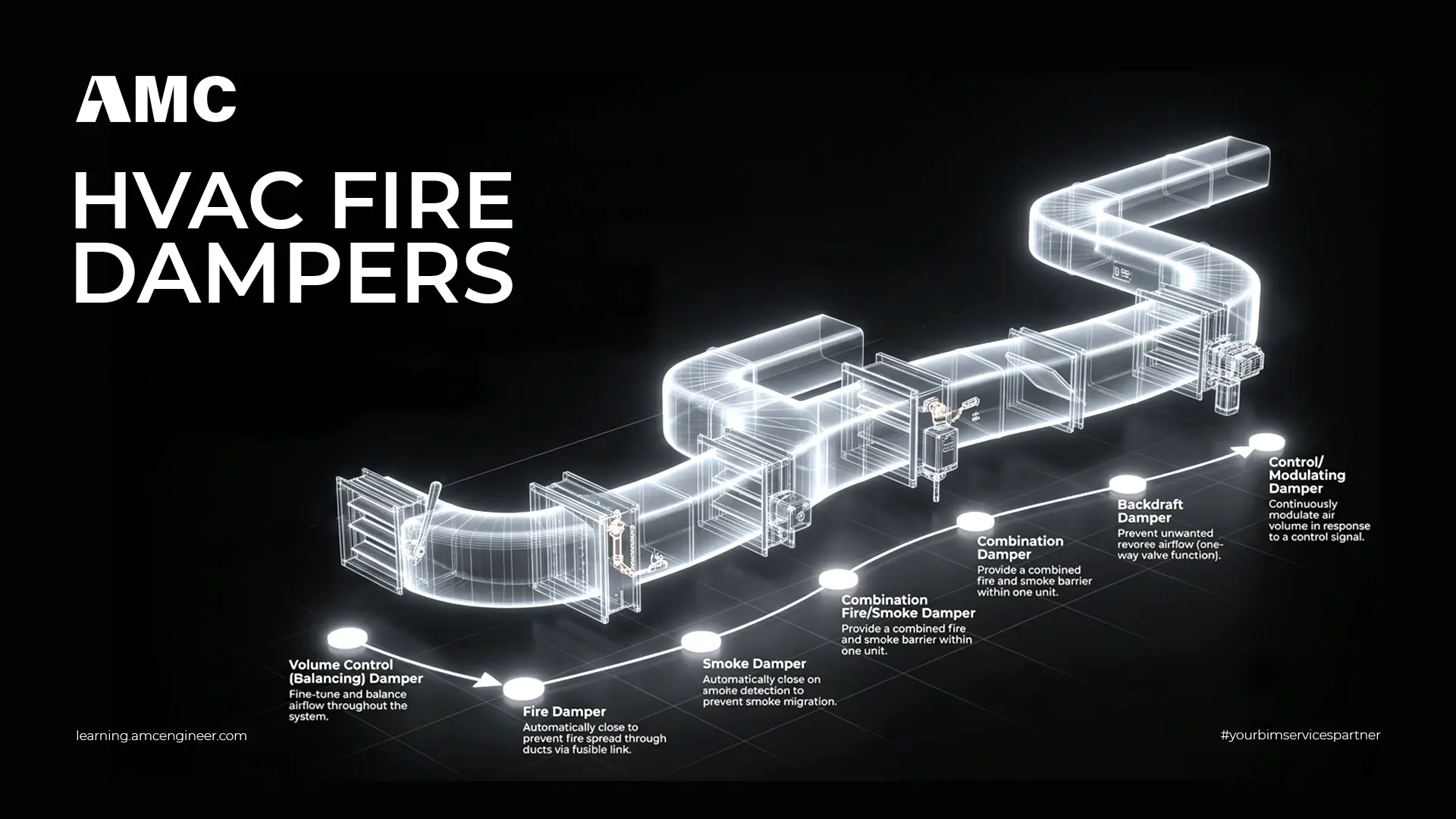
In any modern building, the same ductwork that delivers conditioned air can also become a hidden pathway for fire and smoke to spread between rooms and floors. HVAC fire dampers are the components that stop that from happening. As a critical part of a building’s passive fire protection — and of well-designed mechanical engineering services — these HVAC fire dampers seal off ductwork at the right moment to contain a fire and protect lives.
This guide explains what HVAC dampers are, why they matter, the main types, and how fire dampers in particular function and should be installed.
What Are HVAC Fire Dampers?
An HVAC damper is a movable plate or set of blades installed inside ductwork to control, regulate, or block the flow of air. By opening, closing, or adjusting their position, dampers manage how much air moves through a duct and where it goes.
Dampers are fundamental to any air-distribution system. Some balance airflow between different zones, some shut off air to unused areas, and some — like fire dampers — exist purely for safety, staying open during normal operation and closing only when needed. They can be operated manually, automatically by motorized actuators, or mechanically by a triggering device such as a fusible link.
Why HVAC Fire Dampers Matter
Dampers play a bigger role than most people realize, affecting comfort, efficiency, and safety:
- Airflow control and comfort. Dampers balance air distribution so each space receives the right amount of conditioned air — important in the hot climates of the Gulf and Egypt, where cooling performance is critical.
- Energy efficiency. By directing air only where it is needed, dampers reduce wasted energy and operating cost.
- Zoning. They allow different areas of a building to be controlled independently.
- Fire and smoke safety. Fire and smoke dampers are a core part of a building’s passive fire protection, preventing the spread of fire and smoke through ducts.
In short, dampers are small components with an outsized impact on how well — and how safely — a building performs.
Main Types of HVAC Dampers
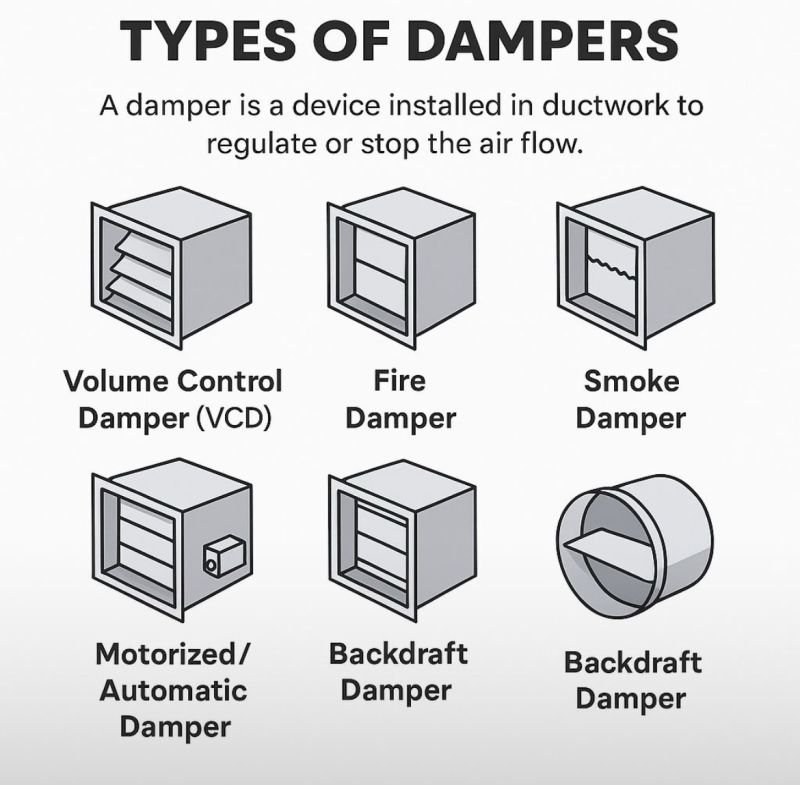
There are several types of dampers, each with a specific purpose:
- Volume control (balancing) dampers — adjust and balance airflow to different parts of the system.
- Fire dampers — close automatically to block the spread of fire through ducts that pass through fire-rated barriers.
- Smoke dampers — close to prevent smoke from moving through ductwork, often triggered by smoke detection.
- Combination fire/smoke dampers — perform both functions in a single unit where ducts penetrate barriers that resist both fire and smoke.
- Backdraft dampers — allow air to flow in one direction only, preventing unwanted reverse airflow.
- Control/modulating dampers — motorized dampers that adjust airflow automatically as part of the building’s controls.
Choosing and locating the right dampers is a key part of mechanical system design.
How Fire Dampers Work and Where They’re Installed
A fire damper is a passive fire protection device installed wherever ductwork or an air-transfer opening passes through a fire-rated wall, floor, or partition. Its job is to preserve the integrity of that fire barrier. A wall may be rated to resist fire for a set period, but a duct cutting straight through it would create a gap for flames to pass — unless a fire damper seals that opening when fire strikes.
Under normal conditions, the fire damper stays open and lets air flow freely. When a fire raises the temperature, the damper closes and blocks the duct, maintaining the fire-resistance rating of the barrier it sits in. Because of this role, fire dampers are located precisely at fire-barrier penetrations and must be installed strictly according to their listed instructions and the rating of the assembly. Their selection and placement should be coordinated during design, where the building’s fire compartments and duct routes intersect.
How Do HVAC Fire Dampers Work?
The operating principle of a typical fire damper is elegantly simple and reliable:
- Held open. During normal operation, the damper’s blades or curtain are held in the open position by a heat-sensitive fusible link.
- Heat triggers it. When a fire raises the air temperature in the duct to the link’s rated melting point (commonly around 74°C), the fusible link melts and releases.
- It closes. A spring mechanism then drives the damper’s curtain or blades shut, sealing the duct.
- Fire is contained. With the duct blocked, the damper stops fire from spreading through the barrier, helping confine it to one compartment.
Fire dampers come in static and dynamic types. Static dampers assume the HVAC system shuts down in a fire, while dynamic dampers are rated to close against moving air when the system continues running. Selecting the correct type for the system’s operating conditions is essential.
HVAC Fire Dampers Installation Considerations
Correct installation is what makes a fire damper actually work when it matters. Key considerations include:
- Correct location. Fire dampers must be placed exactly where ducts penetrate fire-rated walls, floors, or partitions.
- Listed installation method. They must be installed within a proper sleeve and mounting, following the manufacturer’s listed instructions and the assembly’s fire rating.
- Breakaway connections and clearances. Duct connections and expansion clearances must allow the damper to close freely and the system to behave correctly under heat.
- Correct orientation. Dampers are listed for specific orientations (vertical or horizontal) and must be installed accordingly.
- Access for inspection. Access doors are required so dampers can be inspected, tested, reset, and maintained.
- Code compliance. Installation must meet international standards — such as NFPA 90A and UL 555 (UL 555S for smoke dampers)—alongside the local authority in each market: the Saudi Building Code and Civil Defense requirements (Saudi Arabia), the UAE Fire and Life Safety Code of Practice issued by Civil Defence (UAE), and the Egyptian Code for fire protection under Civil Protection, which itself aligns with NFPA (Egypt).
- Periodic testing. NFPA 80 requires an operational test one year after installation, then every 4 years — and every 6 years in hospitals — to confirm dampers still close properly.
Getting these details right requires experienced mechanical engineering expertise, both in design and on site.
Protect Your Building With Properly Engineered Fire Dampers
HVAC fire dampers are a small but life-critical part of any building’s safety system. From selecting the right damper types to installing and testing them in full compliance with fire-safety standards, the quality of the engineering behind them directly affects how safe a building is. In markets with the scale and rising standards of Saudi Arabia, the UAE, and Egypt, that engineering cannot be left to chance.
AMC Engineer’s mechanical engineering services cover the design, specification, and coordination of HVAC and fire-protection systems across Saudi Arabia, the UAE, and Egypt — including fire and smoke dampers installed to international and local code. Talk to our mechanical engineering team about your next project.
FAQs about HVAC Fire Dampers
What are HVAC fire dampers?
A passive fire protection device installed where ductwork passes through a fire-rated barrier. It stays open normally and closes automatically in a fire to stop flames from spreading through the duct.
What are fire dampers used for in HVAC systems?
They preserve the fire-resistance rating of walls, floors, and partitions that ducts pass through. Without a fire damper, a duct penetration would leave an open path for flames; the damper seals that opening so the barrier keeps doing its job.
How do HVAC Fire Dampers close?
A heat-sensitive fusible link holds the damper open. When fire raises the temperature to the link’s rated point (commonly around 74°C), the link melts and a spring drives the damper shut, sealing the duct.
How do fire dampers contribute to building fire safety?
They are part of a building’s passive fire protection. By keeping fire and smoke from travelling through ductwork, they confine a fire to a single compartment, protect escape routes, and buy time for occupants to evacuate and for responders to act.
What is the difference between a fire damper and a smoke damper?
A fire damper blocks the spread of fire through ducts at fire-rated barriers; a smoke damper blocks the spread of smoke, often triggered by smoke detection. Combination dampers do both.
What are the UAE requirements for HVAC Fire Dampers installation?
In the UAE, fire dampers must comply with the UAE Fire and Life Safety Code of Practice issued by Civil Defence, alongside international listings such as UL 555. The code sets out where dampers are required at duct penetrations, listed installation methods, and inspection and testing obligations.
How often should fire dampers be tested?
NFPA 80 requires an operational test one year after installation, then every 4 years — and every 6 years in hospitals — to confirm they still operate correctly.