

In the construction and engineering industry, accurate cost estimation can make or break a project. At the heart of this process sits one essential document — the bill of quantities (BOQ). From the earliest stages of tendering to final project delivery, a well-prepared BOQ ensures that every stakeholder—clients, contractors, and consultants—speaks the same financial language
What Is a Bill of Quantities?
A bill of quantities (BOQ) is a detailed document used in the construction industry that itemizes all the materials, labor, and services required to complete a construction project, along with their estimated quantities and costs.
- It is typically prepared by a quantity surveyor or cost estimator during the pre-construction phase and is used as the basis for contractor tendering and project cost control.
- The BOQ translates architectural and engineering designs into measurable, priced line items, allowing multiple contractors to bid on the same project under identical conditions. This creates a fair, transparent, and competitive tendering process that protects both the client and the contractor.
- In large-scale infrastructure, commercial, or industrial projects, the BOQ can run into hundreds of pages—covering everything from earthworks and concrete to mechanical, electrical, and finishing works.
Importance & Purpose of Bill of Quantities
In highly competitive construction hubs like Riyadh, fair tendering and transparency are critical for both local contractors and international firms. A standardized BOQ framework ensures consistency in pricing, scope interpretation, and contract administration across all project stakeholders.
- Fair tendering: Provides all bidding contractors with the same scope of work, enabling accurate and comparable bids
- Cost control: Serves as the financial baseline against which actual project costs are measured throughout construction
- Contract administration: Forms the contractual basis for valuing completed work, variations, and payment certificates
- Dispute resolution: Provides a clear reference document when disagreements arise over scope, quantities, or pricing
- Budget planning: Helps clients and financiers understand the full cost of a project before committing to construction
- Procurement efficiency: Guides material and subcontractor procurement by clearly defining what is needed and when
- Progress monitoring: Allows project managers to track work completion against BOQ items and process interim payments accurately
Without a BOQ, construction projects rely on rough estimates that frequently lead to budget overruns, contractual disputes, and scope creep.
Composition of a Bill of Quantities
A standard BOQ is organized into clearly defined sections. Each section contains line items with the following fields:
- Item number: A sequential reference number for each work item
- Description of work: A detailed description of the task, material, or service—written in accordance with a standard method of measurement
- Unit of measure (UOM): The unit used to quantify the item—cubic meters (m³), square meters (m²), linear meters (m), kilograms (kg), or lump sum (LS)
- Quantity: The measured amount of work or material required
- Unit rate: The cost per unit of the item, filled in by the contractor during tendering
- Total amount: Quantity multiplied by the unit rate, giving the total cost for each line item
- Preliminary and general (P&G) section: Covers site setup, project management costs, temporary facilities, and contractor overhead.
- Summary / Grand total: A consolidated cost summary by trade or work section
A well-composed BOQ leaves no room for ambiguity—every item is described precisely enough that any contractor can price it consistently.
Types of Bill of Quantities
Different project types and procurement strategies call for different bill of quantities formats:
- Firm BOQ: Quantities are fully measured and fixed before tendering; contractors price exactly what is specified—the most common type for lump-sum contracts
- Approximate BOQ: Used when designs are not fully complete; quantities are estimated and subject to remeasurement during or after construction
- Elemental BOQ: Organized by building elements (foundations, walls, roof, finishes) rather than by trade—commonly used for cost planning and early-stage budgeting
- Trade BOQ: Organized by contractor trade (civil, structural, mechanical, electrical)—the standard format for detailed tender documentation
- Provisional BOQ: Includes provisional sums for work that cannot be fully defined at tender stage, such as specialist installations or contingency allowances
- Operational BOQ: Groups work items by the construction operation rather than by element or trade—less common but useful for highly repetitive structures
Selecting the right BOQ type depends on the project’s design stage, procurement method, and contract strategy.
Pro Tip: Preparing accurate BOQs starts with precise quantity takeoff — discover our professional Quantity Takeoff Services to ensure your measurements are BIM-accurate from day one.
How To Prepare a Bill of Quantities
Preparing an accurate bill of quantities is a step-by-step process. It needs technical knowledge, close attention to detail, and a solid understanding of construction methods. Here’s how it’s done step by step:
- Review design documents: Thoroughly study architectural drawings, structural designs, MEP (mechanical, electrical, plumbing) drawings, and project specifications
- Select a standard method of measurement: Use a recognized standard like POMI, CESMM, or the local Saudi Standard Method of Measurement (SSMM) commonly applied across major projects in the Kingdom.
- Divide the project into work sections: Organize the BOQ into logical sections—site preparation, substructure, superstructure, finishes, external works, etc.
- Take off quantities: Measure each item from the drawings using the rules of your chosen measurement standard. This is called a quantity takeoff
- Write item descriptions: Create clear, simple descriptions for each work item. Include the material specs, workmanship standards, and any related limits
- Compile the BOQ document: Put all sections into one clear document. Include item numbers, descriptions, units, and quantities. Leave the rate and amount columns blank for contractors to fill in
- Add preliminaries and preambles: Include the P&G section. Add preamble notes that clarify pricing assumptions, measurement rules, and contract conditions
- Review and validate: Ask a senior quantity surveyor or engineer to review the BOQ. Have them check for errors, omissions, and consistency before issuing it for tender
Common Mistakes & Challenges When Preparing a BOQ
Even experienced quantity surveyors encounter pitfalls during BOQ preparation. Being aware of these common mistakes helps you avoid them:
- Incomplete quantity takeoff: Missing items or work sections leads to underpriced tenders and budget shortfalls during construction
- Vague item descriptions: Ambiguous descriptions allow contractors to interpret items differently, resulting in inconsistent bids and disputes later
- Using inconsistent units: Mixing measurement units within the same section causes confusion and pricing errors
- Ignoring site conditions: Not allowing for hard ground, tight access, or demolition needs can lead to claims and changes
- Not updating the BOQ for design changes: Issuing BOQs from old drawings is a common and costly tendering mistake
- Underestimating preliminaries: Site overheads, mobilization costs, and temporary works are frequently undervalued, leaving contractors unable to recover their true costs
- Skipping the review stage: If you rush a bill of quantities without an internal review, errors will slip through. Those errors often appear later during construction and can be costly
What Should Be Included in a Bill of Quantities?
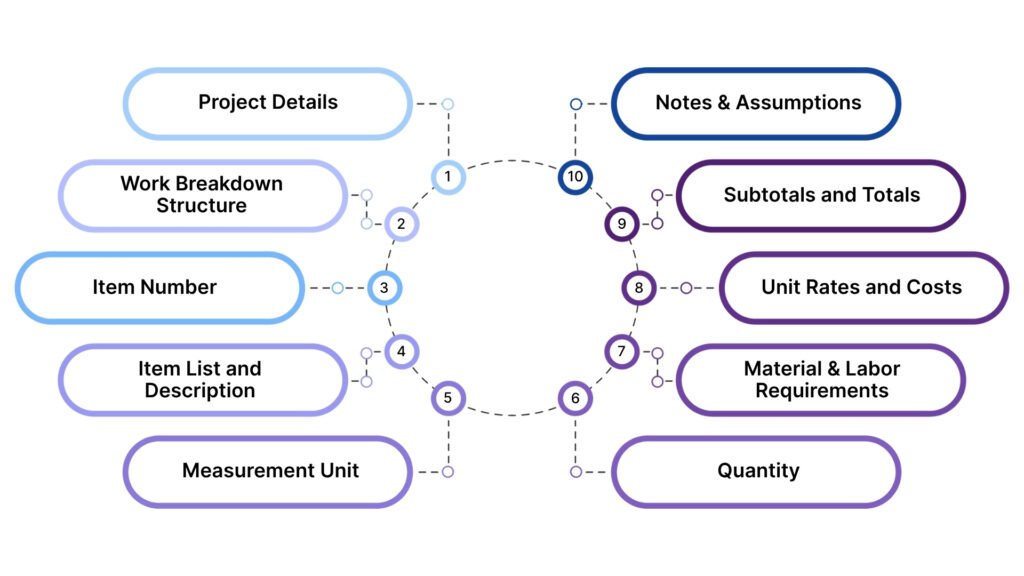
Purpose of bill of quantities in Construction Projects
Beyond tendering, the BOQ serves as a multi-functional tool throughout the entire construction project lifecycle:
- Pre-construction: Establishes the project budget and forms the basis of the contract sum
- During construction: Used to value monthly payment certificates, assess variations, and track cost performance against the budget
- Post-construction: Provides the basis for final account preparation, settling all financial matters between the client and contractor
- Dispute resolution: Acts as the contractual reference document for any claims related to scope, quantities, or pricing
- Benchmarking: Historical BOQs from completed projects serve as valuable benchmarks for estimating future similar projects
Why bill of quantities Is Important in Project Planning
- In project planning, the BOQ bridges the gap between design intent and financial reality. It pushes project teams to review every part of the project in detail before construction starts. This discipline often reduces surprises during execution.
- A fully priced BOQ also enables project managers to build a cash flow forecast, predicting when money will be spent throughout the project timeline. This is critical for both client financing and contractor resource planning. Furthermore, the BOQ supports value engineering. By reviewing each priced item, the team can find cheaper materials. They can also use different methods without reducing quality or performance.
- In multidisciplinary projects with civil, structural, and MEP work, the bill of quantities covers every trade. It helps ensure nothing is missed during planning and procurement.
How BIM Improves the Development Process of BOQ
In a BIM workflow, every element of the 3D model—walls, columns, beams, doors, windows, MEP components—carries embedded data, including dimensions, material specifications, and quantities.
Key ways BIM enhances bill of quantities development:
- Automated quantity takeoff: BIM tools like Autodesk Revit and Navisworks extract quantities directly from the model geometry, reducing manual measurement time by up to 80%
- Reduced errors: Model-based quantities remove common counting and math mistakes found in manual takeoffs from 2D drawings
- Real-time design change management: When the BIM model design updates, quantities update automatically. This ensures the BOQ always reflects the latest design intent
- 5D BIM integration: Linking BOQ line items to cost data in the BIM environment creates a dynamic 5D model. Design changes then instantly update their cost impact
- Clash detection before costing: Find and fix design clashes in Navisworks before preparing the BOQ. This helps avoid re-measuring after coordination changes
- Improved collaboration: All project stakeholders use the same quantity data in a Common Data Environment (CDE). This aligns designers, quantity surveyors, and contractors on the same information
- Better procurement planning: Accurate BIM-generated BOQs give procurement teams precise material quantities, enabling better supplier negotiations and reducing material waste on site
For engineering and construction firms that offer BIM services, delivering model-based BOQs is a key advantage. It gives clients more cost certainty and reduces financial risk across the project.
Conclusion
As construction investment continues to surge across Saudi Arabia, especially in commercial and infrastructure sectors around Riyadh, the demand for accurate, BIM-integrated BOQs is growing rapidly. Firms that master this process gain a clear competitive edge in delivering cost-efficient, transparent, and technologically aligned projects.
FAQ about bill of quantities
Q1:What is the main difference between a BOQ and a BOM?
A BOQ (Bill of Quantities) measures and prices work items like excavation volumes or concrete pours, while a BOM (Bill of Materials) lists specific physical materials like rebar quantities and bricks with procurement details.
Q2.Who prepares a Bill of Quantities?
Professional quantity surveyors or cost estimators typically prepare BOQs, using design drawings and standard measurement methods like CESMM or POMI.
Q3.How accurate should BOQ quantities be?
Firm BOQs aim for ±5-10% accuracy; approximate BOQs allow remeasurement with ±15-20% initial variance.
Q4.Can BIM software automatically generate BOQs?
Yes—Revit schedules, Navisworks quantification, and tools like Solibri extract automated BOQs directly from 3D models, updating in real-time with design changes.
Q5.What happens if design changes after BOQ issuance?
Changes trigger variations or remeasurements; BIM integration minimizes this by automatically recalculating affected quantities.
Q6.How long does BOQ preparation take?
2-6 weeks for medium projects, 2-3 months for complex high-rises, depending on design completeness and team experience.
Q7.Is a BOQ required for all construction projects?
Essential for competitive tendering and lump-sum contracts; smaller projects may use simplified material schedules instead.