BIM Construction Management in Saudi Arabia and the UAE: The Complete 2026 Guide
BIM construction management is the practice of running a project through a shared, data-rich model instead of disconnected drawings — so design, coordination, cost, scheduling, and facility handover all draw from one trusted source of truth. In Saudi Arabia and the UAE it has moved from nice-to-have to contractual baseline: Vision 2030 giga-projects, Dubai Municipality’s BIM mandate, and ISO 19650-aligned client requirements now make model-based delivery the default for any serious contractor in the Gulf. This guide explains how it actually works, what the regional rules require, and how to implement it without the common failures.
What this guide covers
- What BIM construction management is
- Why it matters in KSA and the UAE
- How the workflow works
- The BIM dimensions (3D–8D)
- LOD 100–500 in practice
- The real benefits
- Standards and compliance
- BIM construction management tools
- Handover, facility management, and digital twin
- Challenges and an adoption roadmap
- Frequently asked questions
What Is BIM Construction Management?
BIM construction management is the discipline of planning, coordinating, and delivering a built asset using an intelligent 3D model that carries data — geometry, materials, cost, time, and performance information — rather than relying on separate 2D drawings, spreadsheets, and email threads. The “management” part is the key distinction: BIM is not just modelling software, it is a process for controlling how project information is created, checked, shared, and handed over across every discipline and every stage.
The practical difference is the single source of truth. In a traditional workflow, the architect’s drawing, the structural model, the MEP layout, and the quantity surveyor’s take-off all live in different files that drift out of sync. In BIM construction management, those disciplines federate their models into one coordinated environment, so a change in one place is visible — and checkable — everywhere. That shared workspace is called a Common Data Environment (CDE), and it is the backbone that separates real BIM from “3D CAD with extra steps”.
It is worth stating what BIM is not. It is not simply Revit, and it is not a prettier rendering. A 3D CAD model shows shapes; a BIM model knows that a wall is a two-hour fire-rated partition made of a specific block, with a cost, a supplier, and a maintenance schedule attached. That embedded intelligence is what lets a project manager use the same model to detect clashes, price the job, sequence the site, and later operate the building.
Why BIM Construction Management Matters in Saudi Arabia and the UAE
Most global guides on this topic stop at generic benefits. In the Gulf, the more useful question is what the market actually requires of you. Here BIM is no longer optional for large and public projects — it is written into mandates, client requirements, and the delivery model of the region’s flagship programmes.
Saudi Arabia: Vision 2030 and the giga-project effect
Saudi Arabia’s pipeline is driven by Vision 2030 and its giga-projects — NEOM (including THE LINE and Oxagon), Qiddiya, Red Sea Global, and Diriyah Gate. These programmes are too large, too fast, and too complex to coordinate on drawings alone, so BIM is embedded in their contracts and information requirements. For contractors and consultants this creates a hard commercial reality: winning and delivering work on these programmes means demonstrating mature BIM capability, from a compliant BIM Execution Plan to structured model deliverables.
Alongside the giga-projects, the Saudi Building Code (SBC) and the Ministry of Municipal and Rural Affairs and Housing (MOMRAH) continue to raise the bar on documentation, quality, and lifecycle information — all of which BIM is designed to satisfy. Even where a blanket federal BIM law is still maturing, the practical effect on the ground is that serious Saudi clients now expect model-based delivery. AMC covers this in depth in Leading BIM in Saudi Arabia.
The UAE: a BIM mandate since 2013
The UAE was one of the earliest regional adopters to legislate BIM. Dubai Municipality’s Circular 196 (2013) mandated BIM for specific project types — including tall buildings, large-footprint developments, hospitals, universities, and government projects — and a 2015 expansion (Circular 207) widened that scope to more buildings at lower storey and area thresholds, government and semi-government works, and projects designed or built by international firms. In Abu Dhabi, the sustainability-driven Estidama Pearl Rating System reinforces the need for the structured, analysable information a BIM model provides.
The takeaway for any contractor operating in the Emirates is simple: on a large Dubai project, BIM is not a differentiator you offer — it is a compliance requirement you must meet before you can build.
Regulatory note. Mandates and thresholds change. Treat the Dubai circulars and Saudi requirements above as a framework, and always confirm the current information requirements for your specific project and authority. The constant across both markets is the same: model-based, standardised, checkable information.
How BIM Construction Management Works: The Workflow
BIM construction management runs as a continuous information loop rather than a one-time modelling exercise. A typical project flows through these stages:
- Information requirements and the BEP. The client’s Exchange Information Requirements (EIR) define what data is needed and when. The delivery team responds with a BIM Execution Plan (BEP) that sets standards, software, model structure, level of detail, and responsibilities.
- Modelling and authoring. Each discipline — architecture, structure, MEP — authors its own model to the agreed standards, so geometry and data are consistent from the start.
- Federation and coordination. Discipline models are combined and reviewed together, where clash detection and BIM coordination resolve conflicts on screen before they become expensive on site.
- 4D/5D integration. The coordinated model is linked to the programme (4D) and cost data (5D), giving the project manager a live, visual view of sequence and budget.
- Construction and site use. The model drives shop drawings, quantities, and site coordination, and is updated to reflect as-built conditions.
- Handover. A structured, data-complete as-built model is handed to the owner for operations — the start of the asset’s digital life.
For a step-by-step breakdown of each stage, see AMC’s BIM workflow process guide. Where an existing building or site must be captured accurately first, Scan to BIM turns reality-capture point clouds into a reliable model to start from.
The BIM Dimensions: From 3D to 8D
“Dimensions” describe the layers of information attached to a BIM model beyond geometry. Understanding them helps a project manager decide how far to take the model on a given job.
| Dimension | What it adds | Why it matters on a Gulf project |
|---|---|---|
| 3D | Coordinated geometry across disciplines | Visualisation and clash-free design |
| 4D | Time and construction sequencing | Programme control on fast-track giga-projects |
| 5D | Cost and quantities | Accurate budgeting and change control |
| 6D | Sustainability and energy performance | Supports Estidama, LEED, and Vision 2030 sustainability goals |
| 7D | Facility management data | Feeds operations and maintenance after handover |
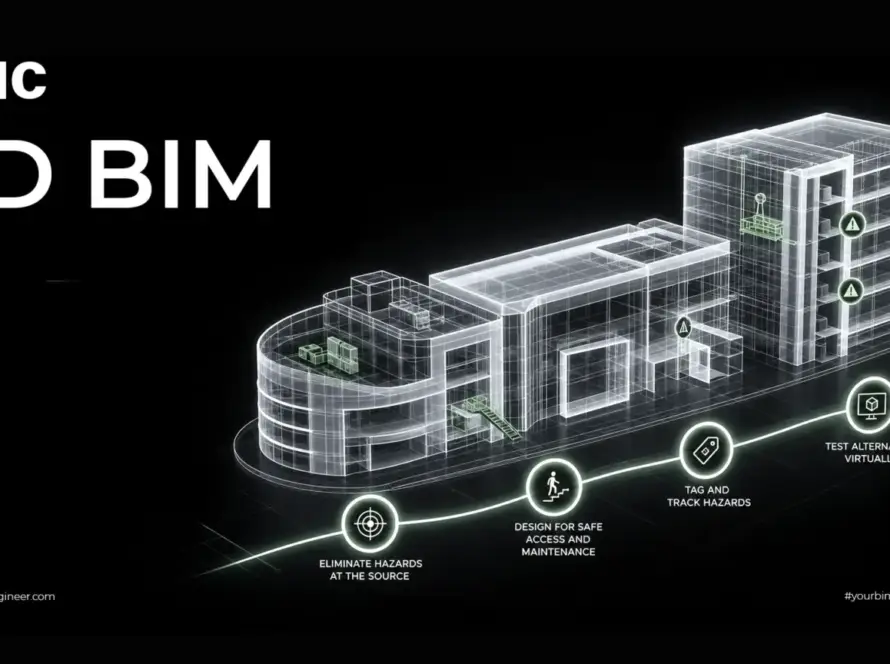
| 8D | Safety and risk information | Design-stage safety planning for complex sites |
LOD 100–500: How Much Detail, and When
One of the most misunderstood — and most important — parts of BIM construction management is Level of Development (LOD). LOD defines how reliable and detailed each element in the model is at a given stage, from LOD 100 (conceptual mass) to LOD 500 (verified, as-built). Specifying the wrong LOD is a leading cause of disputes: teams either over-model early, wasting time, or under-model late, leaving gaps at handover.
- LOD 100 — conceptual; overall mass, area, orientation.
- LOD 200 — approximate geometry, generic systems.
- LOD 300 — precise geometry suitable for coordination and documentation.
- LOD 350 — adds interfaces and connections between systems, critical for MEP coordination.
- LOD 400 — fabrication and assembly detail.
- LOD 500 — field-verified as-built, ready for facility management.
Getting LOD right is where regional contractors win or lose margin. AMC’s complete guide to LOD 100–500 breaks down exactly what to specify at each stage, and what LOD 500 really means for handover.
Need model-based delivery your Gulf client will actually accept?
AMC Engineering provides BIM modelling and coordination services built to KSA and UAE information requirements — from BEP to LOD 500 handover.
The Real Benefits — with Numbers
The generic benefit list (better collaboration, fewer errors) is true but forgettable. What matters to a project manager is where BIM protects money and time:
- Fewer clashes, fewer RFIs. Resolving MEP-versus-structure conflicts in the model instead of on site removes a major source of rework and change orders. On coordinated projects, clash detection routinely eliminates hundreds of physical conflicts before a single service is installed.
- Rework reduction. Industry studies consistently attribute double-digit reductions in rework to model-based coordination — directly protecting programme and budget on tight Gulf schedules.
- Cost certainty (5D). Quantities pulled from the model are faster and more consistent than manual take-offs, tightening the link between design changes and their cost impact.
- Programme control (4D). Visual sequencing exposes logistics conflicts on congested urban and giga-project sites before they cause delay.
- Lifecycle value. A data-complete model becomes an operations asset the day the building opens, not a stack of drawings that gets shelved.
Reality check. BIM does not deliver these numbers automatically. The savings come from disciplined coordination and a well-run CDE — not from opening Revit. The teams that under-invest in process see cost, not return.
Standards and Compliance: ISO 19650 and Local Frameworks
Standards are what separate a coordinated project from a chaotic one, and this is where most competing guides are thin. The global backbone is ISO 19650, the international standard for managing information over the whole life of a built asset. It defines how information is requested (EIR), planned (BEP), produced, checked, and delivered — the same vocabulary now used across Gulf client requirements.
For a full breakdown, see AMC’s guide to the ISO 19650 framework and the practical BIM standards that streamline delivery. In practice, a compliant project in KSA or the UAE layers three things: ISO 19650 as the process spine, the client’s own EIR, and the relevant local authority requirement (Dubai Municipality, MOMRAH, Estidama). Aligning all three in the BEP at the start is the single highest-leverage step in BIM construction management.
BIM Construction Management Tools
| Tool | Primary role | Best used for |
|---|---|---|
| Autodesk Revit | Model authoring | Architecture, structure, MEP modelling to LOD |
| Autodesk Navisworks | Federation and clash detection | Combining discipline models and running coordination |
| Autodesk Construction Cloud / BIM Collaborate | CDE and collaboration | Shared information environment and issue tracking |
| Bentley OpenBuildings / ProjectWise | Authoring and CDE | Infrastructure-heavy and large programmes |
| Trimble Tekla Structures | Structural detailing | Steel and concrete fabrication-level models |
| Solibri | Model checking and QA | Rule-based quality and compliance checking |
Tool choice matters less than process discipline. For a wider view of the technology stack driving projects today, see BIM construction technology.
From Handover to Operations: FM and Digital Twin
BIM construction management does not end at practical completion. The most valuable output of the whole process is a structured as-built model that the owner can operate the building with. That model feeds facility management — asset registers, maintenance schedules, spare-part data — turning a one-time construction deliverable into a long-term operational tool.
Increasingly, that model becomes a live digital twin: a continuously updated virtual counterpart of the building connected to real-time data. For owners of large Gulf assets, this is where BIM pays back over decades, through better construction asset management across the whole lifecycle. In a region building entire cities from scratch, the operational value of good handover data is enormous.
Challenges and a Practical Adoption Roadmap
The honest part most guides skip: BIM adoption fails when it is treated as a software purchase instead of a change in how a company works. The recurring obstacles — and how to handle them — are:
| Challenge | Practical response |
|---|---|
| Skills gap and resistance to change | Start with one pilot project, invest in training, and pair experienced BIM coordinators with site teams |
| No clear standards | Adopt ISO 19650 and lock a BEP before modelling begins |
| Interoperability between disciplines | Agree file formats (including IFC/openBIM) and a single CDE up front |
| Under- or over-modelling | Specify LOD explicitly per stage and per element |
| Upfront cost concern | Measure against rework and change-order savings, not licence cost alone |
A realistic roadmap for a Gulf contractor: run a single well-scoped pilot to build capability; standardise on ISO 19650 and a reusable BEP template; invest in coordinators and a proper CDE; then scale across projects once the process — not just the software — is proven.
Frequently Asked Questions
Is BIM mandatory in Saudi Arabia and the UAE?
In the UAE, Dubai Municipality has mandated BIM for defined project types since 2013 (Circular 196), with a 2015 expansion widening the scope. In Saudi Arabia, BIM is embedded contractually in Vision 2030 giga-projects and increasingly expected by major clients, even where a single blanket federal law is still developing. In practice, model-based delivery is the default for large and public projects in both markets.
What is the difference between BIM and 3D CAD?
3D CAD produces geometry — shapes and lines. BIM produces an intelligent model where each element carries data such as material, cost, fire rating, supplier, and maintenance information, and where all disciplines coordinate in a shared environment. BIM is a managed process, not just a drawing tool.
What does BIM construction management actually manage?
It manages the flow of project information: how models are authored to agreed standards, federated and coordinated, linked to time (4D) and cost (5D), used on site, and handed over as structured as-built data for operations — all from a single Common Data Environment.
What is LOD and why does it matter?
Level of Development (LOD 100–500) defines how detailed and reliable each model element is at a given stage. Specifying the correct LOD per stage prevents both wasted effort from over-modelling early and costly information gaps at handover — a frequent source of disputes.
Which standard governs BIM information management?
ISO 19650 is the international standard for managing information across an asset’s lifecycle. It defines how information is requested (EIR), planned (BEP), produced, checked, and delivered, and it underpins the client information requirements used across KSA and UAE projects.
Can smaller contractors adopt BIM, or is it only for giga-projects?
Smaller firms can and do adopt BIM successfully. The proven path is to start with one well-scoped pilot project, standardise on ISO 19650 with a reusable BEP, invest in coordination skills and a CDE, and scale once the process is working — rather than buying software and expecting results automatically.
The Bottom Line
BIM construction management is not defined by owning Revit or rendering a pretty model. It is defined by whether project information flows without breaking — from design intent, through coordination, into cost and programme, onto the site, and out the other side into operations. Every part of the process either serves that flow or is an expensive distraction.
For contractors and consultants across Saudi Arabia and the UAE, the commercial reality is straightforward: clients are increasingly specifying these capabilities contractually. The question is no longer whether to adopt BIM, but how to do it on a real project without absorbing the cost of learning on a live programme.
Ready to make BIM your competitive edge in KSA and the UAE?
From a compliant BIM Execution Plan to fully coordinated LOD 500 handover models, AMC Engineering delivers BIM construction management built for the Saudi and Emirati market.