A digital twin is not a better BIM model. It is a virtual replica of a physical asset that exchanges data with it automatically and in both directions, integrates live inputs such as sensors and building systems, and keeps doing so for the life of the asset. BIM is the foundation it stands on — but only if the model handed over at completion was built to carry the data a twin needs. That handover is where most digital twin ambitions quietly fail, and it is decided long before anyone buys a platform.
- What a digital twin is
- Digital twin vs BIM
- What a digital twin is made of
- The handover problem
- What the handover model must contain
- LOD 500 as the foundation
- Maturity levels: not every twin is the same
- Where it pays off in the Gulf
- Use cases in operation
- Building the business case
- Barriers and why adoption is slow
- Getting started without overcommitting
- Seven digital twin failures
- Frequently asked questions
What Is a Digital Twin in Construction?
A digital twin is a dynamic virtual replica of a physical asset that maintains a continuous, two-way connection with it. Data flows from the building to the model — equipment status, temperatures, occupancy, energy consumption — and decisions flow back. The model does not describe what the building was designed to be; it reflects what the building is doing right now.
That is the whole distinction, and it is worth stating plainly because the term is used loosely enough to have lost meaning. A 3D model with a nice visualisation is not a digital twin. A model with some asset data attached is not a digital twin. What makes it one is the live, bidirectional data connection and the fact that it persists across the asset’s operational life.
Digital Twin in Construction vs BIM
The most-asked question on this subject, and one where the confusion is not the reader’s fault. A 2026 systematic literature review published in Buildings examined 160 peer-reviewed studies from 2018 to 2026, selected from 463 Scopus records using a PRISMA-guided process, and identified conceptual ambiguity between digital twins and BIM as one of the key barriers to adoption in its own right.
That review clarified that digital twins extend beyond BIM in three specific ways:
- Bidirectional, automated data exchange between the physical and the digital — not a model someone updates manually.
- Integration of heterogeneous real-time sources such as IoT sensors and operational systems.
- Lifecycle continuity from design through to end of life, rather than stopping at handover.
In practical terms:
| BIM | Digital twin | |
|---|---|---|
| Primary focus | Design and construction | Operations, prediction and simulation |
| Nature | Static, or updated at intervals | Continuously evolving with the asset |
| Data sources | Design and construction information | Sensors, building systems, weather, maintenance records, occupancy |
| Direction of data | Authored into the model | Flows both ways, automatically |
| Lifespan | Design through construction | Handover through to end of life |
| Answers | What are we building, and does it fit? | How is it performing, and what will fail next? |
The shortest useful summary: BIM helps you build the asset; a digital twin helps you run it. BIM is a key data input for any digital twin, but BIM alone cannot answer the operational questions a facility manager has.
Planning a handover model that has to support operations?
AMC Engineer delivers LOD 300–500 BIM models across Architecture, Structure, MEP, Electrical, Infrastructure and Landscape — classified, tagged and structured so the handover deliverable can carry asset data forward. Free LOD 200 sample from your own drawings in 24 hours.
Explore BIM Modeling Services Request a Free SampleWhat a Digital Twin in Construction Is Made Of
A digital twin is not a software package. It is an assembly of components, and it fails if any one of them is missing.
| Layer | What it provides | Where it comes from |
|---|---|---|
| As-built model | The geometric and spatial foundation | The project BIM model, verified against site |
| Commissioning data | Verified performance of installed systems at handover | Commissioning records |
| Asset tags | The unique identifiers that link a physical item to its digital record | Set during construction and handover |
| Building automation system | Live control and monitoring of HVAC, lighting and services | BAS, commonly over BACnet/IP |
| Sensors | Additional measurement beyond what the BAS covers | Wired or wireless IoT devices |
| Analytics platform | Storage, processing and interpretation of the data | Cloud platform |
| Integrations | Connection to maintenance and business systems | APIs to CMMS or ERP |
The Handover Problem
This is the section that matters most, and it is the one almost nobody writes about.
BIM implementations have predominantly focused on design and construction, with limited integration into operational and maintenance activities. That lifecycle discontinuity results in substantial information loss at project handover — and it is identified in the research as one of the persistent barriers to digital twin adoption, alongside fragmentation across project phases.
What that looks like in practice is familiar to anyone who has taken over a completed building:
- The model handed over is the design model, not an as-built one, and does not match what was installed.
- Equipment was substituted during construction and the substitutions were never reflected.
- Asset data exists, but in a folder of PDFs rather than attached to model elements.
- Element naming and classification were never standardised, so nothing can be queried programmatically.
- The facility management team receives a model they have no software to open and no data structure they can use.
Two years later someone decides to build a digital twin, and discovers that the foundation does not exist. At that point the options are to survey and re-model the building from scratch, or to abandon the idea. Both are expensive consequences of decisions taken during a project that finished successfully by every other measure.
What the Handover Model Must Contain
If a digital twin is a plausible future for the asset — and on any significant commercial, institutional or industrial building it should be — these are the requirements to write into the information requirements at the start, not at the end.
Verified as-built geometry
The model must reflect what was installed, including field changes and approved substitutions. Verification comes from survey, laser scanning or documented site confirmation. A model relabelled as-built without verification is a design model with a new title.
Consistent classification
Every element classified to an agreed system, so that a query for all air handling units returns all of them and only them. Without classification the model is a picture rather than a database.
Asset tagging aligned across three places
The tag on the model element, the label on the physical equipment, and the record in the maintenance system must correspond exactly. This alignment is the single highest-value thing a project team can do for the asset’s operational future, and it costs almost nothing if planned from the start.
Structured asset data
Manufacturer, model, serial number, capacity and rating, installation date, warranty period and expiry, maintenance interval, spare part references, and the responsible contractor. Attached to elements, not filed alongside them.
Commissioning records linked
Verified performance data connected to the elements it relates to, so that operational readings later can be compared against the commissioned baseline rather than against the design intent.
Open, durable formats
An asset outlives software versions. IFC for the model and a structured data exchange format such as COBie for the asset information protect against being locked into a platform that may not exist in fifteen years. Our guide to BIM standards and openBIM formats covers the framework.
Defined ownership and access
Who owns the model and the data, where it is hosted after completion, and how the operator accesses it. These are contractual questions, and they belong in the appointment rather than in a handover conversation. Our guide to the common data environment covers the hosting and ownership questions in detail.
LOD 500 as the Foundation
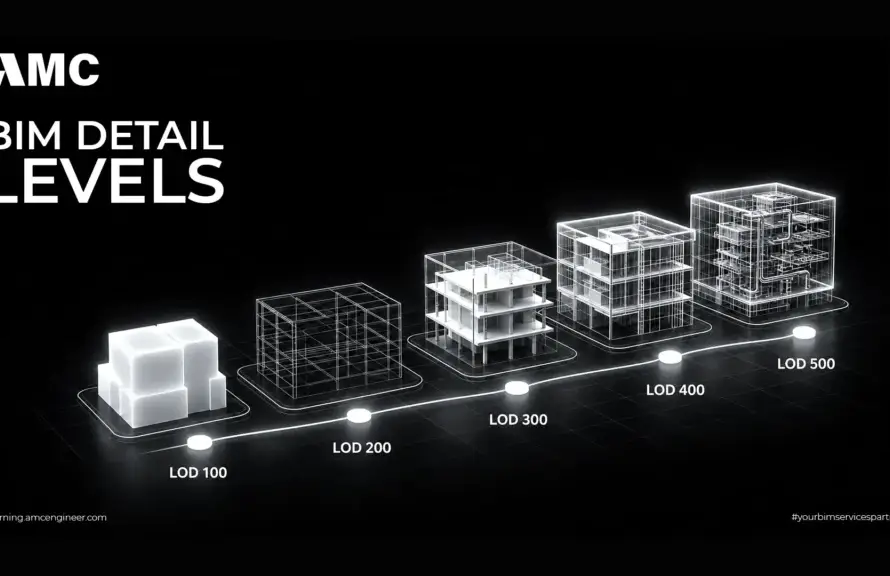
Level of development 500 is the point on the LOD scale where an element is field-verified and carries operational data. It is often described as the top of the scale, which is slightly misleading — LOD 500 is defined by verification against reality rather than by geometric richness. An LOD 500 element can be geometrically simpler than an LOD 400 one and still be the more valuable, because it is true.
That makes it the natural handover deliverable for any asset intended to support a digital twin. Two practical routes exist:
- Progressive verification during construction, where the model is updated and verified as work completes. More accurate, spreads the effort, and requires discipline throughout.
- Post-construction survey, typically using laser scanning to capture the completed building and verify or rebuild the model against it. Our guide to LiDAR and scan to BIM covers that workflow and its limits — notably that scanning cannot see services above ceilings or inside risers, which is exactly where the assets a twin cares about tend to live.
The second route is why progressive verification is worth the discipline: a post-completion scan captures geometry beautifully and captures concealed services not at all. Our guide to BIM levels of development covers what each level does and does not include.
Maturity Levels: Not Every Twin Is the Same
“Digital twin” covers a wide range of capability, and conflating the levels is how projects commit to something far more ambitious than they realise.
| Level | What it does | What it needs |
|---|---|---|
| Descriptive | Shows the asset as it is — a verified model with asset data attached | As-built model, classification, asset tags, structured data |
| Informative | Shows what is happening now — live readings from systems and sensors | The above, plus BAS and sensor integration |
| Predictive | Indicates what is likely to happen — performance trends, failure likelihood | The above, plus historical data and analytics |
| Prescriptive | Recommends or triggers action — scheduling maintenance, adjusting setpoints | The above, plus integration into maintenance and control systems |
Each level is a genuine achievement and each requires the one below it. The useful discipline is to name the level you are actually targeting, because a descriptive twin delivered well is worth more than a prescriptive twin promised and never completed.
Want the handover model to be an asset rather than an archive?
We structure models for the life after construction — classification, asset tagging, structured data and open format delivery — alongside the coordination and documentation the project itself needs.
See How We Model Talk to Our BIM TeamWhere It Pays Off in the Gulf
The business case for a digital twin is stronger in this region than in most, for a reason that has nothing to do with technology.
Cooling dominates operating cost
Buildings in Saudi Arabia and the UAE carry cooling loads that temperate-climate buildings do not, and cooling is the dominant component of operational energy consumption. That matters for two reasons. First, the absolute value of any efficiency improvement is larger, because the baseline consumption is larger. Second, cooling systems are exactly the kind of asset that operational monitoring is good at — chillers, air handling units, pumps and controls all produce continuous performance data and all degrade in ways that show up in that data before they show up as a failure.
A percentage improvement in cooling performance is worth more here than the same percentage almost anywhere else. That is the core of the regional business case.
District cooling adds a monitoring interface
Many UAE developments connect to district cooling rather than generating on site. That introduces an energy transfer station, a metered supply, and a commercial relationship where consumption is billed. Monitoring consumption against expected performance has a direct financial consequence, and the interface is a natural place for a twin to earn its keep.
Portfolio operators and long-hold assets
Much of the region’s commercial stock is held long term by developers and institutional owners rather than sold on. That changes the calculation entirely: an owner who will operate a building for decades has a direct interest in operational data, whereas a developer who sells at completion does not. Where you are in that spectrum determines whether a twin is an investment or an expense.
Model-based submission is already normalising
Dubai Municipality has required the use of BIM on defined categories of project since 2013, and a circular issued in October 2023 introduced BIM model submission for new building permits in IFC format. Abu Dhabi Municipality publishes submission requirements covering naming conventions, coordinate systems and file formats referencing ISO 19650, alongside model quality requirements.
The relevance is indirect but real: projects that already have to produce classified, correctly named, IFC-exportable models for permitting are much closer to a usable handover deliverable than projects that do not.
Giga-projects and smart city programs
The large development programmes across Saudi Arabia and the UAE routinely specify digital delivery and operational data requirements contractually, often ahead of any statutory obligation. On those programmes the handover data specification is frequently more demanding than anything a municipality requires.
Use Cases in Operation
- Predictive maintenance. Equipment performance data trended over time indicates degradation before failure, shifting maintenance from scheduled or reactive to condition-based. Highest value on plant with long lead times or expensive failure consequences.
- Energy management. Actual consumption compared against the commissioned baseline and against expected performance for the conditions, so drift is visible rather than absorbed into the bill.
- Space and occupancy management. Utilisation data supporting decisions about how space is allocated, sublet or reconfigured.
- Fault detection and diagnostics. Automated identification of systems operating outside their expected envelope — simultaneous heating and cooling, dampers stuck, sensors drifting.
- Capital planning. Asset condition and age data supporting replacement forecasting, which is the difference between a planned capital programme and an emergency one.
- Fit-out and refurbishment. A verified model with accurate service routing removes survey cost and risk from every subsequent tenant works package — often the most tangpackage—often.
- Compliance and reporting. Evidence for green building certification, energy reporting and regulatory reporting, produced from data rather than assembled manually.
Building the Business Case
Digital twin proposals fail commercially more often than technically, usually because the case is made in capability terms rather than financial ones.
A case that survives scrutiny has four parts:
- A named problem with a current cost. Not “better visibility” but a specific operational cost that is measurable today — energy spend above benchmark, reactive maintenance callouts, survey costs on every fit-out, downtime in a critical space.
- A defined baseline. What the current cost actually is, measured, before anything changes. Without it, no improvement can be demonstrated afterwards.
- A scoped intervention. One asset, or one system across a portfolio — not an enterprise programme.
- An honest total cost. Model preparation, sensors and installation, platform licensing, integration, and the ongoing cost of someone actually using it. That last item is the one most often omitted and the one that most often kills the initiative in year two.
Barriers and Why Adoption Is Slow
Despite years of attention, digital twin adoption in construction remains limited. The research identifies consistent reasons.
| Barrier | What it means in practice |
|---|---|
| Fragmentation across project phases | Design, construction and operation are separate contracts with separate parties and no continuous information owner |
| Weak data continuity at handover | Information produced during the project does not survive into operation in a usable form |
| Conceptual ambiguity | Teams commit to “a digital twin” without agreeing what that means, then disagree about whether it was delivered |
| Split incentives | The party who would pay to structure the data is often not the party who would benefit from it |
| Data ownership and security | Operational data about a building is sensitive; who holds it and under what terms is frequently unresolved |
| Operational capability | A twin nobody is resourced to use produces a dashboard nobody opens |
Note how few of these are technical. The technology has been adequate for years; the obstacles are contractual, organisational and economic.
Getting Started Without Overcommitting
- Decide the maturity level you are targeting and say it out loud. Descriptive
- is a legitimate destination.
- Write the handover requirements into the information requirements now — classification, tagging, structured data, open formats — even if the twin itself is years away. This is the step with the highest return and the lowest cost.
- Pick one asset or one system for a first implementation. A single building, or chilled water plant across a portfolio.
- Establish the baseline before you change anything.
- Resolve data ownership and hosting contractually before the first sensor is installed.
- Name the person who will use it. If that person does not exist, build the descriptive foundation and stop there until they do.
- Measure against the baseline and use the result to justify the next step rather than assuming it.
Seven Digital Twin Failures
| Failure | What it causes | The fix |
|---|---|---|
| Handover model is the design model | The foundation does not reflect the building; the twin cannot be built on it | Verify as-built during construction, not after |
| Asset tags inconsistent across model, equipment and CMMS | Nothing can be linked; the twin cannot be assembled at any price | Align tagging across all three during construction |
| Asset data in PDFs beside the model | Data exists but cannot be queried or used | Attach structured data to elements, delivered in an open exchange format |
| No classification standard | The model is a picture, not a database | Agree and enforce a classification system from the start |
| Platform selected before requirements defined | Capability bought that does not match the problem | Define the problem, baseline and maturity level first |
| Nobody resourced to operate it | A dashboard nobody opens; the initiative dies in year two | Name the user and fund the role before committing |
| Data ownership unresolved | Disputes at handover or on platform change | Settle ownership, hosting and access in the appointment |
Frequently Asked Questions about digital twin in construction
What is a digital twin in construction?
A dynamic virtual replica of a physical asset that maintains a continuous, two-way data connection with it. Data flows from the building — equipment status, temperatures, occupancy, energy use — and decisions flow back. What makes it a twin rather than a model is the live bidirectional connection and the fact that it persists across the asset’s operational life.
What is the difference between BIM and a digital twin?
Research published in 2026 identifies three specific extensions: digital twins enable bidirectional automated data exchange between physical and digital, integrate heterogeneous real-time sources such as IoT sensors and operational systems, and maintain lifecycle continuity from design to end of life. BIM focuses on design and construction and is relatively static; a digital twin focuses on operations and evolves continuously. In short, BIM helps you build the asset and a digital twin helps you run it.
Can BIM become a digital twin?
BIM is the foundation but not the twin itself. A BIM model becomes usable as a foundation when it is verified as-built, consistently classified, asset-tagged, carries structured asset data and is delivered in open formats. Adding live data connections, analytics and integration to maintenance systems is what turns that foundation into a twin.
What is a digital twin made of?
A verified as-built model providing the spatial foundation; commissioning data recording verified performance at handover; asset tags linking physical items to digital records; a building automation system, commonly over BACnet/IP; additional sensors; a cloud analytics platform; and APIs connecting to maintenance or business systems such as CMMS or ERP. It is an assembly of components rather than a single software package.
Why do digital twin projects fail at handover?
Because BIM implementations have predominantly focused on design and construction, with limited integration into operations, and that discontinuity causes substantial information loss at handover. Typically the model handed over is the design model rather than an as-built one, substitutions were never reflected, asset data sits in PDFs rather than attached to elements, and naming and classification were never standardised — so nothing can be queried.
What must a handover model contain to support a digital twin?
Verified as-built geometry reflecting what was installed; consistent classification so elements can be queried; asset tagging aligned between the model, the physical equipment and the maintenance system; structured asset data attached to elements including manufacturer, capacity, warranty and maintenance interval; linked commissioning records; delivery in open durable formats such as IFC and COBie; and contractually defined data ownership and access.
What LOD is needed for a digital twin?
LOD 500, which is defined by field verification against reality rather than by geometric richness. An LOD 500 element can be geometrically simpler than an LOD 400 one and still be more valuable because it is true. Verification can be achieved progressively during construction or through post-construction survey, though scanning cannot capture services concealed above ceilings or inside risers.
Is LOD 600 a real standard?
No. It does not appear in the AIA protocol or the BIMForum specification and is not defined by any recognised body. It circulates informally to describe an operations model enriched with live data, which is a digital twin and is better described that way. The LOD scale measures model reliability, not data integration.
Are there different levels of digital twin?
Yes. A descriptive twin shows the asset as it is. An informative twin adds live readings from building systems and sensors. A predictive twin adds analytics indicating likely future performance or failure. A prescriptive twin recommends or triggers action. Each requires the one below it, and naming the level you are targeting prevents committing to more than intended.
Why is the business case stronger in the Gulf?
Because cooling dominates operational energy consumption in Saudi Arabia and the UAE, so the absolute value of any efficiency improvement is larger than in temperate climates. Cooling plant also produces continuous performance data and degrades in ways visible in that data before failure. District cooling arrangements add a metered, billed interface where monitoring has direct financial consequence, and long-hold portfolio ownership means the party paying for the data is often the party operating the asset.
What are the main barriers to adoption?
Fragmentation across project phases with no continuous information owner; weak data continuity at handover; conceptual ambiguity about what a digital twin actually is; split incentives where the party who would pay to structure the data is not the party who benefits; unresolved data ownership and security; and lack of operational capability to use the result. Few of these are technical.
How should a first digital twin project be scoped?
Start with a named problem carrying a measurable current cost, establish the baseline before changing anything, scope to one asset or one system rather than an enterprise programme, cost the whole thing honestly including the ongoing resource to use it, and target a maturity level you can actually reach. A descriptive twin that removes survey cost from every future fit-out often pays for itself faster than a predictive one can promise to.
Conclusion
The distance between a BIM model and a digital twin is not technological. It is a matter of whether the information produced during a project survives into operation in a form anyone can use — verified, classified, tagged, structured and openly formatted.
That is decided during the project, by people who will have moved on before anyone tries to build a twin. Which makes the practical recommendation simple and unglamorous: write the handover requirements into the information requirements now, enforce asset tagging during construction, and deliver in open formats. Do that and a digital twin remains possible for as long as the building stands. Skip it and the option closes quietly at practical completion, and reopening it means surveying a finished building to recover information that was in someone’s hands two years earlier.
Let’s make the handover model worth having.
AMC Engineer delivers federated LOD 300–500 BIM modelling, clash detection and construction documentation for contractors, consultants and asset owners across Saudi Arabia and the UAE — classified, tagged and structured for the life the building has after handover.
BIM Modeling Services Book a Strategic Meeting