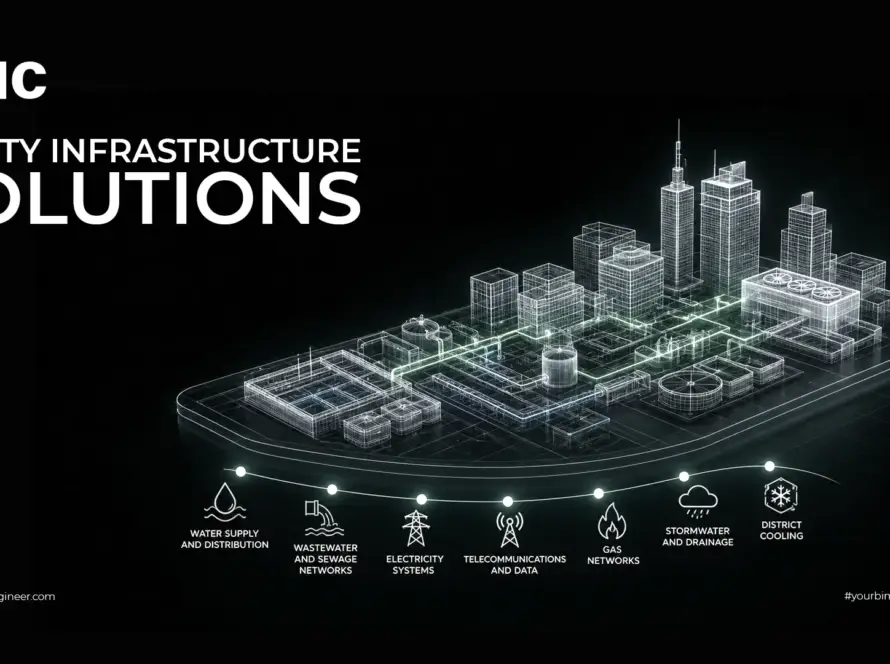
Water utility infrastructure is the network of engineered assets that captures, treats, stores, distributes, and reclaims water for a community. This guide breaks down every core component, walks through how these systems are engineered and modeled with BIM, and shows what modern, resilient water networks look like — with a close focus on the projects reshaping Saudi Arabia and the UAE.
- What is water utility infrastructure?
- The core components (with lifespans)
- How water infrastructure is engineered
- BIM & digital twins in water networks
- Asset management and O&M
- Key challenges and engineering responses
- Water infrastructure in Saudi Arabia & the UAE
- The future: smart, sustainable networks
- How AMC Engineer supports water projects
- Frequently Asked Questions
What Is Water Utility Infrastructure?
Water utility infrastructure is the full set of physical and digital assets a utility uses to move water through its life cycle — from a raw source, through treatment and delivery to the tap, and back out through collection, treatment, and either discharge or reuse. It is one of the most capital-intensive and long-lived asset classes any city owns, with buried pipelines routinely expected to serve for 50 to 100 years.
Engineers usually divide the domain into three interlocking systems:
- Drinking (potable) water — abstraction or desalination, treatment, storage, and pressurized distribution to customers.
- Wastewater (sewerage) — collection of used water, conveyance to treatment, and safe treatment before discharge or reuse.
- Stormwater — capture and management of rainfall runoff to prevent flooding and protect water quality.
According to the US EPA’s guidance on sustainable water infrastructure, these three systems are best planned together rather than in isolation. They share corridors, control rooms, and increasingly a single digital model. That is why treating water infrastructure as one coordinated engineering problem — rather than three separate trades — is where most of the value, and most of the risk, now sits.
The Core Components of Water Utility Infrastructure
Every water utility, whether it serves a small town or a giga-project, is assembled from the same building blocks. The table below maps each component to its function and a typical design life — useful when planning capital renewal and asset-management strategies.
| Component | Function | Typical design life |
|---|---|---|
| Source & abstraction (wells, intakes, desalination plants) | Provide raw water — groundwater, surface water, or seawater | 25–50 years (plant); wells vary |
| Treatment plants (WTP / desalination) | Remove contaminants and meet potable standards | 20–40 years (equipment shorter) |
| Storage (reservoirs, tanks, towers) | Balance supply and demand, provide emergency and fire reserve | 50–80 years |
| Pumping stations | Maintain pressure and lift water across terrain | 15–30 years (pumps & controls) |
| Distribution network (mains, valves, hydrants, meters) | Deliver treated water to every connection | 50–100 years (pipe); fittings shorter |
| Wastewater collection (gravity sewers, laterals, lift stations) | Convey used water to treatment | 50–100 years |
| Wastewater treatment plants (WWTP) | Treat effluent for safe discharge or reuse | 20–40 years |
| Reclaimed / recycled water systems | Deliver treated effluent for irrigation and industry | 40–60 years |
| SCADA, sensors & control | Monitor, automate, and secure the network | 5–15 years (fast-moving) |
How Water Utility Infrastructure Is Engineered
Delivering water infrastructure is a staged engineering process, not a single design act. Getting the early stages right is what prevents expensive rework later, so most utilities follow a sequence broadly like this:
- Water master planning — assess current and projected demand, define service levels, and prioritize capital improvement projects across a 20–30 year horizon.
- Hydraulic modeling — simulate flow, pressure, and storage under peak and emergency conditions to size mains, pumps, and reservoirs correctly.
- Concept & schematic design — establish layout, routing, and the major civil and MEP interfaces.
- Detailed design & documentation — produce coordinated drawings, specifications, and quantities that a contractor can build from.
- Construction & commissioning — sequence the works, verify installed assets, and hand over accurate as-built records.
Because water assets combine heavy civil works with dense mechanical, electrical, and instrumentation systems, coordination across disciplines is the make-or-break factor. This is exactly where the workflow shifts from paper to a shared digital model, and where the MEP design and structural teams need to work inside the same environment rather than exchanging files.
BIM & Digital Twins in Water Networks
Building Information Modeling (BIM) has moved from an optional deliverable to the backbone of serious water infrastructure delivery. Instead of a set of drawings, the project becomes a coordinated 3D model enriched with data — pipe materials, pump curves, valve specifications, and maintenance attributes — that carries through the whole life cycle.
For water and wastewater work specifically, BIM delivers value in four ways:
- Clash detection — catching interferences between pipes, structures, cabling, and ducts before they reach site. See our guide to BIM clash detection.
- Coordinated documentation — drawings, quantities, and schedules generated from one source of truth, so a change updates everywhere at once.
- An Asset Information Model (AIM) — the model becomes a structured handover of asset data the operator can actually use, governed by ISO 19650 information management (see the ISO 19650-1 standard) and a common data environment.
- Digital twins — a live, data-connected replica of the network used to test scenarios, predict failures, and optimize operations. Our guide to the digital twin in BIM goes deeper.
Not sure your water project model is build-ready?
AMC Engineer delivers coordinated, ISO 19650-compliant BIM for water and infrastructure projects across Saudi Arabia and the UAE — clash-free, data-rich, and handover-ready. Get a free LOD 200 sample built from your own drawings within 24 hours.
Asset Management and Operations & Maintenance
The build phase is a fraction of a water asset’s total cost. The decades of operation that follow are where budgets are won or lost, which is why leading utilities run formal asset-management programs rather than reactive repair cycles.
Modern water O&M rests on three pillars:
- Lifecycle asset control — tracking condition, criticality, and renewal timing so capital is spent on the assets most likely to fail with the highest consequence. Our guide to construction asset management covers the framework.
- Non-revenue water (NRW) reduction — finding and cutting the physical leakage and commercial losses that consume 20–40% of produced water in many networks.
- Monitoring & automation — SCADA, smart meters, and IoT sensors that turn a passive network into one that reports its own performance and flags anomalies early.
When the design-stage BIM model is carried into operations — as an AIM feeding a facility- and asset-management platform — the operator inherits accurate data instead of rebuilding it from scratch. That continuity is the single biggest lifecycle saving BIM offers water utilities.
Key Challenges and Engineering Responses
Water utilities everywhere face a similar set of pressures. What separates a resilient network from a fragile one is whether these challenges are engineered for deliberately. The table pairs each challenge with the engineering response that addresses it.
| Challenge | Impact | Engineering response |
|---|---|---|
| Ageing pipelines | Main breaks, service disruption, water loss | Condition-based renewal, trenchless rehabilitation, asset-management modeling |
| Non-revenue water | 20–40% of treated water lost before billing | District metering, pressure management, acoustic leak detection |
| Water scarcity & climate stress | Supply insecurity, demand peaks | Desalination, reuse networks, storage buffering, demand modeling |
| Energy intensity | Pumping and desalination dominate operating cost | Efficient pumps, variable-speed drives, energy recovery, solar integration |
| Cybersecurity of control systems | SCADA and OT networks are a critical-infrastructure target | Network segmentation, monitoring, secured remote access |
| Funding & capital planning | Renewal needs outpace budgets | Risk-based CIP prioritization, whole-life costing, digital asset registers |
Water Utility Infrastructure in Saudi Arabia & the UAE
Nowhere is water infrastructure being built and modernized more aggressively than the Gulf. With minimal natural freshwater, the region has engineered its way to water security — and the scale of current investment makes it one of the most active water-infrastructure markets in the world.
Several forces shape the Saudi and Emirati context specifically:
- Desalination at scale — Saudi Arabia and the UAE are among the largest desalination producers globally, with a decisive shift from thermal plants toward energy-efficient reverse-osmosis capacity, led by bodies such as the Saudi Water Authority (SWCC).
- Vision 2030 and mega-projects — NEOM, giga-projects, and rapid urban growth demand entirely new water and reuse networks engineered from the ground up.
- Institutional reform — bodies such as Saudi Arabia’s SWCC/SWA and the privatization of production and transmission are reshaping how projects are procured and delivered.
- Reuse and sustainability — high targets for treated-wastewater reuse in irrigation and industry, aligned with sustainability frameworks such as Mostadam (KSA) and Estidama (Abu Dhabi).
- Digital mandates — growing adoption of BIM in Saudi Arabia and ISO 19650 on public infrastructure raises the bar for how water projects are modeled and handed over.
The Future: Smart, Sustainable Water Networks
The direction of travel is clear: from static, reactive infrastructure toward connected, predictive networks. The building blocks are already deploying on leading projects:
- Digital twins that simulate the network in real time to pre-empt failures and optimize energy use.
- AI-driven analytics for leak prediction, demand forecasting, and treatment optimization.
- Decentralized treatment and reuse that cut long-haul pumping and improve resilience.
- Full information continuity — a single data thread from master plan through scan-to-BIM capture of existing assets to live operations.
What unites all of these is data. A water utility that has modeled its assets accurately, to the right level of detail, and kept that model alive into operations is positioned to adopt every one of these advances. One that has not will keep paying to rediscover its own network.
How AMC Engineer Supports Water Infrastructure Projects
AMC Engineer works with contractors, consultants, and asset owners across Saudi Arabia and the UAE to model, coordinate, and document water and infrastructure projects to international standards. From hydraulic-driven layouts and MEP coordination to clash-free BIM and ISO 19650 asset-information handover, the goal is the same: a model your team can build from and your operator can actually use.
Planning or delivering a water infrastructure project?
Let AMC Engineer turn your drawings into a coordinated, data-rich BIM model ready for construction and lifecycle operation. Start with a free LOD 200 sample built from your own drawings within 24 hours — no obligation.
Frequently Asked Questions
What is water utility infrastructure?
Water utility infrastructure is the network of engineered assets a utility uses to capture, treat, store, distribute, and reclaim water. It spans three interlocking systems — drinking water, wastewater, and stormwater — together with the pumping, storage, and control assets that operate them.
What are the main components of a water utility system?
The core components are sources and abstraction (including desalination), treatment plants, storage reservoirs and tanks, pumping stations, the distribution network of mains and valves, wastewater collection and treatment, reclaimed-water systems, and the SCADA and sensor layer that monitors and controls the whole network.
How long does water infrastructure last?
It varies widely by asset. Buried pipelines and reservoirs are typically designed for 50 to 100 years, treatment plants for 20 to 40 years, pumps and mechanical equipment for 15 to 30 years, and SCADA and digital control systems for only 5 to 15 years. Sound renewal planning budgets each layer on its own lifecycle.
How is BIM used in water infrastructure projects?
BIM provides a single coordinated 3D model enriched with asset data. It is used for clash detection, coordinated documentation, ISO 19650-compliant asset-information handover, and as the foundation for a digital twin that supports operations and maintenance across the asset’s life.
Why is water infrastructure a major focus in Saudi Arabia and the UAE?
The Gulf has minimal natural freshwater, so water security is engineered through large-scale desalination and reuse. Vision 2030, giga-projects such as NEOM, institutional reform, and digital mandates around BIM and ISO 19650 make Saudi Arabia and the UAE one of the most active water-infrastructure markets globally.
What is non-revenue water and why does it matter?
Non-revenue water (NRW) is treated water that is produced but never billed — lost to physical leakage or commercial losses such as metering errors. It reaches 20 to 40% in many networks, so reducing it through district metering, pressure management, and leak detection is one of the highest-return investments a utility can make.
Conclusion
Water utility infrastructure is among the most valuable and least visible systems any community depends on. Building and operating it well means treating drinking water, wastewater, and stormwater as one coordinated engineering problem — designed with sound hydraulics, modeled in BIM to the right level of detail, and carried into operations as living asset data. For utilities and developers in Saudi Arabia and the UAE, where the pace of investment is exceptional, that discipline is the difference between infrastructure that merely gets built and infrastructure that stays reliable for the century it is meant to serve. AMC Engineer is ready to help you model, coordinate, and future-proof yours.