A building is designed and built once, but it is operated for decades — and the operations phase, not construction, is where most of a facility’s lifetime cost is spent. BIM in facility management is about carrying the structured data created during design and construction into that long operational life, so the people running the building are not rebuilding its information from scratch. This guide explains what an FM-ready model actually is, how ISO 19650, COBie and the CDE move data into operations, how BIM connects to the CAFM and CMMS systems FM teams already use, and what building owners across Saudi Arabia and the UAE need to specify to get an asset they can operate — not just a handsome 3D model that stops being useful the day the contractor leaves.
- What BIM in facility management actually is
- Why BIM is where FM pays off
- The information chain: ISO 19650, AIR and the AIM
- From handover to operations: COBie and the CDE
- Connecting BIM to CAFM and CMMS systems
- How BIM improves efficiency and monetization
- Platforms for BIM in facility management
- Core applications across the operational phase
- LOD for FM: why LOD 500 isn’t automatically FM-ready
- Scan-to-BIM for existing buildings
- BIM-to-FM in Saudi Arabia and the UAE
- How to implement BIM for FM
- Challenges and the future
- Frequently asked questions
What Is BIM in Facility Management?
BIM in facility management is the use of a building information model — enriched with operational asset data — to run, maintain and improve a building after it is occupied. It is a different activity from the BIM used during design and construction, even though it depends on it. Design BIM answers “how do we build this?” Operational BIM answers “what do we have, where is it, and what does it need?”
The distinction is captured in two terms from ISO 19650. During delivery the model is the Project Information Model (PIM) — geometry and data produced to design and construct the building. At handover, the relevant subset is transferred into the Asset Information Model (AIM) — the maintained record the owner uses to operate the asset. The AIM is not a 3D showpiece; it is a structured, queryable source of truth about every space, system and maintainable component in the building.
When that model is connected to live data from sensors, meters and building systems, it becomes the basis of a digital twin — a model that reflects the real, current state of the building rather than its as-designed state. The digital twin is the destination; a well-structured AIM is the foundation that makes it achievable.
Why BIM Is Where Facility Management Pays Off
The economic case rests on a single, well-established fact about buildings: the cost of designing and constructing an asset is a fraction of the cost of operating and maintaining it over its life. Operations, maintenance, energy and replacement typically dominate whole-life cost, while design and construction are the smaller, front-loaded share. Any information that makes the long operational phase more efficient is leveraged against the largest part of the budget.
Yet this is exactly where information is traditionally lost. The industry norm is a handover of boxes of PDFs, O&M manuals and a hard drive of drawings — documents, not data. On day one of operations, the FM team starts re-creating an asset register by walking the building, because the information that existed in the model was never structured to reach them.
This is why BIM for FM is an owner’s discipline more than a contractor’s. The owner who specifies the operational data they will need — and verifies it at handover — receives an asset they can run efficiently for its whole life. The owner who leaves it to chance receives a building and a filing problem.
The Information Chain: ISO 19650, AIR and the AIM
Getting usable data into operations is not luck; it is a defined chain of requirements that starts with the owner. ISO 19650 — and specifically Part 3, which governs the operational phase — sets out how that chain works. Stripped of the acronyms, it says: the owner states what they will need to operate the asset, that statement drives what the delivery team produces, and a controlled process moves the result into the owner’s hands.
| Term | What it is | Why it matters for FM |
|---|---|---|
| OIR — Organizational Information Requirements | What the owner’s organisation needs to know to run its business and estate | The strategic layer — portfolio reporting, compliance, sustainability targets |
| AIR — Asset Information Requirements | The specific information needed to operate and maintain the asset | The single most important document for FM outcomes — it defines the data you will actually receive |
| EIR — Exchange Information Requirements | What each appointed party must deliver, when, and in what format | Turns the AIR into a contractual obligation on the supply chain |
| BEP — BIM Execution Plan | The supply chain’s response: how the requirements will be met | Where the delivery team commits to producing FM data, not just design geometry |
| PIM → AIM | Project Information Model in delivery; Asset Information Model in operation | The handover transaction itself — the point where FM either gains a data asset or inherits a gap |
| CDE — Common Data Environment | The single controlled source for information, with defined states | Where the AIM lives and is version-controlled through operation |
The chain reads in one direction: AIR defines the destination, EIR makes it contractual, the BEP commits the supply chain, and the PIM-to-AIM handover delivers it. The most common failure in FM is that this chain is never started — no AIR is written, so there is no requirement for the model to carry operational data, so it does not. The BIM Execution Plan and the common data environment are the two mechanisms that carry the requirement into reality, and each is worth understanding in its own right.
From Handover to Operations: COBie and the CDE
If the AIR defines what data is needed, COBie is the most common answer to how it is delivered. COBie — Construction Operations Building information exchange — is an open, structured format for handover data. It is not a 3D model; it is the non-graphic asset information organised into a defined schema, most familiar as a multi-tab spreadsheet, that any FM system can read.
A COBie deliverable organises information into linked worksheets: the facility and its floors, the spaces and zones, the systems, the individual components and their types, and then the operational detail attached to them — documents, warranties, spares, job types and maintenance intervals. The value is that it captures the answer to “what do I maintain, where is it, and how often?” in a consistent structure rather than scattered across manuals.
Why a COBie deliverable so often disappoints
COBie’s reputation suffers because a file can be technically valid and practically empty. The failures are consistent:
- Populated late. Data typed in as a submission task at the end of the job, from memory and PDFs, rather than captured in the model as work proceeds.
- Structurally complete, informationally hollow. Every required field present, but manufacturer, model, warranty and maintenance data left blank or generic.
- Unvalidated. No check that space names match the model, that every serviceable component is present, or that classifications are consistent.
The fix is to treat COBie as an output of a well-structured model and a disciplined CDE workflow, not as a spreadsheet exercise bolted on at the end. When the AIR is clear, the model carries the data from the start, and the handover moves a verified subset of the PIM into the AIM through the CDE — with its status codes proving what has been reviewed and authorised — the COBie file is a by-product, not a scramble.
Worried your handover model won’t actually run the building?
AMC Engineer structures BIM deliverables for the operational phase — AIR-driven asset data, COBie handover and a validated Asset Information Model — so your FM team inherits a data asset, not a box of PDFs. Send us your drawings for a free LOD 200 sample in 24 hours.
Explore BIM Modeling Services Request a Free SampleConnecting BIM to CAFM and CMMS Systems
The AIM is where the data lives; the CAFM and CMMS systems are where FM teams actually work. Bridging the two is the step that turns a model into an operational tool — and the step most generic BIM-for-FM content skips.
- CAFM (Computer-Aided Facility Management) manages space, occupancy, moves, and asset location.
- CMMS (Computerised Maintenance Management System) manages work orders, preventive maintenance schedules, asset history and spares.
- IWMS (Integrated Workplace Management System) combines these with real estate, lease and sustainability management in one platform.
Integration means the structured data in the model populates these systems rather than being re-keyed into them. In practice, this is a mapping exercise: each field the FM system needs is matched to a source in the model or the COBie deliverable.
| What the FM system needs | Source in the BIM / COBie deliverable | What it enables in operation |
|---|---|---|
| Asset register (every serviceable component) | Model components + COBie Component / Type tabs | A complete, structured CMMS asset list on day one |
| Location (building, floor, space, zone) | Model spatial hierarchy + COBie Facility / Floor / Space | Work orders routed to the exact room, not “somewhere on level 3” |
| Maintenance intervals and job types | COBie Job / Type data driven by the AIR | Preventive maintenance schedules generated, not built manually |
| Warranties and documents | COBie Warranty / Document links | Warranty claims and O&M references retrieved in seconds |
| Spare parts and suppliers | COBie Spare / Resource / Contact data | Faster procurement and stock planning |
Where a full live link between the model and the FM platform is not justified, the COBie file alone still delivers most of the value by seeding the CMMS asset register at handover — turning weeks of manual data entry into a structured import. The deeper the integration, the closer the building moves toward continuous BIM-based building maintenance and full construction asset management across the portfolio.
How BIM Helps Facilities Management Improve Efficiency and Monetization
With the model connected to operations, the benefits become concrete rather than aspirational:
- Faster maintenance response. An operative locates an asset, its access route, its shut-off valve and its manual before leaving the office instead of hunting on site.
- Preventive over reactive. Maintenance schedules built from real asset data catch failures before they happen, extending asset life and cutting emergency callouts.
- Energy and sustainability. A model tied to meter and BMS data locates waste and supports the reporting that ESG and green-building compliance increasingly demand.
- Space optimisation and monetization. Accurate, current space data lets owners right-size, re-let and charge back space — turning the model into a revenue lever, not just a cost record.
- Better capital planning. Knowing the real age, condition and replacement horizon of major assets turns capital budgeting from guesswork into a schedule.
- Risk and compliance. Fire, safety and statutory-inspection assets are tracked with their certificates and due dates, reducing the compliance exposure that comes with paper records.
Platforms for BIM in Facility Management Software
There is no single “BIM FM” tool; there is a stack, and the pieces are chosen to fit the owner’s estate.
| Layer | Purpose | Representative platforms |
|---|---|---|
| Digital twin / operations model | Hosts the AIM and connects it to live building data | Autodesk Tandem and comparable operations-model platforms |
| IWMS | Integrated space, maintenance, real estate and sustainability management | Archibus, Planon, IBM TRIRIGA |
| CMMS / EAM | Work orders, preventive maintenance and enterprise asset management | IBM Maximo, Bentley AssetWise |
| Handover / data layer | Carries structured asset data from delivery into the FM systems | COBie deliverables and model-checking / validation tools |
Core Applications Across the Operational Phase
Day to day, BIM for FM shows up in a handful of recurring workflows:
- Work-order management — jobs raised, located and closed against a specific modelled asset.
- Asset tracking and lifecycle — a live register of condition, age and replacement horizon for every serviceable component.
- Space and occupancy management — planning moves, utilisation and chargeback from accurate space data.
- Energy and performance monitoring — model tied to metering to find and fix waste.
- Emergency and safety planning — egress routes, isolation points and safety assets available instantly.
- Renovation and retrofit — an accurate base model that makes future alteration a design task, not a survey.
LOD for FM: Why LOD 500 Isn’t Automatically FM-Ready
A persistent misconception is that specifying “LOD 500” guarantees an FM-ready model. It does not, and the confusion costs owners money.
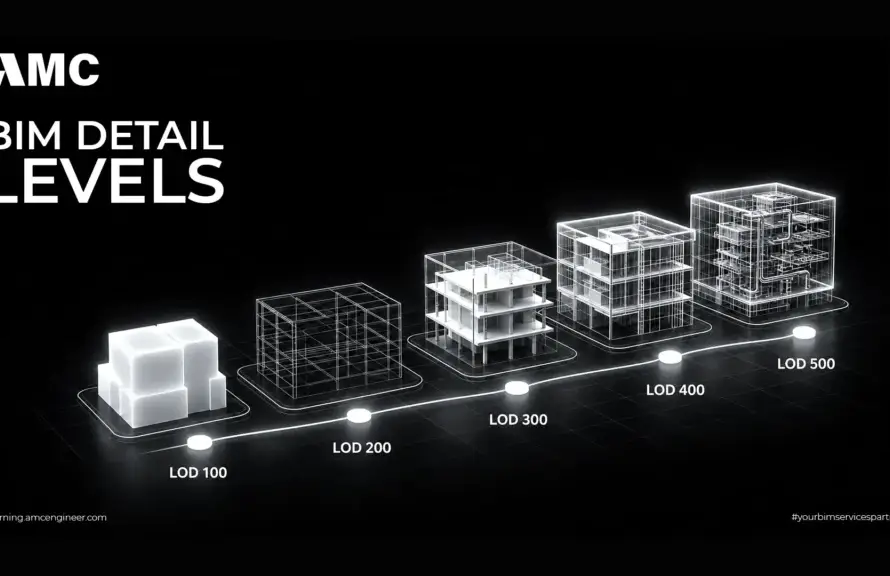
Levels of development describe how much a modelled element can be relied upon — its geometric precision and the confidence in its data. LOD 500 refers to field-verified, as-built accuracy. But “as-built accurate geometry” and “carries the operational data an FM team needs” are two different things. A model can be dimensionally perfect and still contain none of the manufacturer, warranty or maintenance-interval data that operations depends on.
This is exactly why ISO 19650 introduced Level of Information Need in place of a single LOD number: it forces you to state what each deliverable is for and specify the geometry and the data required to serve that purpose. For FM, that purpose is operation — which usually means modest geometry and rich, structured asset data, not maximal geometry for its own sake.
Scan-to-BIM for Existing Buildings
Most buildings that need FM today were built without a model. For that far larger existing stock, the route to a BIM-for-FM capability is Scan-to-BIM: capturing the real building with LiDAR laser scanning or photogrammetry to produce a point cloud, then modelling an accurate as-built AIM from it.
For an operational asset, the scan is scoped to what operations needs — the spaces, the major systems and the serviceable plant — rather than to every architectural detail. Combined with an asset-data capture exercise on site (nameplates, model numbers, condition), Scan-to-BIM gives an existing building the same FM-ready foundation that a new building should receive at handover. It is the practical answer to the owner who asks, reasonably, “we didn’t build this with BIM — is it too late?” It is not.
BIM-to-FM in Saudi Arabia and the UAE
The regional context makes the operational case stronger, not weaker. Across Saudi Arabia and the UAE, owners are commissioning very large, long-life asset portfolios — from giga-project districts and mixed-use developments to hospitals, campuses and government estates — precisely the assets where whole-life operating cost dwarfs construction cost and where an FM-ready data handover has the greatest payback.
Several regional dynamics reinforce this:
- BIM is increasingly required at delivery, and where a model is already mandated for design and permitting, extending its information requirements to cover operations is a small step with a large return.
- Master developers and giga-project programmes set their own standards, frequently specifying asset-data and handover deliverables that go beyond statutory minimums — which means an FM-oriented AIR is often already contractually expected.
- Portfolio operators benefit most. Owners running many assets to a consistent standard gain the most from structured, comparable asset data across the estate — the difference between managing a portfolio and managing a pile of buildings.
How to Implement BIM for Facility Management
- Define the AIR first. Before design begins, state what information you will need to operate the asset — which assets, which properties, in what structure. This single document determines everything downstream.
- Choose the FM platform early. Let the CAFM/CMMS/IWMS you will operate in shape the data requirements, so the deliverable fits the destination.
- Make it contractual through the EIR and BEP. Turn the AIR into an obligation on the supply chain, and require the BEP to answer it point by point.
- Capture data in the model as work proceeds, not as a submission task at the end.
- Run the handover through the CDE. Move a verified subset of the PIM into the AIM, with status codes proving what has been reviewed and authorised.
- Validate before acceptance. Check the COBie or asset-data deliverable against the AIR — completeness, population, naming, classification — as a condition of sign-off.
- Integrate or import into the FM system, whether as a live link or a structured seed of the asset register.
- Maintain the AIM. Keep the model current as the building changes, so it stays a source of truth rather than a snapshot of handover day.
For existing buildings, replace steps one to five with a scoped Scan-to-BIM and on-site asset-data capture, then continue from validation and integration.
Challenges and the Future of BIM for Facility Management
The honest obstacles are consistent, and none is primarily technical:
- The handover gap — the persistent disconnect between what construction produces and what operations needs, solved by requirements, not software.
- Data quality — a model is only as useful as the accuracy of the asset data it carries.
- Integration friction — connecting models to legacy FM systems takes deliberate mapping.
- Skills — FM teams need the capability to use a model, and design teams need to understand operational requirements.
The direction of travel is clear. As models connect to IoT sensors and building systems, the maintained AIM becomes a live digital twin; as analytics and AI mature, predictive maintenance moves from aspiration to routine. But every one of those futures rests on the same unglamorous foundation: an FM-ready model with accurate, structured asset data, specified by the owner at the start. The technology is ready. The discipline is the differentiator.
Build an FM-Ready Asset, Not Just a Building
The single decision that determines whether BIM pays off in facility management is made long before handover: whether the owner defines what operational information they need and holds the supply chain to it. Do that, and the model becomes the operating system of the building — a source of truth that cuts maintenance cost, extends asset life and turns space into a managed resource. Skip it, and you own a beautiful model that stops being useful the day the contractor leaves, and an FM team rebuilding the asset register by hand.
Frequently Asked Questions
What is BIM in facility management?
BIM in facility management is the use of a building information model — enriched with operational asset data — to run, maintain and improve a building after occupation. It carries structured information created during design and construction into the operational phase, so the FM team inherits a queryable data asset rather than rebuilding the asset register from PDFs and manuals. The maintained operational model is known as the Asset Information Model (AIM).
What is the difference between a PIM and an AIM?
The Project Information Model (PIM) is the model produced during design and construction to deliver the building. The Asset Information Model (AIM) is the maintained record the owner uses to operate the asset. At handover, a verified subset of the PIM is transferred into the AIM. The PIM answers “how do we build this?”; the AIM answers “what do we have, where is it, and what does it need?”
What is COBie and why does it matter for FM?
COBie (Construction Operations Building information exchange) is an open, structured format for handover data — the non-graphic asset information organised into a defined schema, most familiar as a multi-tab spreadsheet that any FM system can read. It matters because it seeds a CMMS asset register at handover with a structured import rather than weeks of manual data entry. Its value depends on being populated accurately during the project and validated against the Asset Information Requirements before acceptance.
Does a LOD 500 model mean it is ready for facility management?
No. LOD 500 refers to field-verified, as-built geometric accuracy. A model can be dimensionally perfect and still contain none of the manufacturer, warranty and maintenance data an FM team needs. What makes a model FM-ready is the operational property set specified for each maintainable asset in the Asset Information Requirements — which is why ISO 19650 uses Level of Information Need rather than a single LOD number.
How does BIM connect to a CAFM or CMMS system?
Through a mapping between the data in the model or COBie deliverable and the fields the FM system needs — asset register, location, maintenance intervals, warranties and spares. This can be a live integration between the model and the platform, or a structured import that seeds the CMMS at handover. Either way, the point is that operational data populates the FM system instead of being re-keyed into it.
What is the AIR and why is it the most important document for FM?
The Asset Information Requirements (AIR) is the owner’s statement of exactly what information is needed to operate and maintain the asset — which assets, which properties, in what structure. It is the most important document for FM outcomes because it defines the data you will actually receive. If no AIR is written, the model is never required to carry operational data, so it does not, and the handover gap is guaranteed.
Can BIM for FM be applied to an existing building?
Yes. For buildings constructed without a model, Scan-to-BIM captures the real building with LiDAR laser scanning or photogrammetry and produces an accurate as-built Asset Information Model, scoped to the spaces, systems and serviceable plant that operations needs. Combined with on-site asset-data capture, it gives an existing building the same FM-ready foundation a new building should receive at handover.
Is BIM for facility management required in Saudi Arabia and the UAE?
BIM is increasingly required at the delivery and permitting stage across the region, and master developers and giga-project programmes frequently specify asset-data and handover deliverables that support operations. Whether operational-phase information is a statutory requirement, a developer condition or a commercial choice varies by authority, emirate and programme, so confirm the applicable requirement with the authority or your client’s information manager for each project.
What is a digital twin, and how does it relate to BIM for FM?
A digital twin is a model connected to live data from sensors, meters and building systems, so it reflects the real, current state of the building rather than its as-designed state. It is the destination for BIM in facility management; a well-structured, accurate Asset Information Model is the foundation that makes it achievable. Without a good AIM underneath it, a digital twin has nothing reliable to be a twin of.
Conclusion
BIM in facility management is less a technology than a discipline of information. The model is only the vehicle; what pays off in operations is the structured asset data it carries — and whether that data exists is decided by the owner’s requirements at the start of the project, not by the contractor’s skill at the end. Define the Asset Information Requirements, make them contractual, run a validated handover through the CDE, and connect the result to the FM systems your team actually uses. Do that, and the building arrives with its own operating manual built in.
For owners and operators across Saudi Arabia and the UAE — where the assets are large, long-lived and expensive to run — that discipline is where the return on BIM is largest.
Turn your model into an asset your FM team can actually run.
AMC Engineer delivers AIR-driven, FM-ready BIM — coordinated LOD 300–500 modelling, COBie handover, Scan-to-BIM for existing buildings and validated Asset Information Models — for owners, developers and FM teams across Saudi Arabia and the UAE.
BIM Modeling Services Book a Strategic Meeting